Embroidery on raffia is not embroidery on cotton. The ground moves, the surface is already a pattern, and the stitch has to work with the weave instead of sitting on top of it. It is very doable — we do it — but the brief has to be written for the material.
A woven ground changes the rules
Embroidery is normally worked on a flat, stable fabric. A raffia panel has hills and valleys, and the strands can shift under the needle. At the bag mouth a 1mm gap is acceptable; in the body anything over 2mm is a reject. Stitch across a loose area and the ground gives, so the mark distorts.
In our sample room, most first samples fail on placement or density, not on the artwork. The drawing is usually right. The mark is either too fine for the weave or sitting where the ground is least stable.
What works
Dense, small marks: a monogram, a short word, a compact geometric repeat. The woven ground already has texture, so a dense mark reads against it and a sparse one disappears into it.
Saturated thread on undyed raffia gives the most contrast and is what most briefs specify. Tonal embroidery — same colour, texture only — is quieter and works well for the higher price band. Marks aligned with the weave sit into the surface rather than on top of it and hold their position better. Metallic thread works as an accent; used as a field, it looks applied.
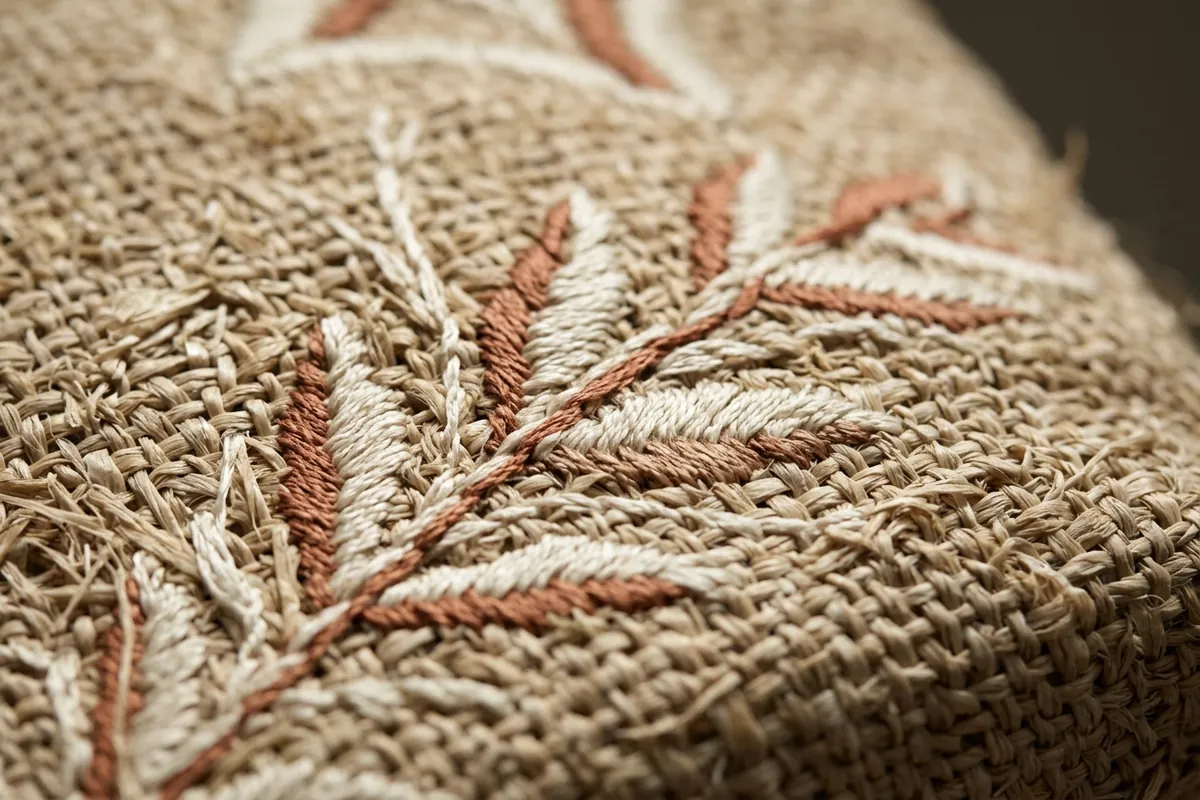 Tonal embroidery on raffia: the weave stays visible under the stitch. That is what keeps the mark from looking applied.
What to put in the brief
Send these five things and the first sample is usually close:
- The mark as vector artwork. A raster image will be redrawn, and redrawing changes corners.
- Placement with dimensions from a fixed point. "Centred on the front" is not a measurement on a soft bag.
- Thread colour as a Pantone plus a physical swatch. A screen colour will not match a dye lot.
- A density reference. One photograph of an embroidered piece at the density you want is worth a paragraph of adjectives.
- The keep-out zone. Keep the mark at least 2cm clear of a seam or handle join. That is where the ground is least stable.
Also say whether the mark sits on the outer surface or a lining, and whether the interior shows through. That one answer changes the backing and the stitch.
Placement, tolerance and what we reject
Our acceptance for embroidery is position within ±5mm. Over 10mm off is a reject, as are a wrong thread colour, a missing letter and uneven density. Put those numbers in the purchase order, because "centred" is not a measurement.
The question worth asking early is what happens if the mark crosses a seam or a handle join. Moving the same mark by 2cm can be the difference between a clean result and a distorted one. It is cheaper to move the artwork than to remake the panel.
Decoration methods, compared
| Method | Best for | Limit on raffia | Schedule note |
|---|---|---|---|
| Hand embroidery | Small dense marks, tonal texture, premium pieces | Slow; density limited by the ground | Book capacity early; allow for it inside the 30–45 day bulk window |
| Machine embroidery | Repeatable small logos at volume | Registration drifts on an uneven surface; hoop marks | Test on the production weave, not a flat sample |
| Screen print | Flat graphics and larger areas | Ink sits on top; the texture breaks fine lines | Lower unit cost at volume; colour matching on dyed raffia |
| Foil stamp | A sharp metallic logo | Heat and pressure can flatten the weave | Small area only |
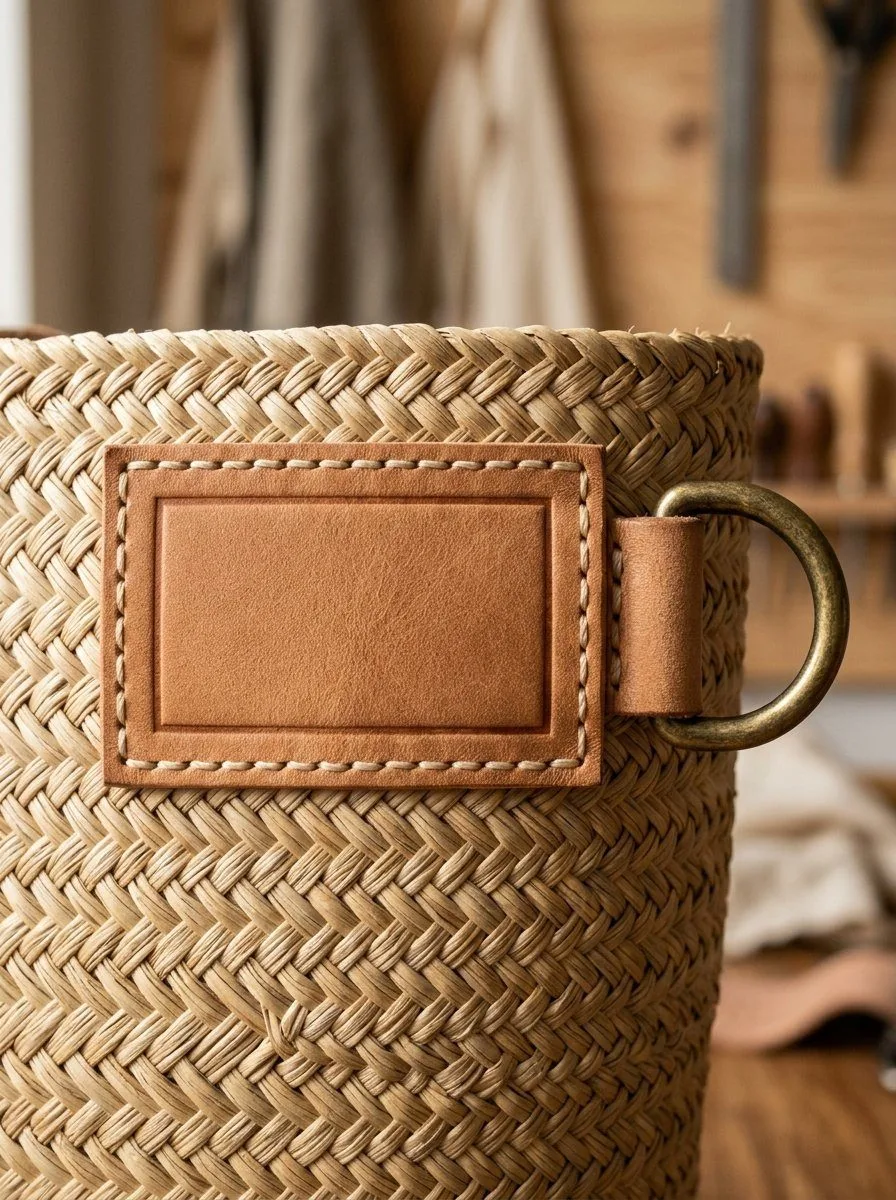
| Leather patch | A clean logo, or hiding a join | Adds a hard edge and a component | Fast and consistent |
| Every method is a schedule decision as much as a look decision. Sampling takes 10–15 days; bulk takes 30–45 days. Hand embroidery has to be planned inside that window, not squeezed into the last week. |
When embroidery is the wrong choice
Large pictorial work loses definition against a woven ground: the weave and the embroidery compete and neither wins. Very fine, light-coloured line work reads as texture at arm's length and disappears at a distance. Embroidery over an open weave has nothing stable to anchor to.
Dense coverage over a large area is possible, but it adds weight and stiffness and hides the fibre that is the reason to use raffia. And if the launch date cannot move, a patch or a print will land on time when handwork will not.
None of this makes embroidery a bad choice. It makes it a choice with a minimum scale, a placement rule and a schedule.
Where to go next
Common questions
- Can you embroider a raffia bag?
- Yes. Embroidery is worked on a woven ground, and the weave density has to be set before stitching so the panel does not pucker. Placement, thread and tolerance are agreed in the brief.
- What embroidery works on woven raffia?
- Flat stitches and low-relief motifs hold best; heavy raised work can pull the weave. We test the motif on a sample panel before bulk.
- Does embroidery change the MOQ?
- No. The baseline is still 100 pcs per style, though multi-colour embroidery adds sampling time and should be confirmed at quotation.
Embroidery sits alongside screen printing, foil stamping and leather patches in the private label range. If the mark needs a new structure or a placement that does not exist yet, that is custom development. For how the fibre behaves under a needle, the woven bag material guide covers the ground.
If you are choosing between embroidery and a patch, send the mark at final size. Legibility at 1:1 settles it faster than a mock-up.
See the raffia bags we currently produce in this range.