Buyers usually ask this as a quality question. It is not one. A machine-woven surface is not a worse handwoven one, and a handwoven surface is not an upgraded machine one. They are two methods built for different targets, and the target should come from the product.
The question behind the question
Sometimes the question is about cost: is the handmade version worth the difference? Sometimes it is about repeatability: will the second delivery match the first?
In our inquiries, the second is usually hiding under the first. A buyer wants the handwoven look but needs two colourways to match across a season. That tension is the real subject, and it is better answered before sampling than after.
Consistency is the real difference
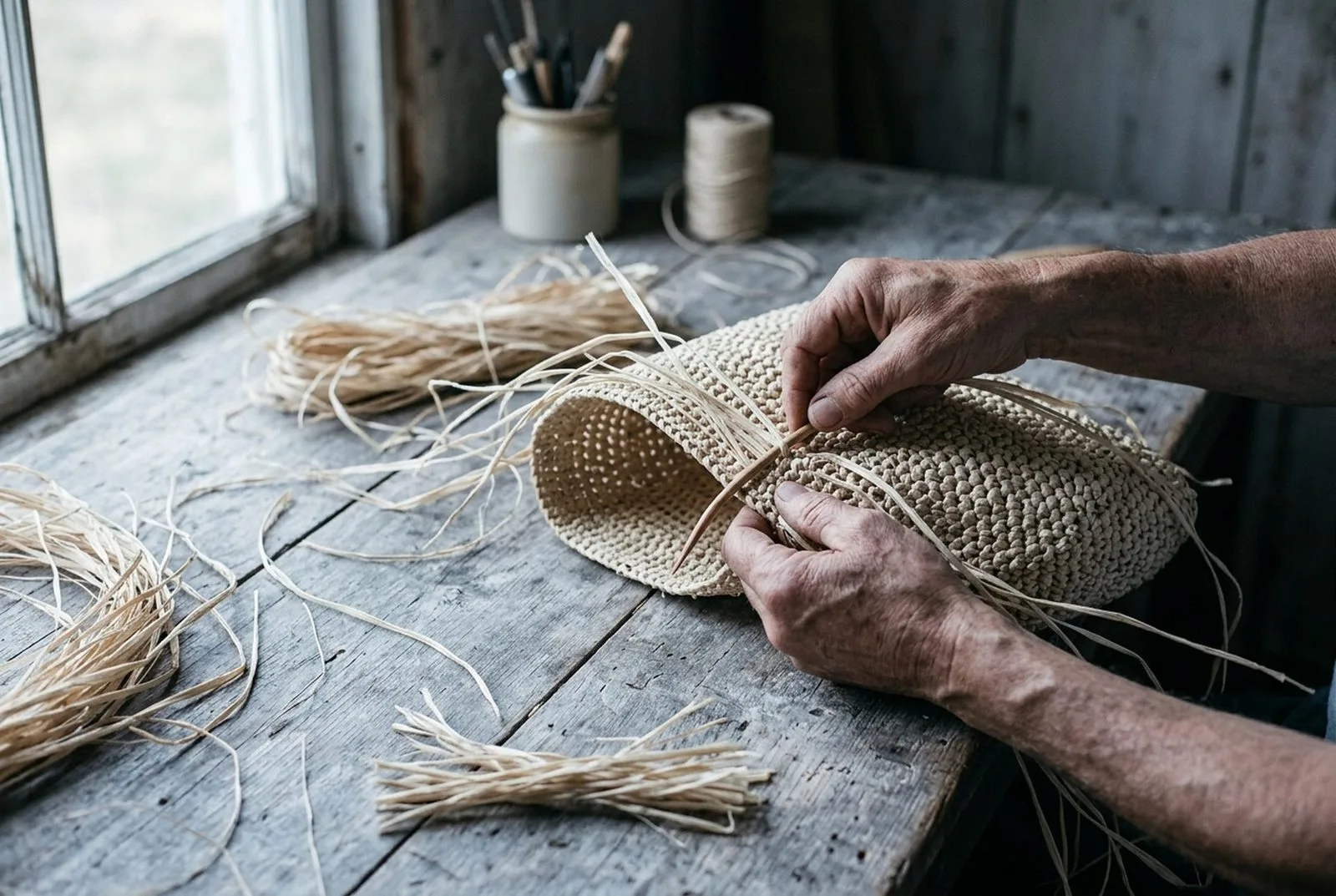
A machine sets tension once and holds it. Two metres are the same as the next two. A hand adjusts constantly: the fibre thickness changes, the row tightens, the maker compensates. The result is a surface that varies slightly across a bag and between bags.
That variation is not a defect. It is what the material is. But it has consequences. We hold 35cm width and depth to ±2cm; on a handwoven body, part of that tolerance is consumed by the weave itself. On a machine-woven panel, the same tolerance is easy. If the product has to fit a fixed insert or a shelf, that difference matters more than the surface does.
In our sample room, this usually surfaces when two samples sit side by side and one is visibly wider at the base. The answer is in the rows, not the pattern.
A comparison that holds up
| What you are comparing | Handwoven | Machine-woven | What it means for the brief |
|---|---|---|---|
| Repeatability | Varies row to row and bag to bag | Same surface metre after metre | If two lots must match, specify an acceptance range, not "the same" |
| Colour across lots | Batch-dyed fibre; slight lot variation | More uniform | Colour-critical ranges lean machine |
| Dimensions | 35cm ±2cm is realistic; the weave affects it | Tighter tolerances are easier | Fixed inserts and shelves favour machine |
| Surface character | Fibre visible, irregular, material reads as material | Even and manufactured | The look is the decision, not a by-product |
| Small runs | Economic at MOQ 100 | Setup has to be amortised | A first order of 100–400 favours hand |
| Volume | Labour scales with every piece | Unit cost falls with volume | At large volume the economics invert |
| Shape freedom | Round bases, open weaves, sharp tapering | Best on flat repeating panels | Sculptural shapes favour hand |
| Lead time | 30–45 days bulk; 45–60 with dye or a new mould | Stable once tooled | Plan the first run, not just the unit price |
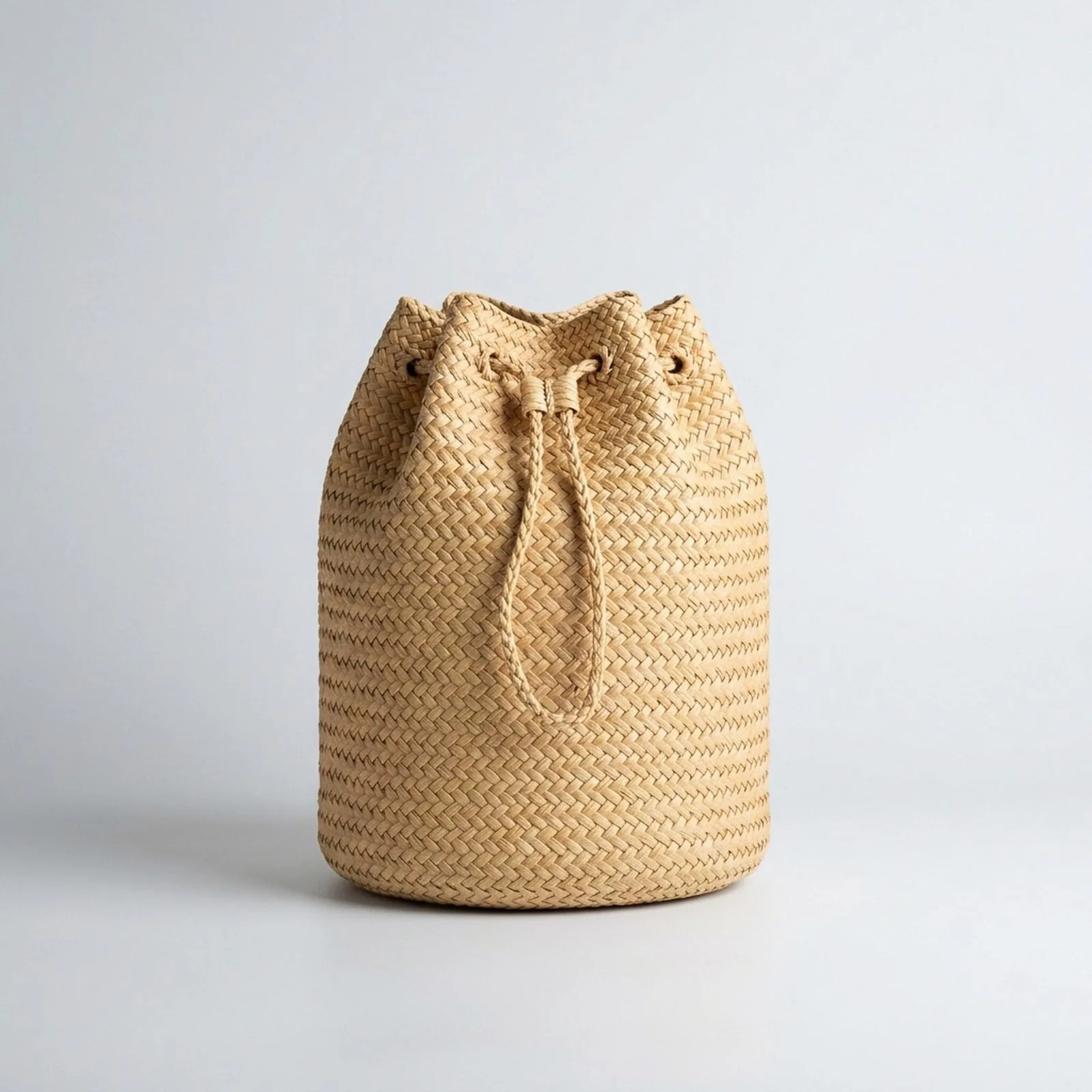
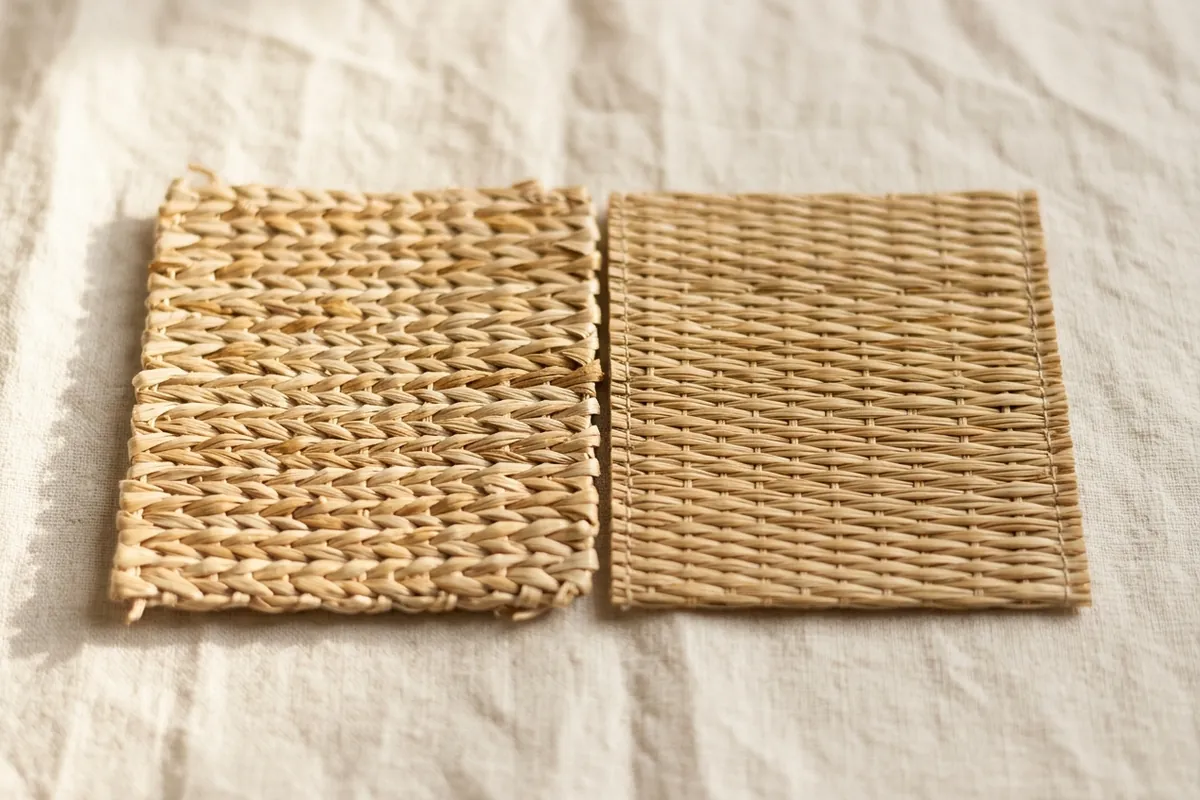 Handwoven surface on one side, machine-woven on the other. The irregularity is the material, not a defect; the regularity is the method, not an upgrade.
Read the table row by row, not column by column. No row makes one method better. They describe where each one stops.
The inspection logic is the same for both, and that is often misunderstood. We sample 5% of cartons with a minimum of 10 pieces either way. What changes is what the inspector looks for: gaps and colour steps on a handwoven body, registration and tension on a machine-woven panel. A 2mm gap in the body is a reject on a handwoven bag; it is not a category that exists on a machine-woven one.
Where hand-weaving wins outright
Small quantities. A machine setup is amortised across volume. At MOQ 100, hand-weaving is not a compromise; it is the sensible route. A 100-piece first order in three colourways is a handwoven order. A 5,000-piece programme in one colour is not, unless the handmade surface is the product and you are willing to pay for the hours.
Open weaves. Deliberately open, irregular surfaces are awkward to produce mechanically and natural by hand.
Non-linear shapes. Round bases, sculptural forms and dramatic tapering are normal in hand-weaving and difficult on a flat machine.
Material honesty. If the product's claim is that a plant fibre was worked by a person, a machine version cannot make that claim. If you plan to use the word handmade, keep the documentation to support it.
Where machine-weaving wins outright
Colour-critical ranges. If two deliveries must match exactly, a machine does that and a hand does not, at least not within the same budget.
Very large volumes on a fixed design. At sufficient quantity the setup disappears and the unit economics invert.
Tight dimensional tolerances. If a bag has to fit a specific insert, a shelf or a rigid gift box, machine consistency is easier to guarantee.
Uniform panels. A calm, even surface takes print, foil and machine embroidery with fewer registration problems than a woven, irregular ground.
The honest middle
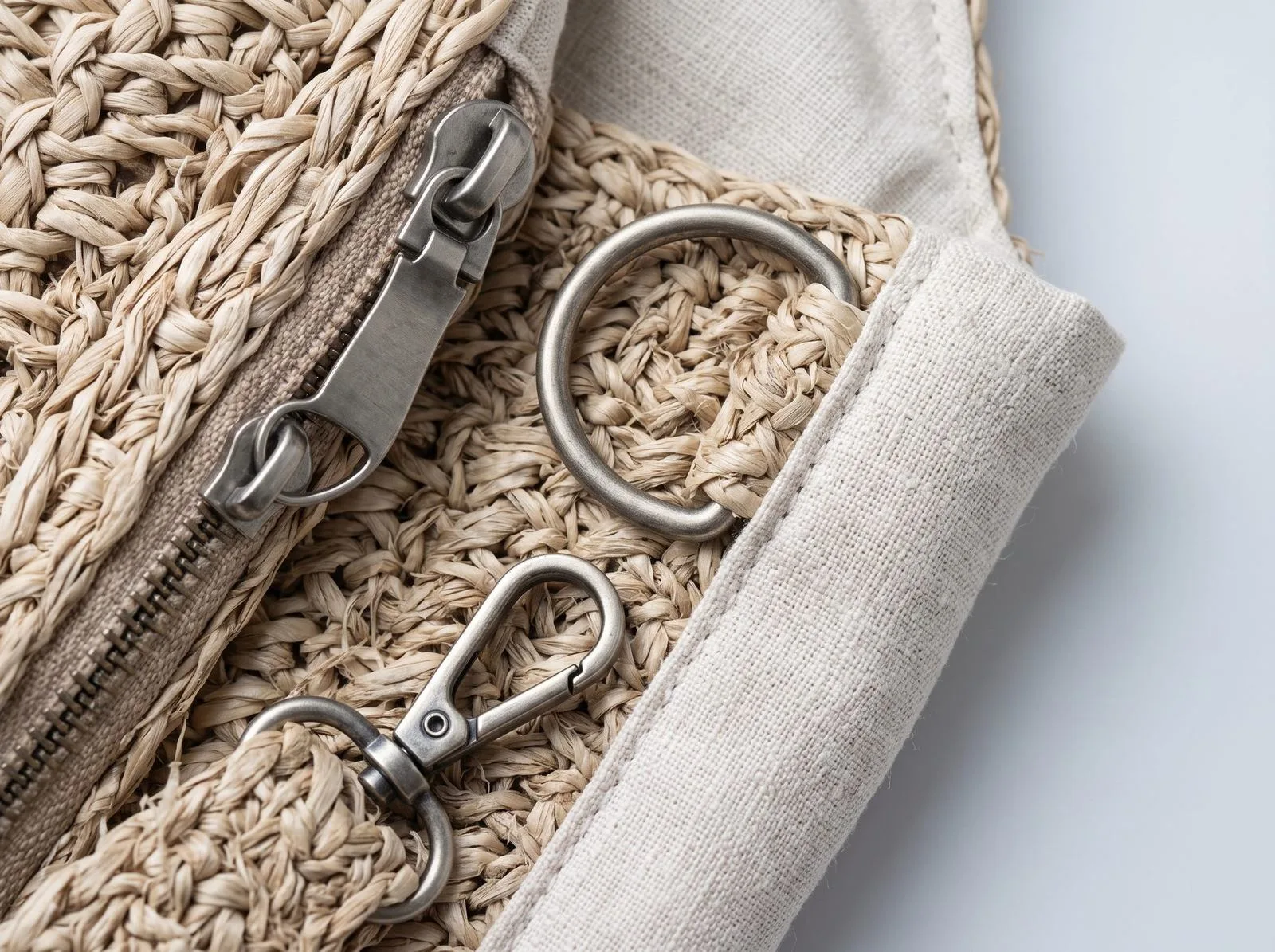
Most ranges are not a choice between the two. A resort tote might have a handwoven raffia body, a machine-woven cotton lining, machine-woven webbing inside the handle join, and a die-cut board base. Each part uses the method that does that job better.
That is not a compromise. What it must not be is undisclosed. A bag sold as handwoven should say which parts are handwoven, and a bag sold as machine-woven should not imply handwork it does not have. The specification should match the story, because the story is what the customer checks.
Why the cost gap exists
Do not compare a handwoven bag and a machine-woven bag by the metre. Compare by the finished piece.
Handwork time depends on structure, not size: a simple small bag can be about 2 hours, a structured handbag about 20, and fine crochet can pass 100 hours. Machine cost depends on setup, run length and waste. At 100 pieces, setup is spread over 100. At 10,000, it is almost free.
Then count the parts that are not the weave. QC, packing and freight. Volumetric weight can add 20–30% to landed cost, and a bag that will not pack flat pays for its own shape.
How to ask for both in one brief
- Which parts of this bag are handwoven, and which are not?
- What variation do you accept between bags — dimension, colour, surface?
- On a repeat, what will you hold constant, and what will you re-approve?
- What is the price at MOQ, at twice MOQ and at four times?
- Can we see the same design in both constructions before choosing?
The second question is the one worth pressing. Handmade does not mean unpredictable; it means the variation has a range, and a workshop should be able to state it. If a supplier answers "each one is unique" and nothing else, ask for the range in centimetres and colour steps.
When this comparison does not apply
If the part is a lining, a dust bag, webbing or packaging, it is machine-made by default and the comparison is irrelevant.
If the design is a flat repeating panel, the volume is high and the buyer needs exact colour matching, choose machine and stop calling it a compromise.
If your market regulates the word handmade, check what the claim requires before you choose the construction. A hand-finished machine-woven panel is not the same claim as a handwoven one.
And if you cannot accept any variation between pieces, handwoven will fail the first inspection. Do not choose it and then reject 10% of the order for being what it is.
Where to go next
Common questions
- Is handwoven stronger than machine woven?
- Not automatically. Handweaving allows variable tension and spot repairs; machine weaving gives uniform density. Strength depends on fibre and density, not on the method alone.
- Why do handwoven bags cost more?
- The cost is bench time. A simple bag can take about two hours, a structured one around twenty, and fine crochet over a hundred. Machines amortise that time; hands do not.
- Can you make handwoven and machine-woven styles in one order?
- Yes, if the brief separates them clearly. They run on different timelines and should not share a single sample approval.
The fibre comparison sits in the woven bag material guide. Wholesale covers how orders are specified and run, and custom development is where a mixed construction is worked out from a reference rather than adapted from the range.
If you are starting with a first order, MOQ 100 is the point where the two methods can be compared on the same design; sampling runs 10–15 days either way.
See the basket bags we currently produce in this range.