Send the same colour reference to two dye houses, or to the same one twice in a year, and you will get two results. Sometimes the gap is invisible. Occasionally it is the difference between a bag that sells and one that goes to the outlet. The cause is not carelessness; it is the material.
What a dye bath actually does
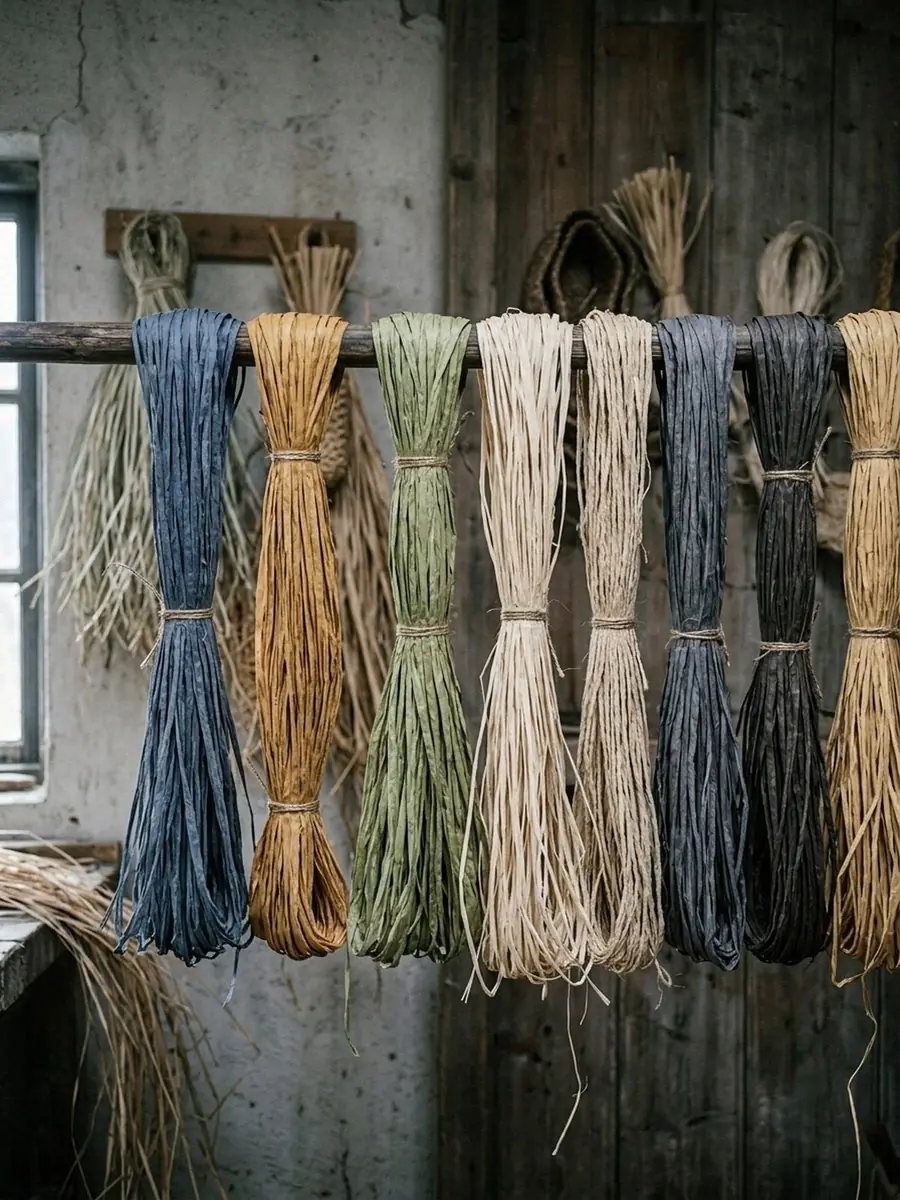
A dye bath does not paint the fibre. It wets the strand, opens it enough for pigment to move inside, and fixes the pigment in place. How much ends up inside depends on the strand thickness, the wax and pectin still on it, how tightly it was bundled, the water temperature and hardness, and how evenly the load moved. A mordant — alum is the common one — can improve take-up and consistency, but it does not remove the variation.
Two consequences follow. Deep shades need a stronger bath, and a stronger bath takes a smaller load, so the same weight of fibre costs more time to dye. And a bath that has run two or three lots is not the bath it was at the start; the recipe has to be re-checked each time rather than run on memory.
There is also a step before the bath. Fresh raffia arrives at around 40% moisture. It has to be dried to a stable level first, or the weight of fibre in the bath is not the weight on the order sheet, and the concentration is wrong before anything is dipped.
Why two batches drift on the same recipe
The recipe is the easy part. The fibre is the variable. A lot of raffia is a mix of strands of different maturity and thickness. We lose 25–30% in sorting and drying, and what survives is still not uniform. Thin strands take up more colour per gram than thick ones. A batch that happens to contain more thin strands comes out a shade deeper, with nothing wrong having been done.
Two lots dyed to the same recipe, at the same weight, in the same bath, will land in slightly different places. In isolation nobody notices. Side by side in a shop, everyone does.
A colour card beats a photograph
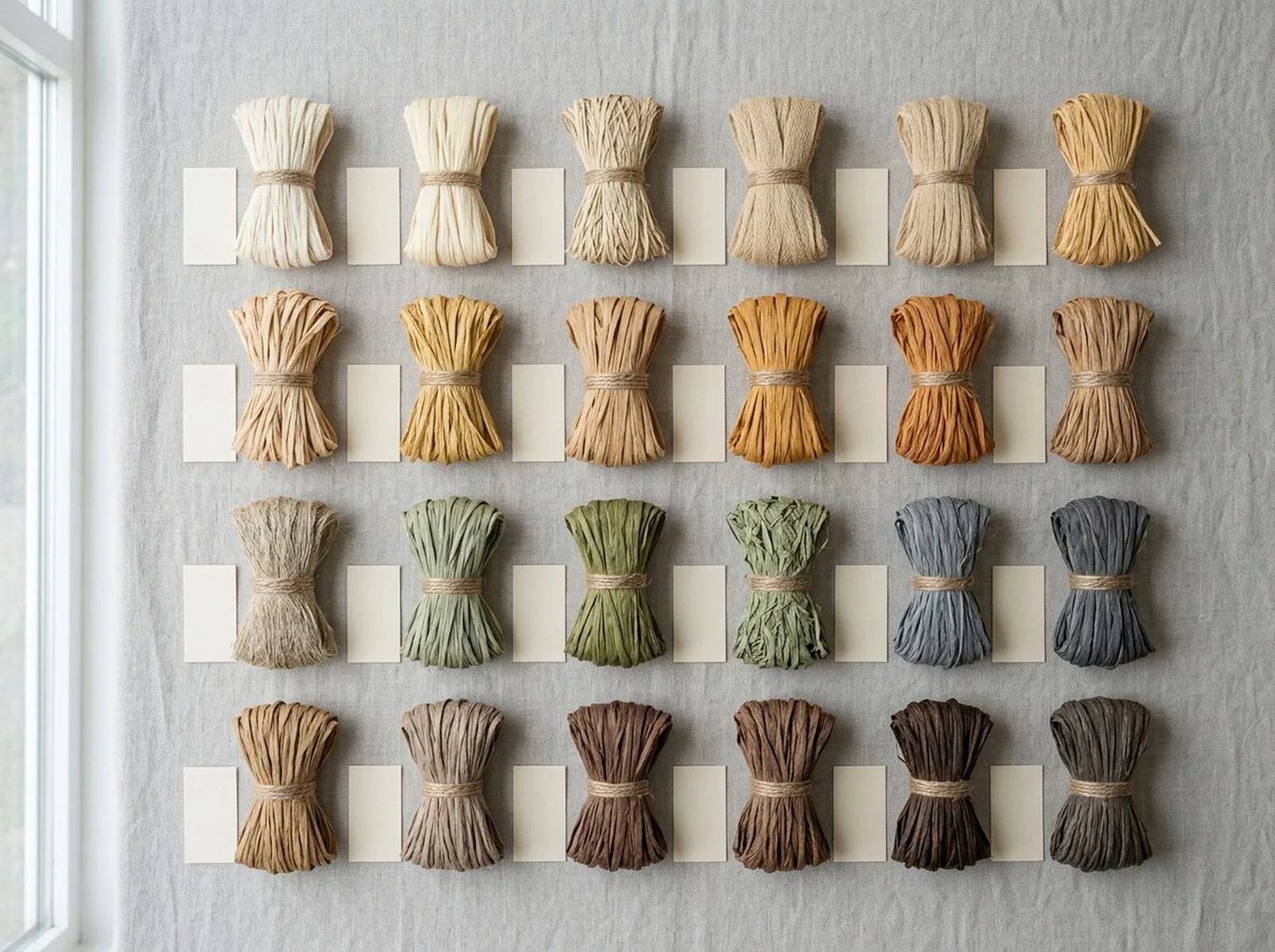
A JPEG tells you almost nothing about the next lot. Screens render colour differently, cameras correct for light they were not present for, and the file is compressed before it reaches you. A good photograph still cannot be held against a sample.
A card is a physical object cut from a specific lot. Hold it next to the sample and you are comparing two things under the same light, which is the only comparison that means anything. Our acceptance standard is set against it: if two adjacent bags in one order differ by more than about 10%, the lot is rejected.
This matters more at reorder than at first order. Six months later, "the natural one, like last time" is not a specification. The card is.
Look at a card properly, too. Daylight at a window, then the shop light the bag will actually sit under; a card that only looks right in one of them will disappoint in the other. Check the date and lot number on the back — an undated card is a colour, not a reference.
 Cards cut from the actual lot: the reference that survives a season change, a new buyer and a new phone.
Dye before weaving, not after
We dye the strand, not the finished bag. A dyed strand takes colour evenly through its thickness. A finished bag does not, because tight courses resist the bath and loose courses drink it. Dye a bucket after weaving and you will see the weave density as rings of light and dark — a defect unless you designed it.
There are exceptions. Overdyeing a finished piece for a washed, sun-faded look is a real technique, and dip-dyeing can be a deliberate design. Both work when the unevenness is the intent and is specified before sampling. They do not work when they are discovered at bulk.
A custom colour also moves the calendar. Bulk on a standard colour runs 30–45 days; custom dyeing runs 45–60, because the lot has to be dyed, dried and matched before production starts.
The batch control sheet
This is the part most buyers never ask for, and the part that decides whether the second order matches the first.
| Stage | Recorded | Why it matters | What fails without it |
|---|---|---|---|
| Fibre intake | Lot ID, moisture %, strand grade | Uptake depends on moisture and thickness | Shade moves between identical lots |
| Recipe | Dye weight per kg, water temperature, mordant | "Same recipe" is not reproducible unless written | The second run is a guess |
| Bath | Load weight, lots since replenishment | A bath weakens after roughly three lots | Later lots come out lighter |
| Swatch | Card cut from the lot, dated and numbered | Reorder reference | Six months later nobody knows what "natural" meant |
| Approval | Signed card, checked in daylight and shop light | Buyer and workshop agree on one object | The dispute happens at bulk, not at sample |
| A buyer can ask for this sheet without knowing anything about dye chemistry. The request itself changes how the order is run. |
Colour families and how far they drift
| Colour direction | Drift risk | Why | What we do |
|---|---|---|---|
| Black, navy, deep brown | Low to moderate | Dark shades hide small variation | Keep a card; watch sheen rather than hue |
| Olive, terracotta, mid-tone natural | Moderate | The range where a small shift is visible | Approve two lots, not one |
| Blush, pale sage, powder blue | High | Small pigment differences read as different colours | Use undyed fibre or an engineered cord |
| Brights, fuchsia, cobalt | High | Saturation amplifies every batch difference | Confirm on paper straw or accept a tone family |
When an exact match is not possible
Some colours will never repeat exactly on a plant fibre. The useful question is not "can you match it" but "how close, and how often". If the answer is "close, but not twice", the design has to absorb it: an undyed body with a dyed trim, a contrast panel that makes the shift look intentional, a heather blend that averages two lots, or a different fibre for the pieces where colour is the product.
Bleaching and re-dyeing a lot that came out wrong is possible, and we do it when the alternative is scrap. It costs days, not just money, and it should never be part of the plan.
What we do in the workshop
Colour is confirmed at sampling, not at bulk. A sample in the customer's colour runs 10–15 days; if the colour is new, we dye a small lot first and cut cards from it, because a card from the dyed fibre is the only honest proof that the shade exists.
From then on the card travels with the order. It is taped to the order sheet, photographed next to the first bulk piece, and kept in the file. When the same buyer reorders a year later, the first question in our sample room is which card, not which colour name.
The most common failure we see is not a bad dye house. It is a buyer approving a shade from a screen and discovering at delivery that the file was warmer than the fibre. That is a five-minute conversation at sampling and a difficult one at bulk.
Four questions before the first lot
- Are you matching a physical card or a photograph?
- Will the strand be dyed before weaving?
- If I reorder in six months, what will you match against?
- Which parts of this palette are exact, and which will drift?
A supplier who answers these without pausing has done the work before. One who promises every colour will match exactly has either not dyed much plant fibre or is hoping you will not check.
Common questions
- Why do dyed bags vary between batches?
- Natural fibre absorbs dye unevenly, and moisture, fibre age and bath temperature all move the result. A colour card and a batch control sheet keep the drift visible.
- Can you match a Pantone colour?
- We match to a physical colour card as closely as the fibre allows. An exact match is not possible on every fibre; we confirm the achievable range before dyeing.
- Should fibre be dyed before or after weaving?
- Before. Dyeing yarn lets colour reach the core of the strip; dyeing a finished bag risks uneven penetration and shrinkage.
If you are specifying colour for a range, custom development covers how colour is fixed before production, and the material guide covers how each fibre takes dye. Wholesale sets out what is confirmed at quotation.
See the straw bags we currently produce in this range.