Most sourcing problems with handwoven bags start before a single sample is made. They start with a price.
A buyer sees a bag at a show, photographs it, sends the photo to three suppliers and gets three numbers back within a day. The numbers are real. They are just the prices of three different bags, none of which has been specified yet.
We have watched this exchange from the workshop side since 2014. The buyers who get what they ordered are rarely the ones with the largest volumes. They are the ones who changed the order of operations: specification first, sample second, price third. What follows is that sequence in detail, including the parts where it stops working.
Why a price quoted from a photo cannot be compared
Take a plain handwoven tote in a photograph. Behind that image sit at least six decisions that move the cost: the fibre, the strip width, the weave density, whether the handles are woven or cut from leather, whether the bag is lined, and how the base is reinforced. None of them are visible at 800 pixels wide.
The labour range is wider than most buyers expect. A simple small bag can be about two hours of handwork. A structured handbag is closer to twenty. A fine crochet piece can pass a hundred hours before it is finished. Three bags that look similar on a phone screen can sit an order of magnitude apart in labour.
So when three suppliers return three prices, the gap is usually not markup. Each one filled in the missing specification privately, and each filled it in differently.
The practical fix is to ask for a quote against a written brief, then ask the supplier to mark every line they had to assume. A workshop that knows its fibre will produce a short list of assumptions. A trader will produce a number.
This is not a rule about honesty. It is a rule about information. Nobody can price a specification that does not exist.
Five questions that separate a maker from a trader
Both are legitimate businesses. A trader who consolidates twelve fibres from twelve factories and handles one invoice is worth their margin. The problem is not trading. It is not knowing which one you are talking to.
These five questions sort it quickly. Watch the answer for consequences, not adjectives.
| Question | An answer that suggests a maker | An answer that suggests a trader |
|---|---|---|
| Which part of this bag carries the load, and how is it reinforced? | Names the handle anchor, the base panel and the row count that changes at 35 cm. | "Strong quality. Very strong." |
| Will the sample and the bulk come from the same fibre lot? | Talks about holding a lot and recording the dye bath. | "Same, same. No problem." |
| What in this brief cannot be done in this fibre? | Names a specific part and a specific failure mode. | "Everything is possible." |
| What ships with the sample? | The sample, the lot card and construction notes. | The sample on its own. |
| What happens if the second order does not match the first? | Describes lot records and a remake arrangement. | Reassurance. |
| The third question does the most work. Every fibre has limits, and a maker meets them daily: raffia will not hold a crisp edge without structure behind it, an open weave will not carry a laptop, a soft handle will not survive a wet season. When the answer names a part of the bag and a way it can fail, you are talking to someone who has made it before. "We can do anything" is not confidence. It is a refusal to have the conversation. |
The fifth question matters for a different reason. A first order is a transaction. A second order is where a range is actually built, and it is decided by whether the first can be repeated. Suppliers who think in repeats keep lot records without being asked. Suppliers who think in single orders do not, and the colour of your second run will drift.
There is one case where these questions are wasted: a stock item, in a stock colour, that you simply need shipped. That is purchasing, not sourcing. The questions there are about lead time and carton marks.
The brief that makes quotes comparable
You do not need a formal tech pack to get a comparable quote. You need nine lines and a sketch, and the discipline to write "to be confirmed" instead of leaving a line blank.
| Field | What a usable line looks like | Why it changes the quote |
|---|---|---|
| Fibre and strip width | "Natural raffia, undyed, strip to match swatch A" | Prep time, weaving time, fibre cost |
| Silhouette and dimensions | "Open tote, 35 W x 32 H x 14 D cm" | Fibre quantity, number of panels |
| Weave and finish | "Medium-tight body, tighter base, rolled top edge" | Hours per bag, rejection risk |
| Handles | "Woven raffia, 22 cm drop, through-weave anchor" | Material plus a second bench operation |
| Interior | "Cotton lining, one slip pocket, no closure" | Material and extra QC points |
| Branding | "Woven label in side seam, care label" | Setup cost and per-unit add |
| Quantity and colour split | "300 pcs: 200 natural, 100 black" | Dye minimums, MOQ, sample amortisation |
| Packing | "Individual poly bag, double-wall carton, 20 per carton" | Carton cost and volumetric weight |
| Destination and ship date | "Rotterdam, sea freight, ship by 15 March" | Freight mode and capacity booking |
| A brief written this way looks like this: |
Style: open-top tote, 35 W x 32 H x 14 D cm
Fibre: natural raffia, undyed, strip width to match swatch A
Weave: medium-tight body, tighter base, rolled top edge
Handles: woven raffia, 22 cm drop, anchored through the weave
Interior: cotton lining, one slip pocket, no closure
Branding: woven label in side seam, care label
Quantity: 300 pcs — 200 natural / 100 black
Packing: individual poly bag, double-wall export carton, 20 per carton
Destination: Rotterdam, sea freight, ship by 15 March
In our sample room, the briefs that move fastest are not the longest ones. They are the ones where every line has an answer, even if the answer is "to be confirmed".
Send that and three quotes become comparable, because every supplier is pricing the same nine decisions. Lines you genuinely cannot answer should be marked open. A good supplier will quote the open line as an option rather than a guess, and the option price tells you whether the decision is worth making.
What a sample can tell you, and what it cannot
A sample is a document, not a souvenir. Most buyers assess it the way a customer would: does it look right, does it feel right. Both matter. Neither is the most informative part.
What a sample can prove: density, handle construction, interior finish, weight distribution, and colour under your own light. What it cannot prove: that the five-hundredth bag will match the first, that the next fibre lot will dye the same, or that the bag survives a season of use.
Check the parts in the order they fail. The base first, because that is where construction is hardest and where corner-cutting shows earliest. Then the handle anchors, which take more wear than any other point. Then turn the bag inside out; the interior is the honest part of a sample, because it is what your customer sees every time they open the bag and what a rushed maker assumes nobody checks. Finally set it down and step back. A well-made bag reads as one object. A rushed one reads as a body with handles attached.
Use calipers rather than impressions. On a 35 cm body, width and depth should hold within ±2 cm. Handle drop should hold within ±1 cm, and the two handles should not differ by more than 2 cm. Any movement at the anchor, any slack thread, any stitch that has not passed through the woven layer is a reject rather than a note for next time.
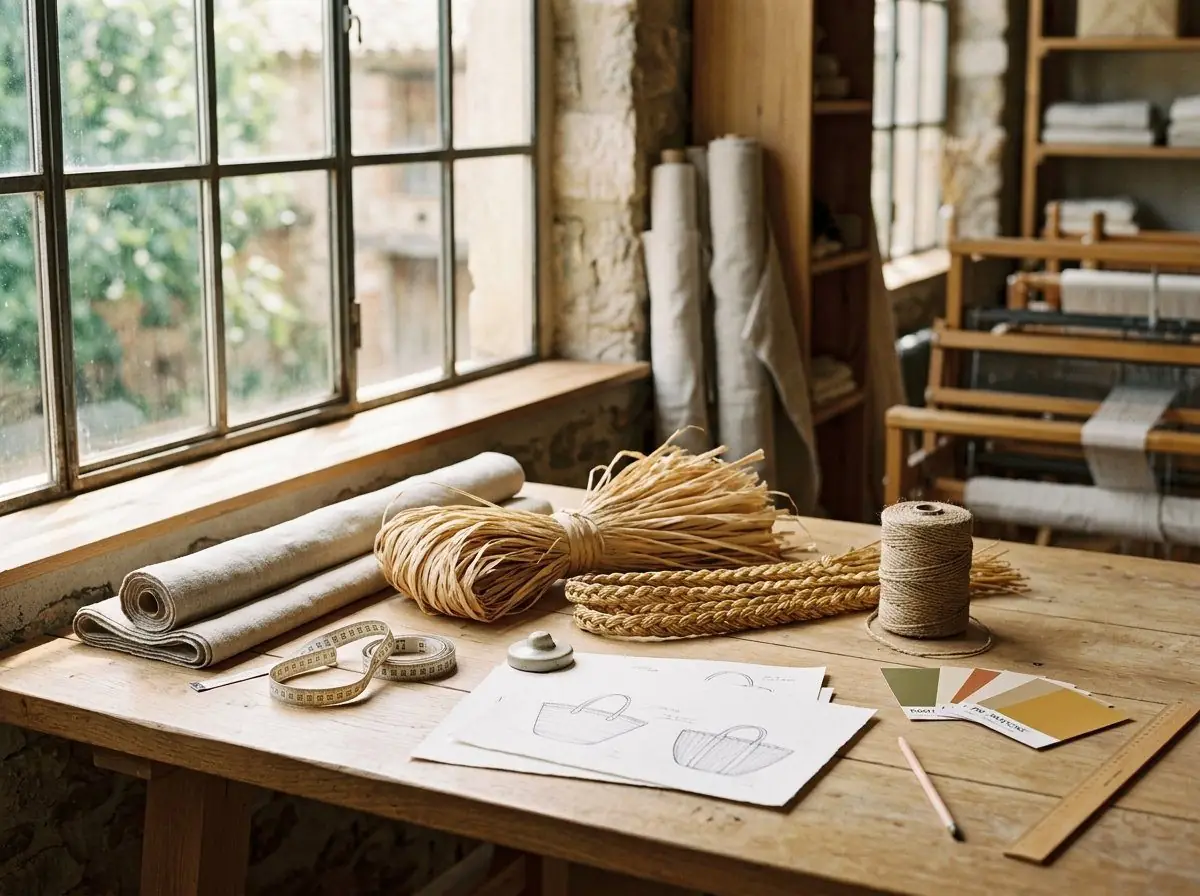
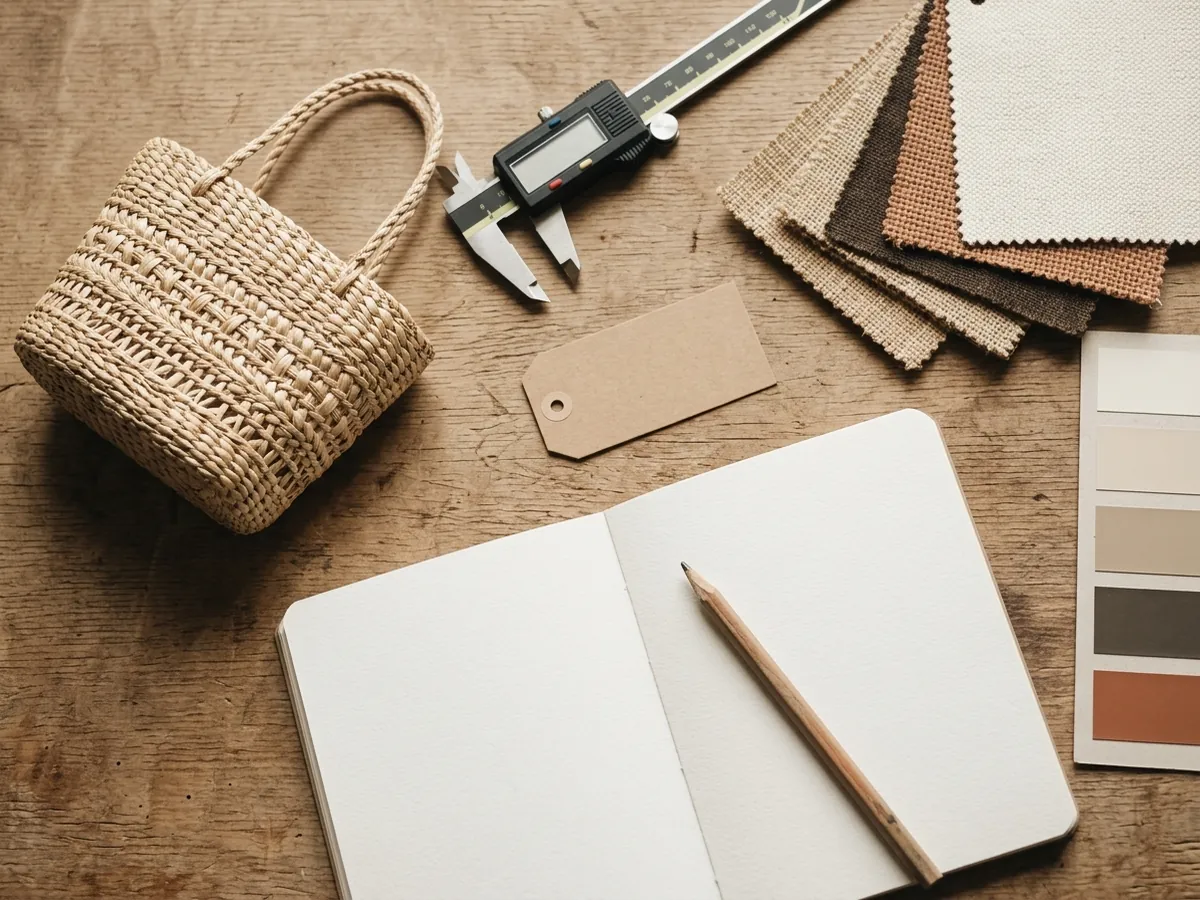 What a sample review actually looks like: the bag, the measuring tool, the fibre reference and the colour card on the same table.
A sample also has a practical limit. It proves what one pair of hands can do on a good day. That is why the next step exists.
The step most buyers skip: the pre-production sample
Between the approved sample and the first bulk carton sits a document with several names. We call it PPS, the pre-production sample. It adds 7–10 days and it is the cheapest insurance in the order.
The difference is the material. A first sample is usually built from whatever fibre is in the sample room. A PPS has to be built from the same lot that will go into bulk: same strip width, same dye bath, same handle material. That is the only way to discover that this lot takes colour darker before five hundred bags are cut.
A first sample takes 10–15 days. Plan for one to two revision rounds afterwards, each five to seven days. If a brief needs more than two rounds, the problem is usually upstream of the workshop: a silhouette that has not been decided, a colour reference that is a screen, or a handle that has not been tested under load.
When PPS is unnecessary: a repeat order of an existing SKU in an existing colour. In that case ask for the fibre lot number in writing and keep it with the approved sample. That record is what makes the third order possible.
Reading the bulk order: a twelve-point sheet
Once bulk starts, inspection is not a feeling. It is a sample size, a sheet and a number.
Take 5% of cartons, with a minimum of ten pieces. Check every piece, photograph failures where they sit, and keep the photos with the carton number. An overall defect rate under 5% is normal for handwork. Between 5% and 10% needs an explanation and a written corrective action before the balance ships. Above 10% is a rework or rejection conversation, not a discount conversation.
| # | Defect | Accept | Reject |
|---|---|---|---|
| 1 | Gaps in the weave | Up to 1 mm at the mouth of the bag, even coverage elsewhere | Any gap over 2 mm in the body, or a visibly loose structure |
| 2 | Colour variation | Slight variation on undyed natural fibre, even across one bag | Adjacent bags differing by more than about 10% against the approved card |
| 3 | Proportion and symmetry | 35 cm body within ±2 cm; handle drop within ±1 cm | Silhouette visibly out of balance; handle height difference over 2 cm |
| 4 | Handle attachment | Even stitching, firm under load | Any movement at the anchor, slack thread, stitch not through the woven layer |
| 5 | Mould or damp | None | Any spot, at any size |
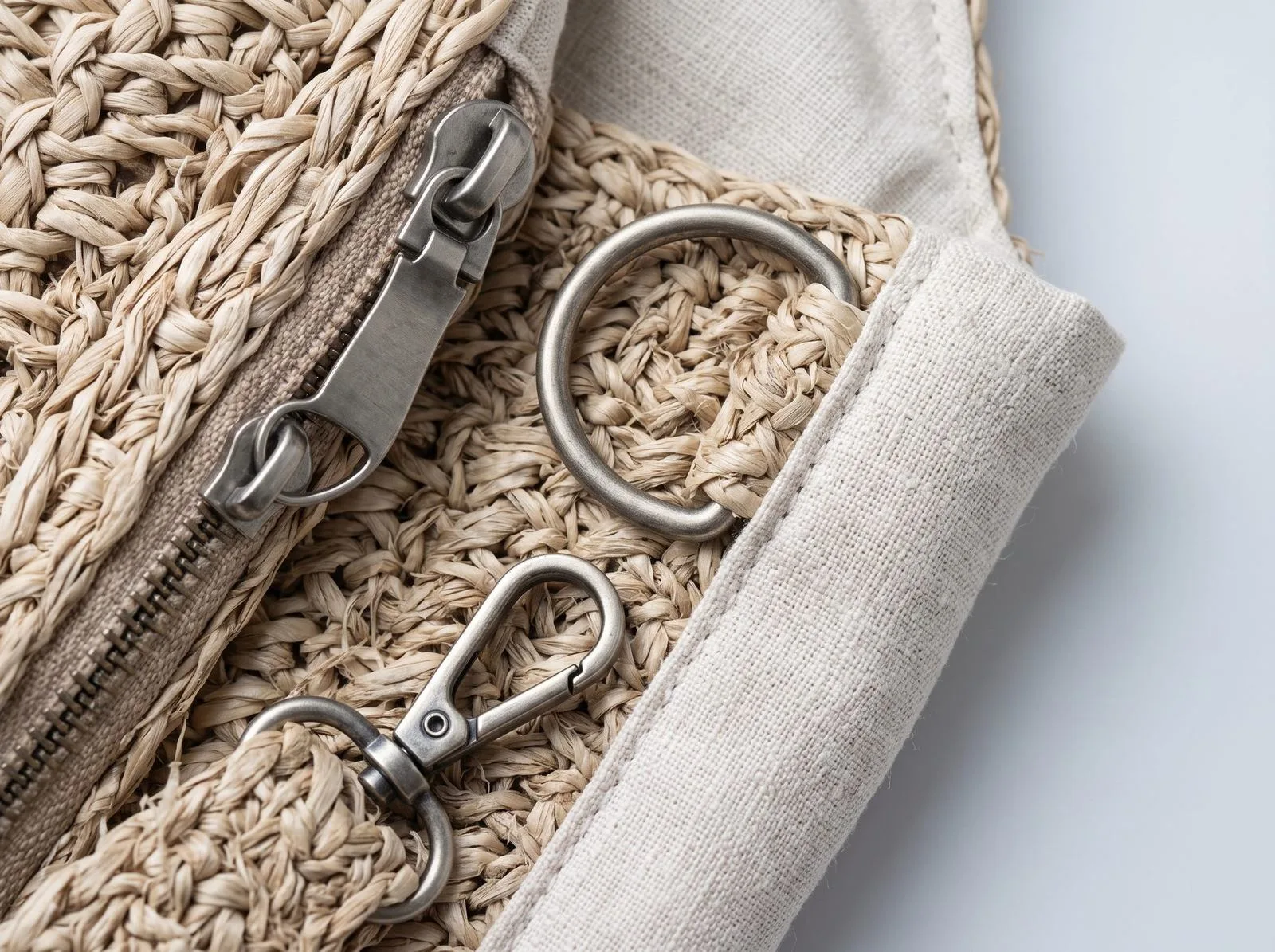
| 6 | Leather and hardware | Natural grain variation, light handling marks | Cracking, edge paint loss, splitting along the grain |
| 7 | Closures | Magnetic snap slightly off-centre but closes | Will not close, missing rivet, zip that catches |
| 8 | Embroidery and logo | Position within ±5 mm, slight tension variation | Wrong colour, missing element, position off by more than 10 mm |
| 9 | Packing | Minor scuffing on the outer carton | Crushed product or missing inner bag; cartons must be double-wall with a moisture barrier |
| 10 | Smell | Natural palm smell that clears within about 48 hours | Chemical smell from uncured dye, or an animal smell from storage |
| 11 | Edges and finish | Slight texture variation on a bound edge | Loose fibres, unbound edge, unravelling |
| 12 | Lining | Minor wrinkling at the corners | Detached edge, tear, colour not as specified |
| Three of these account for most of the money at stake. Handle anchors come first, because that is where low-cost construction fails earliest and where returns cost the most. Gaps in the body come second: up to 1 mm at the mouth can pass as a natural weave characteristic, while any gap over 2 mm in the body is a structural opening. Colour comes third. Adjacent bags more than about 10% off the approved card are a rejection, not a batch note. |
The one almost nobody checks is smell. Natural palm fibre carries an earthy smell that should clear within about 48 hours of unpacking. A chemical smell means dye that has not fully cured. An animal smell means a storage problem. Both are reasons to hold the carton.
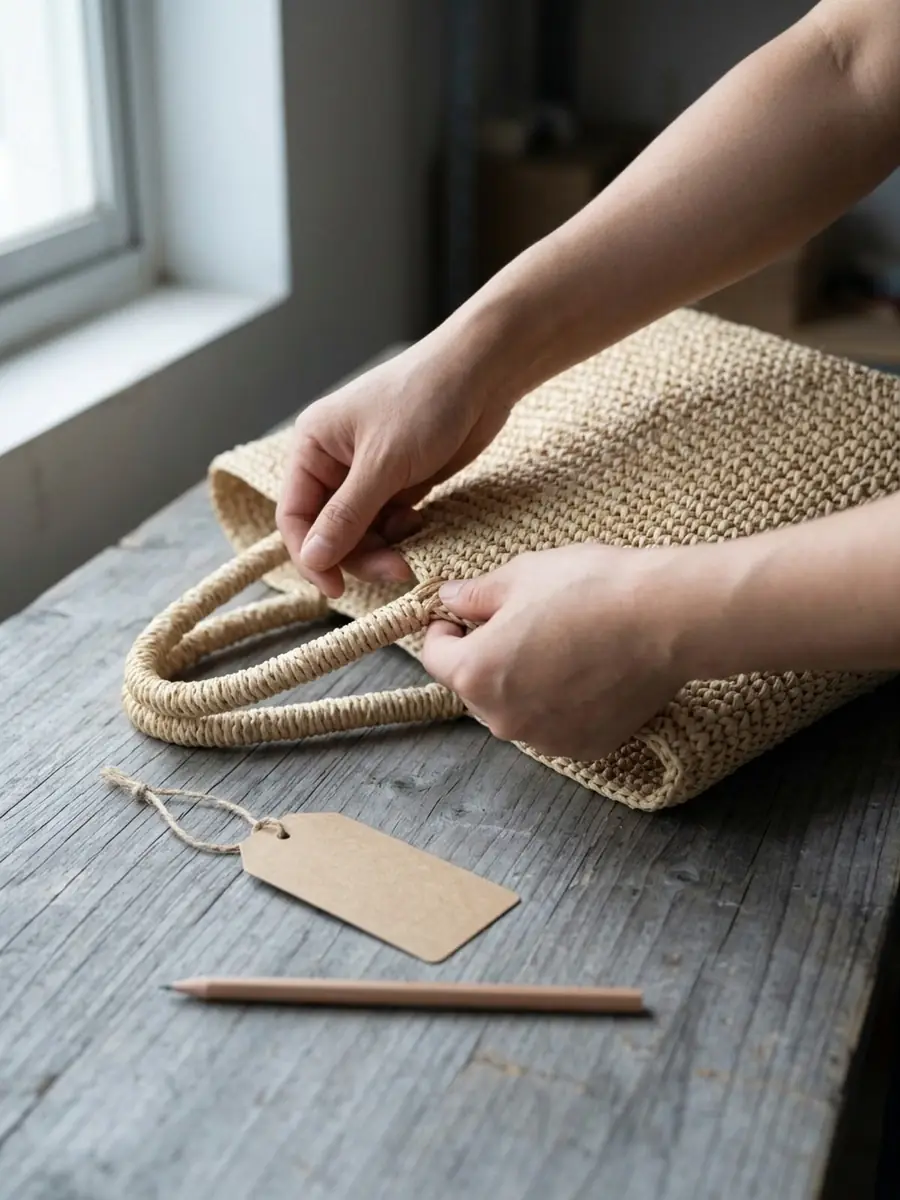 The two checkpoints that decide most claims: the handle anchor under load, and the lining where it meets the shell.
Agree your own acceptance standard in writing before production, not after the first dispute. Our numbers above are ours; what matters is that both sides inspect against the same sheet.
Where the money actually goes
Two quotes for the same bag can differ by a third with both suppliers being honest. The difference is in the specification. These are the lines where it accumulates.
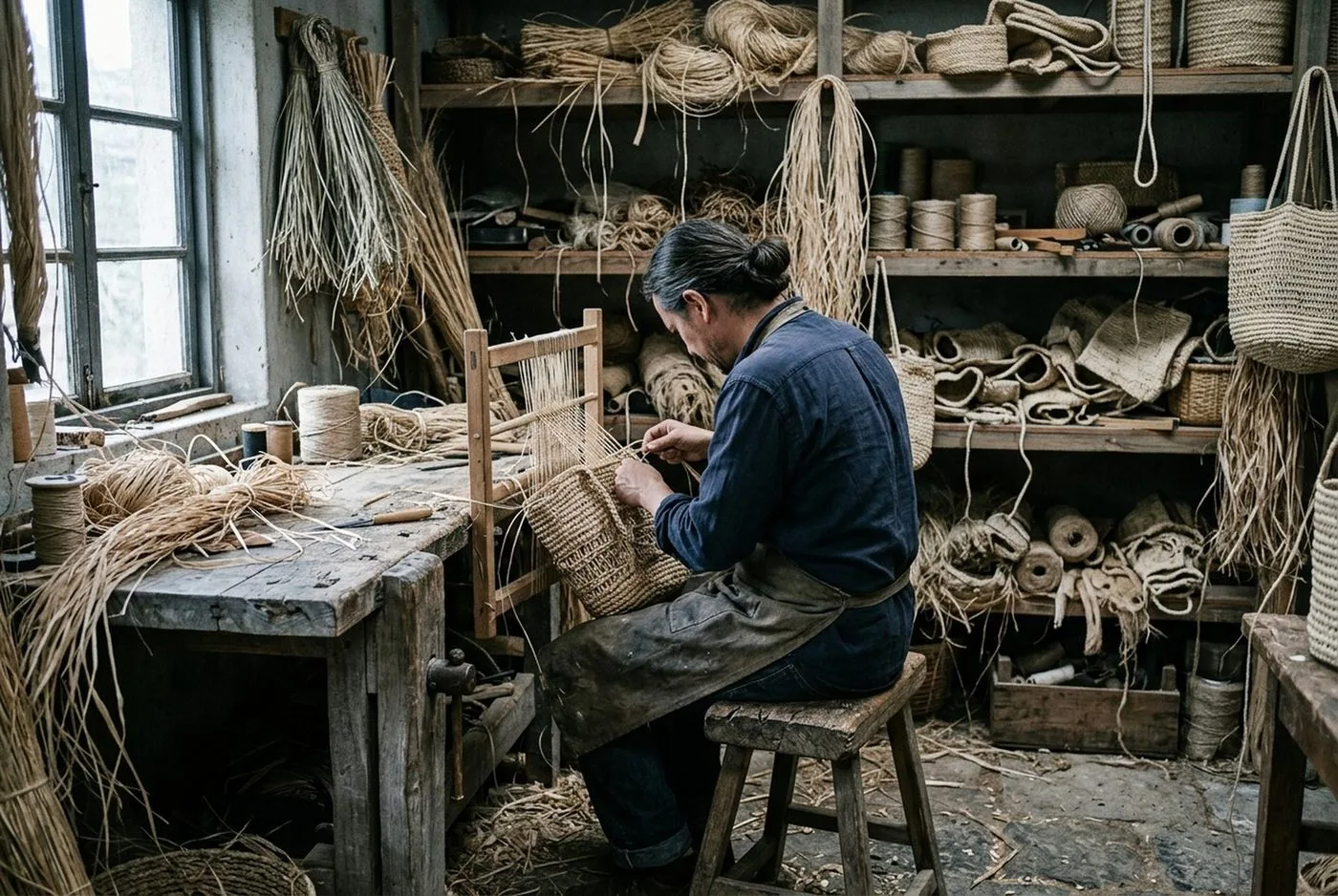
Fibre preparation. Raffia arrives as long ribbons that have to be graded, split and trimmed. Across sorting, short fibres and rejects, 25–30% of the raw material is lost before it reaches a bag. Straw arrives closer to finished strip, which is one reason it costs less.
Weaving hours. Two hours for a simple small bag, around twenty for a structured handbag, a hundred or more for fine crochet. The number is set by structure and finish, not by size.
Construction. A lining, an interior pocket, leather handles, a metal closure: each adds material and a second pass through the bench, and each adds QC points.
Sampling. An approved sample is amortised over the first order. At 100 pieces the sample is a large share of every bag. At 1,000 it is a rounding error.
Packing and freight. A filled carton and a flat-packed carton do not ship at the same cost. On light, bulky goods, volumetric weight can add 20–30% to landed cost before duty.
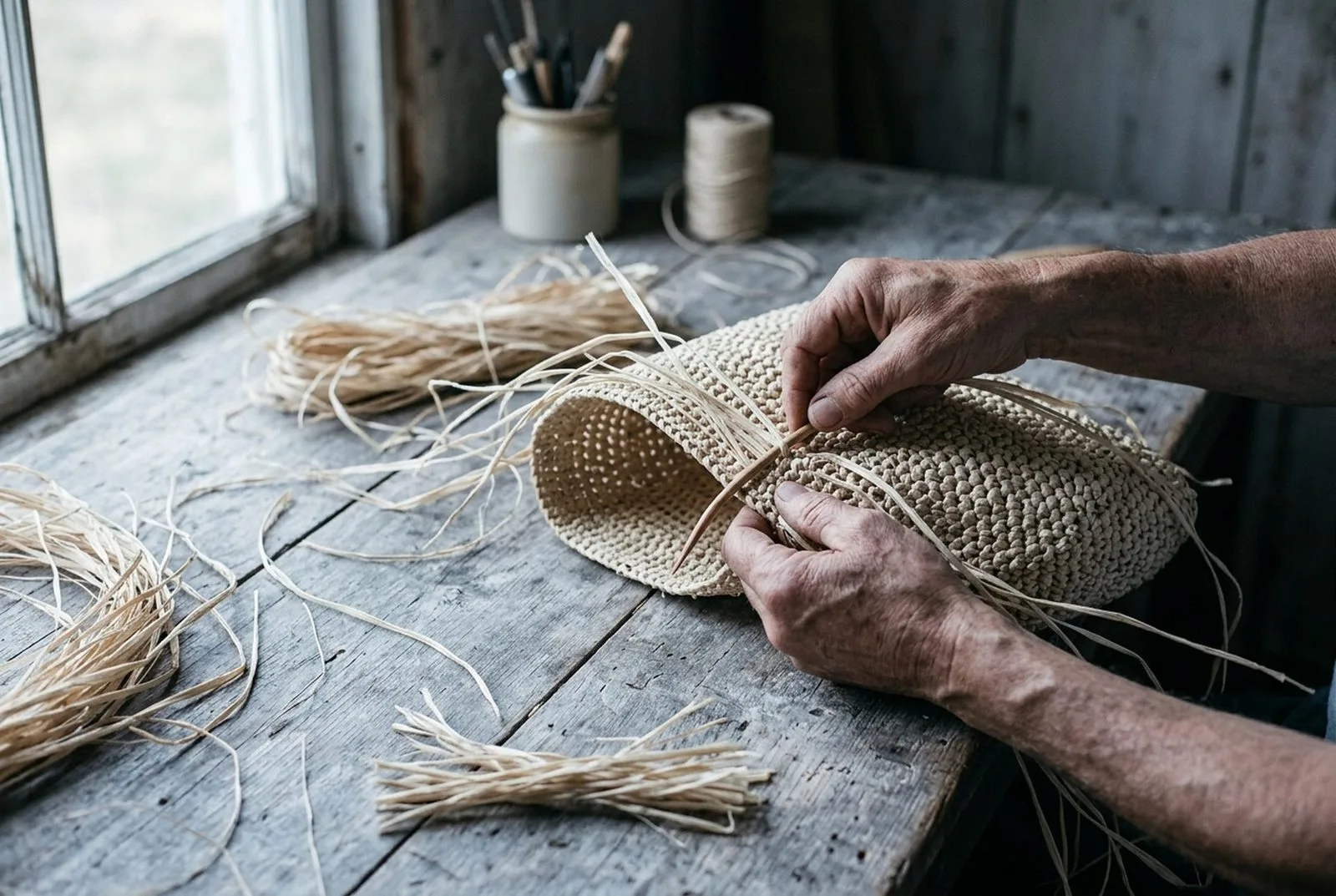
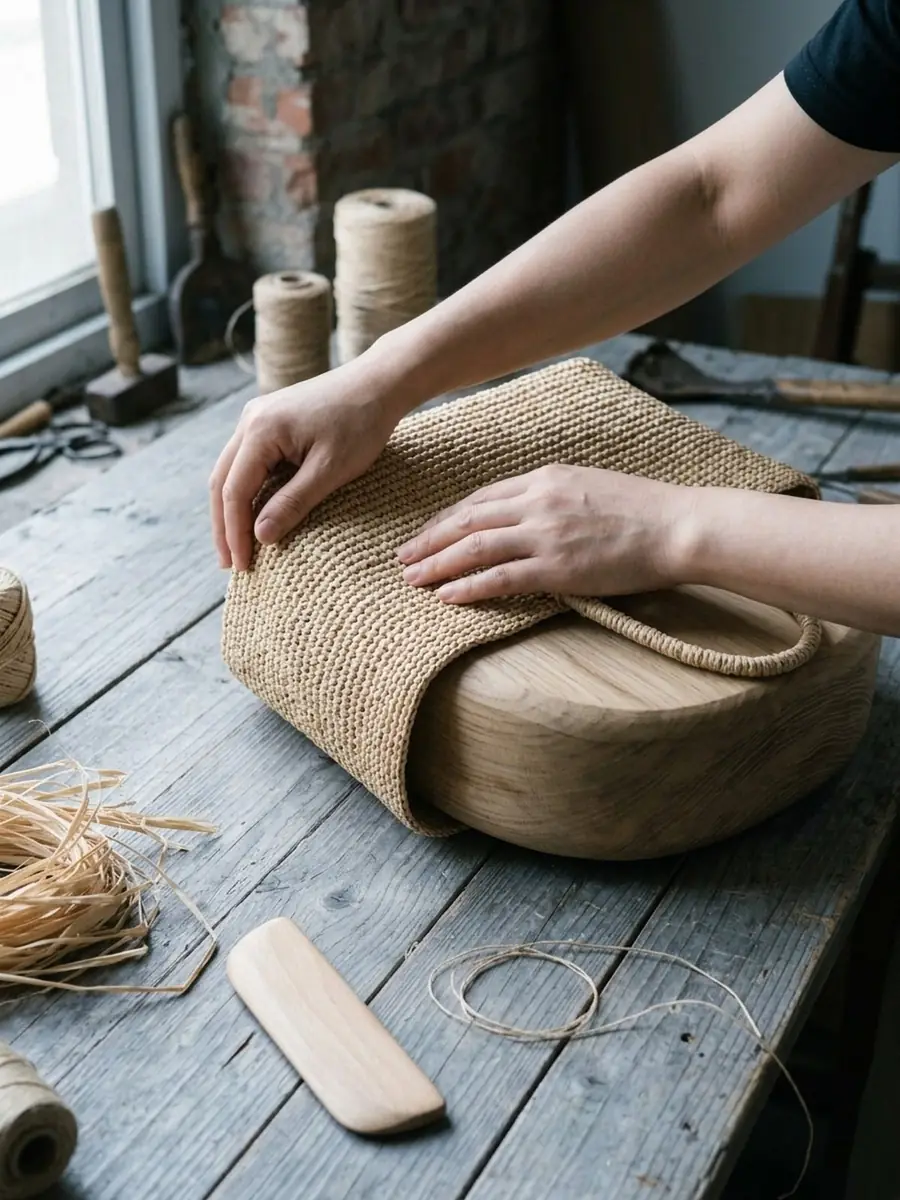 Trimming and edge alignment by hand: the stage that turns a woven panel into a bag, and one of the hours a photo never shows.
None of this is a reason to negotiate the number down. It is a reason to compare quotes line by line, because the supplier who is 30% cheaper has usually removed one of these lines rather than found a way around the labour.
Timing belongs in the brief too
The handwoven calendar is not the apparel calendar. Demand peaks from March to July, which means good capacity is booked by orders placed in January and February. A brief that arrives in April is not impossible; it is a brief quoted against what is left.
Two consequences. First, ask for a ship date rather than a lead time, and check it against the fibre lot. Bulk runs 30–45 days. Custom dyeing or a new mould moves that to 45–60. Second, decide early how the bag ships. Packing 20 per carton instead of 40 can change the volumetric charge by more than a small change in fibre cost, and the decision is cheapest at sampling.
When this process does not apply
Specification-first sourcing breaks down in five situations. It is worth recognising them before spending a month on a brief.
- Very small quantities. Below our MOQ of 100 pcs per style, sampling cost dominates the unit price. Buying a stock design is usually the better decision, even if it is not exactly your bag.
- A repeat order. You already have an approved sample and a lot record. The work is verification, not specification.
- A design that is still moving. Sampling a bag that will change next week produces an expensive reference nobody uses. Buy a swatch set, or have the design conversation first.
- A multi-fibre range from many factories. One trader with one invoice can be the right answer. Ask directly which hat they are wearing and where each fibre is made.
- A retail price that cannot carry handwork. If the target price requires a four-hour bag, the honest conversation is about structure and weave, not about finding a cheaper version of a twenty-hour bag that will still pass inspection.
The process also fails if you treat the sample as the finish line. It is the midpoint. Everything that decides whether the second order matches the first happens after approval: the lot record, the PPS, the inspection sheet, the packing decision.
Common questions
- How do I find a handwoven bag supplier?
- Ask who owns the workshop, who makes the sample and who inspects bulk. A supplier who cannot answer all three clearly is usually a trader.
- What should I ask before requesting a quote?
- The brief: silhouette, dimensions, fibre, colour reference, hardware, lining, branding and target quantity. Without it, quotes are not comparable.
- How do I compare quotes?
- Compare the same specification, the same MOQ and the same Incoterm. A lower unit price with a different fibre or packing is not a lower price.
If you have a brief, send it. If you have a photo and a price target, send those too, and we will tell you which parts of the photo are driving the number. Start with a conversation.
If you are building a range rather than a single bag, wholesale covers how fibre lines, MOQs and shipping fit together. If the bag is your own design, that is custom development. If it is your brand on a structure we already make, that is private label.
See the straw bags we currently produce in this range.