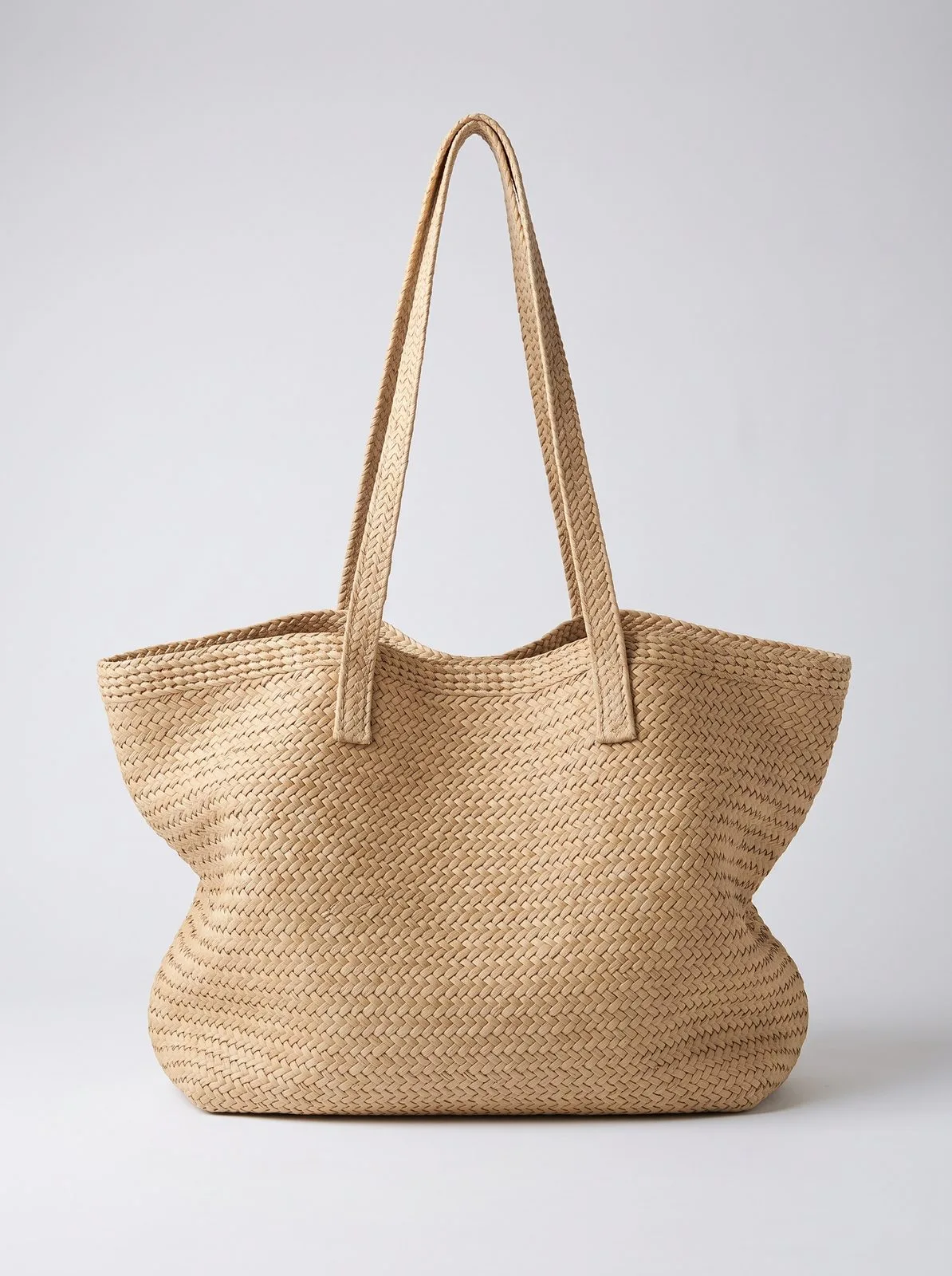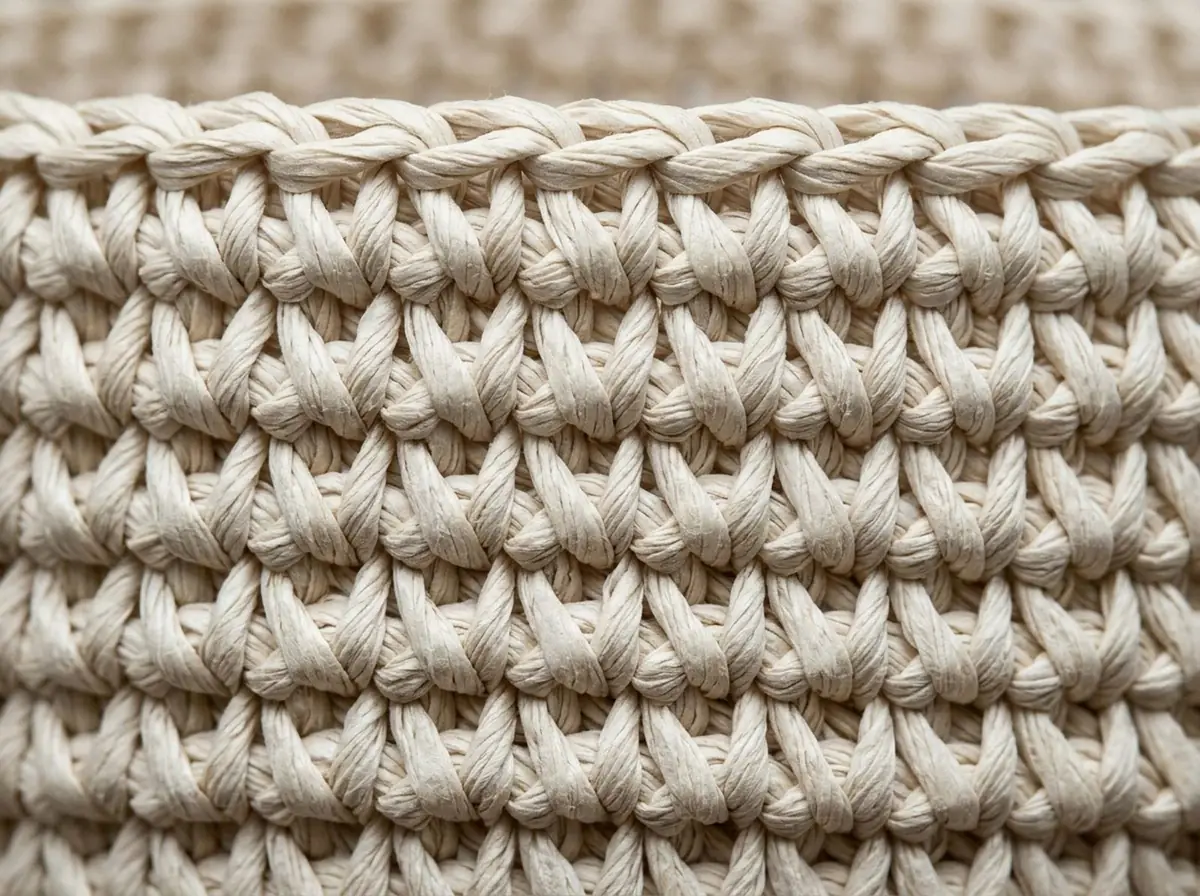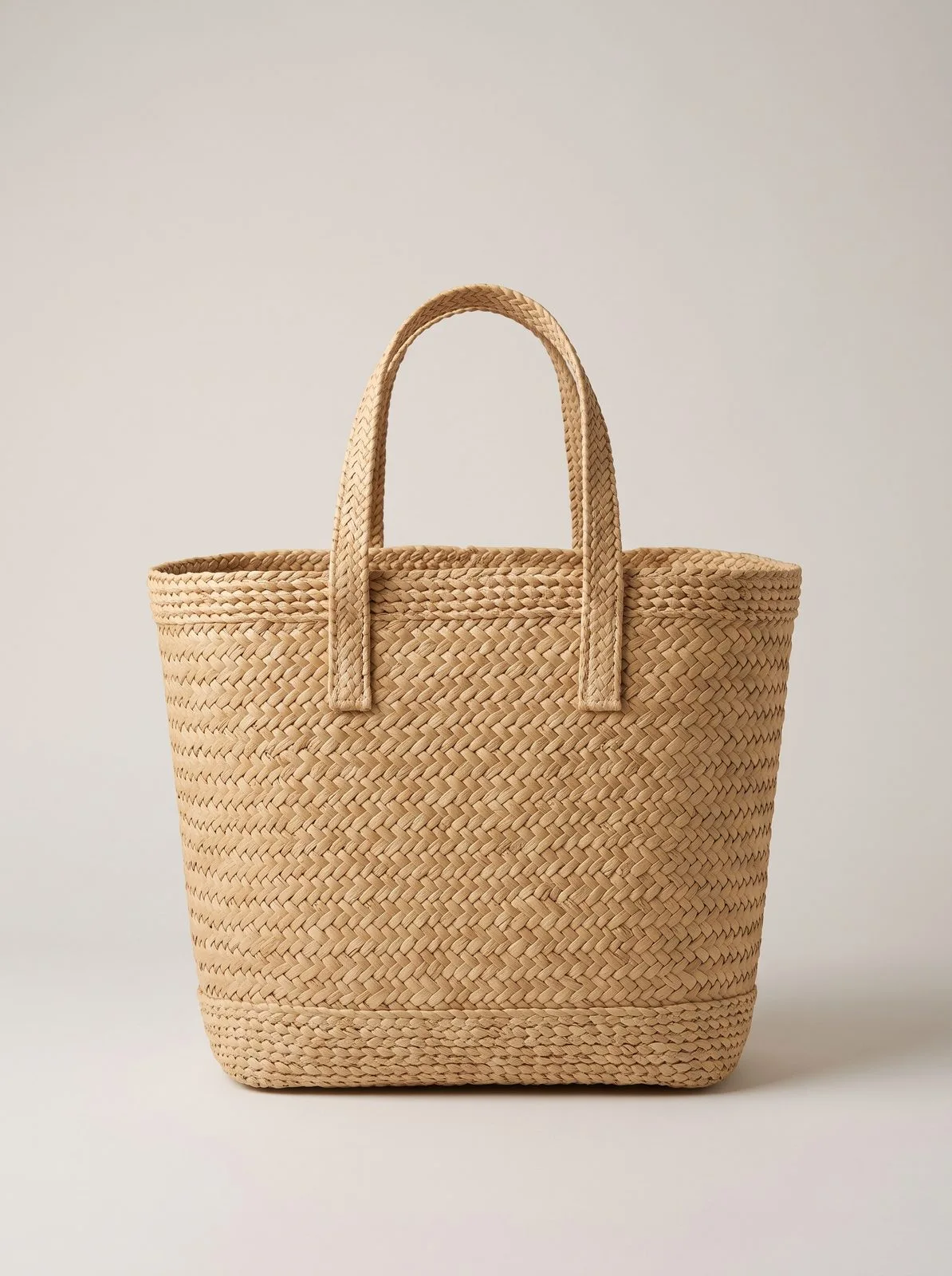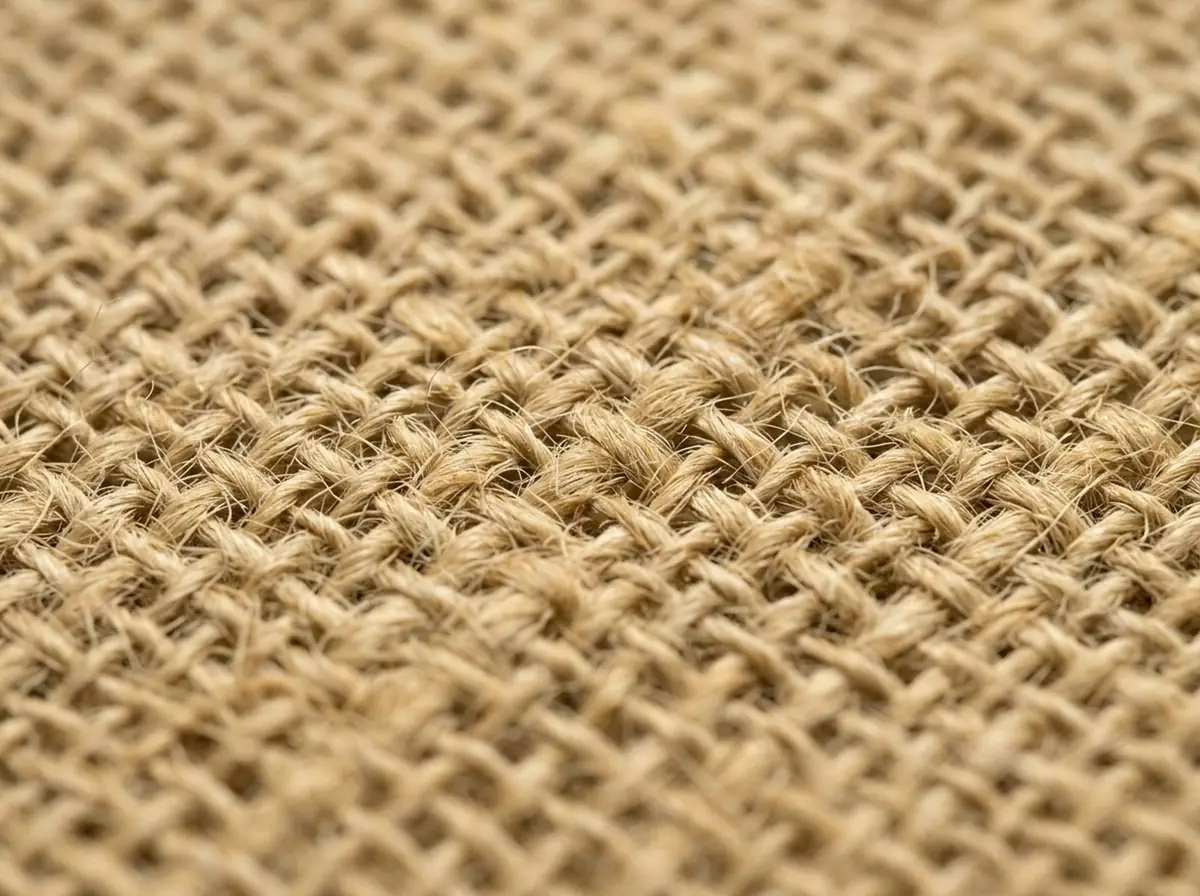
Most buyers meet this category through a photograph and a price. The photograph shows a texture. The price implies a fibre. Neither tells you what will be in the carton eight weeks later.
This is the map we use when a natural-fibre brief arrives at the workshop: the four materials you will be offered, what actually separates them in production, and what to fix before you approve anything.
Four fibres, four different behaviours
Almost every natural-fibre bag you will be offered falls into one of four materials. They are not grades of each other. They are different materials that happen to be woven in similar ways.
Raffia is a ribbon stripped from a palm leaf. It is soft, it drapes, and it takes dye well, though not identically from lot to lot. It does not stand up on its own, which is why raffia bags lean toward soft shapes and defined rims.
Natural straw is cut from the stalk, nodes and all. It is crisp and holds an open shape without a frame. It also creases if it is folded and stored under weight, and the crease does not come out.
Paper straw is paper cut into strips, flat or twisted. Its width and colour are the most consistent of the four. It also weakens faster than the others when it stays damp.
Jute is coarser and heavier. It is strong and widely available, takes bright dye poorly, and is usually better as structure or trim than as a visible body.
| Fibre | What it is | How it behaves | Best for | Watch for |
|---|---|---|---|---|
| Raffia | Palm-leaf ribbon, typically 8–10 mm | Drapes, softens with use, dyes well | Totes, clutches, fine weaves | Will not hold an architectural shape |
| Natural straw | Stalk strips with visible nodes | Crisp, self-supporting, light | Beach bags, baskets, wide shapes | Creases; nodes interrupt fine work |
| Paper straw | Cut paper strips, flat or twisted | Uniform width and colour, smooth | Repeat ranges, colour-critical work | Weakens with prolonged moisture |
| Jute | Coarse bast fibre | Heavy, strong, low stretch | Bases, trim, hidden structure | Poor dye uptake in bright shades |
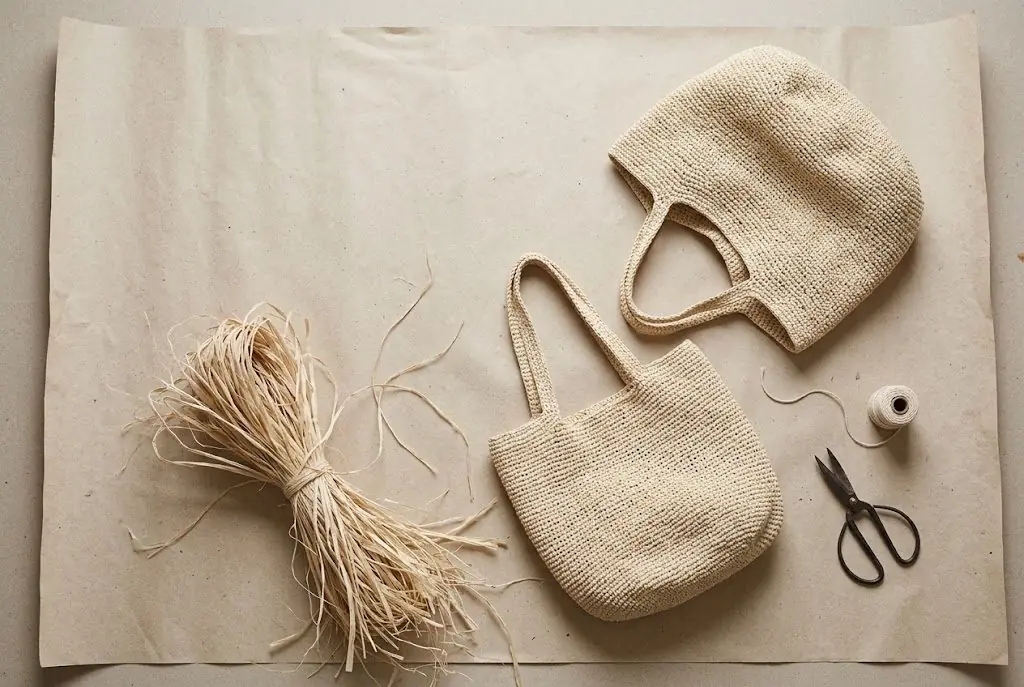
Raffia arrives as fibre before it becomes a bag. Strand quality decides how fine the weave can go.
The table is a starting point, not a specification. A bag in raffia and a bag in straw are not the same product at two prices. They behave differently in the shop, and differently after six months of use.
One confusion worth clearing up early: "straw bag" is often used for anything woven from plant fibre, including raffia. When you are comparing quotes, ask for the fibre by species. Two suppliers quoting "straw" may be quoting different materials at the same price.
The invoice weight is not the fibre you get
The most misleading number in this category is kilos.
Fresh raffia holds roughly 40% moisture. Once it is dried and sorted, a kilo of fresh material yields somewhere between 200 and 600 grams of usable fibre. The range is wide because it depends on the strand, the season, and how much of the bundle is short or uneven.
Sorting removes another 25–30%: split ends, uneven width, strands too short to weave.
So when a quote is built on green weight, you are paying for water and for waste. Ask which basis the price uses. A supplier who prices on dry, sorted fibre will usually look more expensive per kilo and turn out cheaper per bag.
The same arithmetic explains why natural fibre does not compete with machine-made bags at the entry price point. You are not buying a material. You are buying the sorted fraction of a material, plus the hours that follow it.
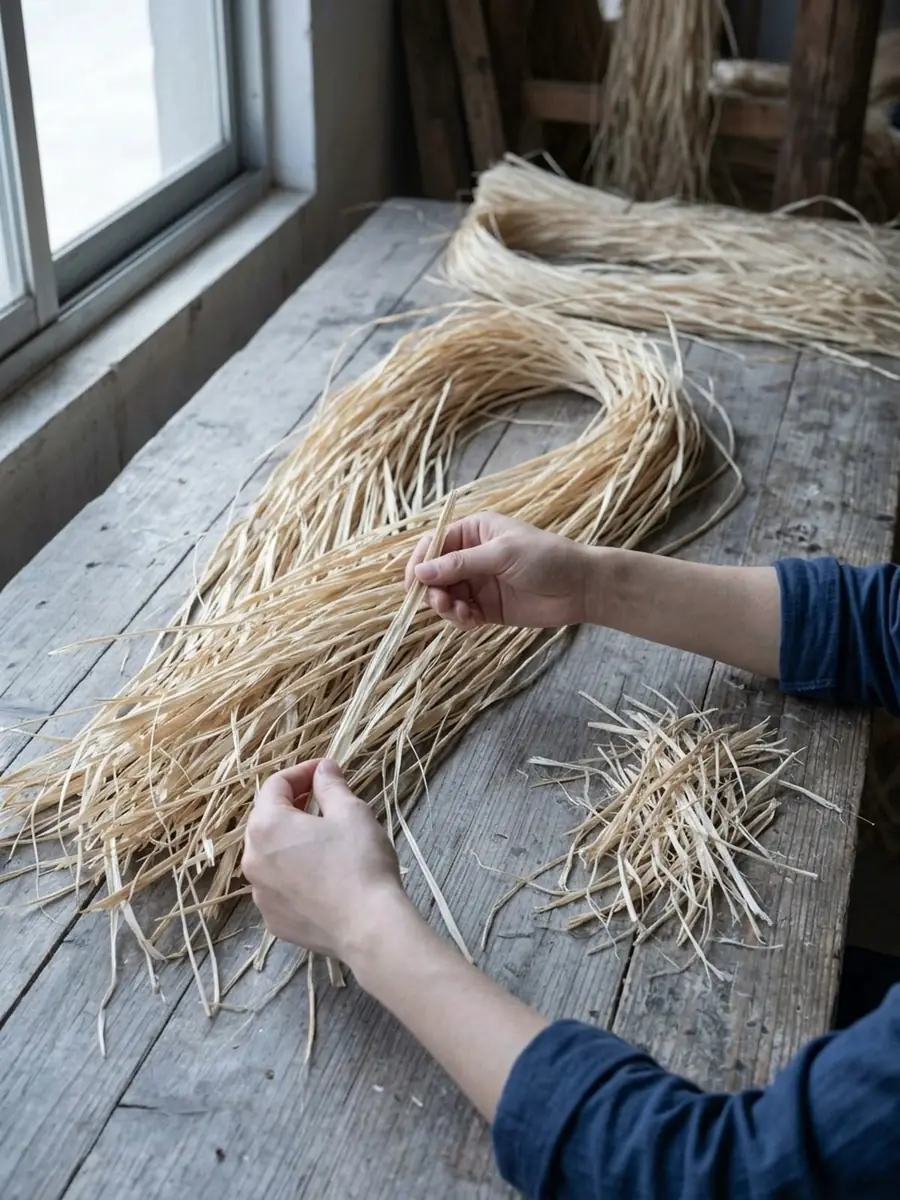
Sorting is where the 25–30% loss happens. Short and uneven strands never reach the loom.
What a specification should fix, and what it should leave open
Two bags can match a photograph and still be different products. A useful specification separates what must not vary from what physically cannot be held constant.
The samples that reach us rarely fail on weaving skill. They fail on a decision that was never made — a handle left to the sample, a colour left to a screen, a fibre left to the trade name.
A workable line for a raffia tote looks like this:
Body: raffia ribbon, 8–10 mm. Weave: tight, gaps ≤1 mm at the mouth. Base: flat, reinforced. Handle: rolled raffia, 12 cm drop. Lining: cotton, undyed. Hardware: brass, two pieces. Label: woven, inside left seam. Packing: dust bag, individual poly bag, double-wall export carton.
None of that requires a technical vocabulary. It requires deciding.
| Fix in the spec | Accept as normal variation |
|---|---|
| Fibre species and ribbon width band | Slight width drift along a single strand |
| Colour against a physical card | Tone shift between dye lots, inside the card's tolerance |
| Silhouette dimensions (35 cm ±2 cm) | A centimetre of softness at the sides |
| Handle attachment method | Small differences in stitch spacing |
| Lining colour and fibre | Weave texture visible under the lining |
| Packing format | Carton appearance after transit |
| A supplier who separates these two lists has run this before. One who promises everything will be identical has either misunderstood the question or is planning to substitute something. |
Six checks on a sample, in about ten minutes
You do not need a laboratory to reject a bad sample. You need hands and a tape measure.
- Measure. A 35 cm bag should be within ±2 cm on width and depth. Handle drop within ±1 cm. If the two handles differ by more than 2 cm, reject.
- Look at the mouth. Gaps up to 1 mm at the rim are acceptable. Any gap over 2 mm in the body is a reject.
- Hang it by one handle. Put two kilos inside first. Any movement at the anchor, loose thread, or stitching that misses the woven layer is a reject.
- Turn it inside out. Lining unravelling, a hole, or a colour that does not match the spec is a reject.
- Fill it and set it down. Density problems do not exist in an empty bag.
- Compare two. Two bags from the same carton, side by side, against the card. More than about 10% apart, and the lot is not shippable.
These six catch more than most inspection reports, because they are the things a customer notices in the first week. They are also the checks you can run in a showroom, which is where most approvals actually happen, rather than in a factory you never visit.
When natural fibre is the wrong answer
Some briefs are better served by an engineered fibre, and we say so before quoting rather than after the first sample.
- A colour-critical range that repeats across seasons. Natural fibre shifts between lots. A synthetic cord or paper straw holds closer.
- A packable travel product that will be folded while damp. Natural fibre creases and can mildew. Synthetic resists both.
- A hard price ceiling. Hand-weaving has a floor. Below it, a machine-woven or synthetic bag serves the customer better.
- Daily heavy use. Natural fibre softens. A lined, structured construction in an engineered cord will outlast it.
Synthetic and textile cord MOQ runs 100–300 pcs depending on the cord, so a lower material cost is not always a lower commitment.
One more case: if the product is meant to be disposable for a single season, the way natural fibre ages is a liability rather than a selling point. Nothing about the material is better in the abstract.
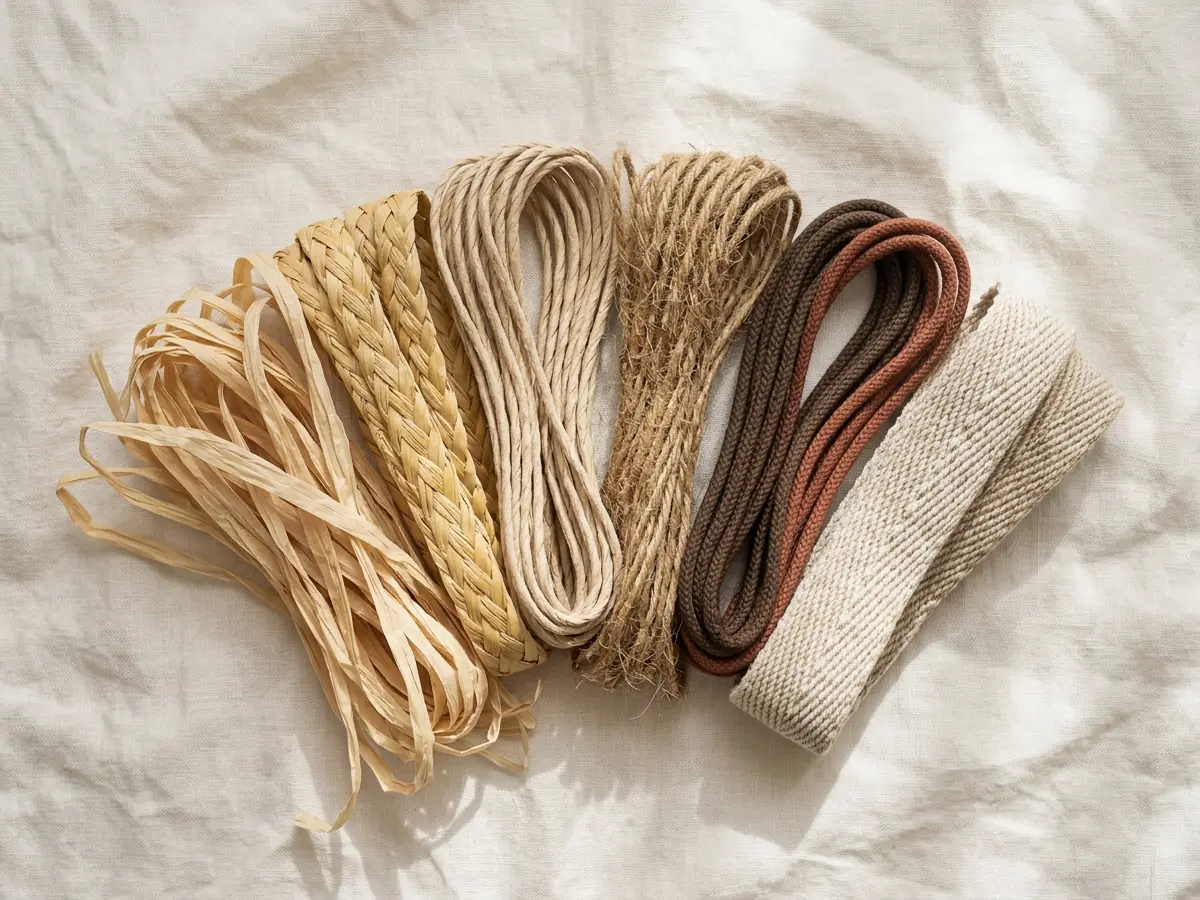
The same brief in four fibres. A swatch fan settles in five minutes what a photograph argues about for a week.
What to send instead of a photograph
Five lines turn a photograph into a brief we can quote against:
- Fibre, by species, and the ribbon or cord width you want.
- Finished dimensions, and whether the bag must stand or fold.
- Colour reference: undyed, or a physical card we can match.
- Handle type, and whether it is a decision or a default.
- Quantity per style, and the packing you need.
With those, the answer is concrete. With a photo and a target price, we can still work, but the first round will be spent finding out which of the five was actually decided.
Common questions
- What are natural fibre bags?
- Bags woven from plant-derived fibre — raffia, straw, rattan, jute, cotton cord or paper straw. The fibre sets the drape, weight and dye behaviour.
- Are natural fibre bags biodegradable?
- Plant fibres are biodegradable in the right conditions, but handles, linings and hardware may not be. Judge the whole bag, not the fibre alone.
- Which natural fibre is best for bags?
- There is no single best. Raffia takes colour and folds well; straw is stiffer; jute is heavy and rustic; paper straw is the most consistent. The shape should choose the fibre.
The four fibres compared side by side, with the questions to ask any supplier, are in the material guide. If you already know the fibre, wholesale explains how bulk supply works, and custom development covers building a bag to your own design. The raffia line has its own wholesale page.
See the straw bags we currently produce in this range.