Two totes can share a name, a fibre and a colour and still be different products. One stands when you set it down; the other folds into itself. One takes a towel and a paperback; the other bulges at the seam.
That is why we treat a silhouette as a specification. It fixes how the bag carries load, how wide the base is, and what happens when it is put down on a resort floor. It is the decision buyers revise least often.
We have been weaving in Houjie, Dongguan since 2014: a 2,000 sqm workshop, around 150,000 pieces a year. Six structures cover almost every brief that reaches us. Here is what each is for, where it stops, and how it usually fails.
A shape is four numbers before it is a look
Before we discuss a silhouette we ask for four dimensions: width, depth, height and handle drop. Those decide whether the bag behaves as the sketch promised.
Our tolerance on a 35cm bag is ±2cm on width and depth, ±1cm on handle height. Handles that differ by more than 2cm are a reject — not because anyone measures them in a shop, but because the bag hangs crooked.
Then we fill it. A tote photographed on a plinth reads larger than it is, and one that will not take a towel plus a book comes back as a return. Before sign-off we load the sample with the items the buyer named; if they have not named them, we ask.
Tote — the workhorse, and the hardest to buy well
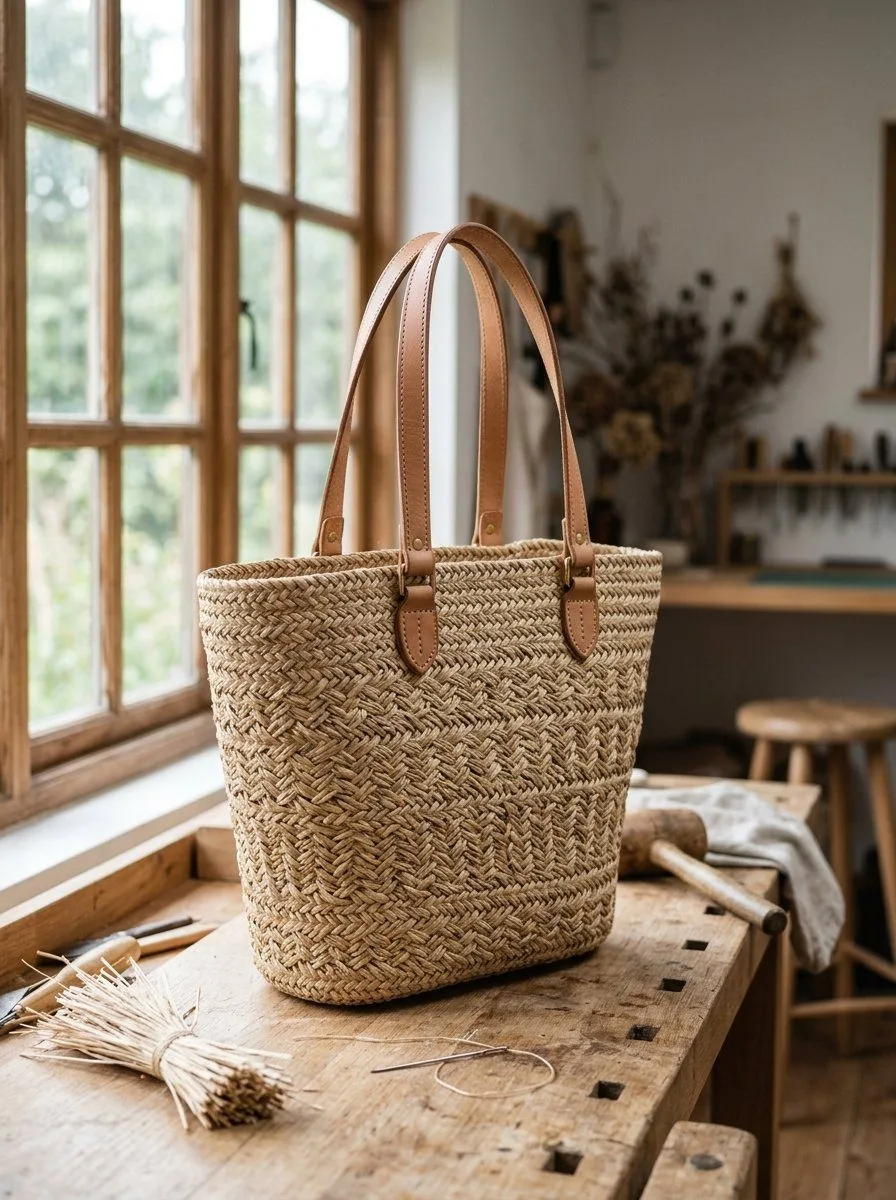
Open top, flat base, twin handles. The tote absorbs more variation than any other shape. The base decides whether it stands; the handle join decides how long it lives.
Handle attachment is the most common reject in our inspection room. Any wobble at the anchor, any loose thread, any stitch that passes beside the weave layer instead of through it, and the piece goes back. That check fails more cheap totes than fibre quality does.
Cost sits in the structure. A structured tote — reinforced base, shaped gusset, anchored handles — runs to roughly twenty hours of weaving and assembly per piece. A simple open tote takes a fraction of that. When two quotes for the same-size tote differ sharply, the gap is almost always in the base.
It takes every fibre we work with, which makes the handwoven tote range a quick way to see how they differ.
Where it stops: a tote that must stand when empty needs a stiff fibre or a lining. Soft fibre and an unstructured base will not stay crisp.
Bucket — the shape that shows every row
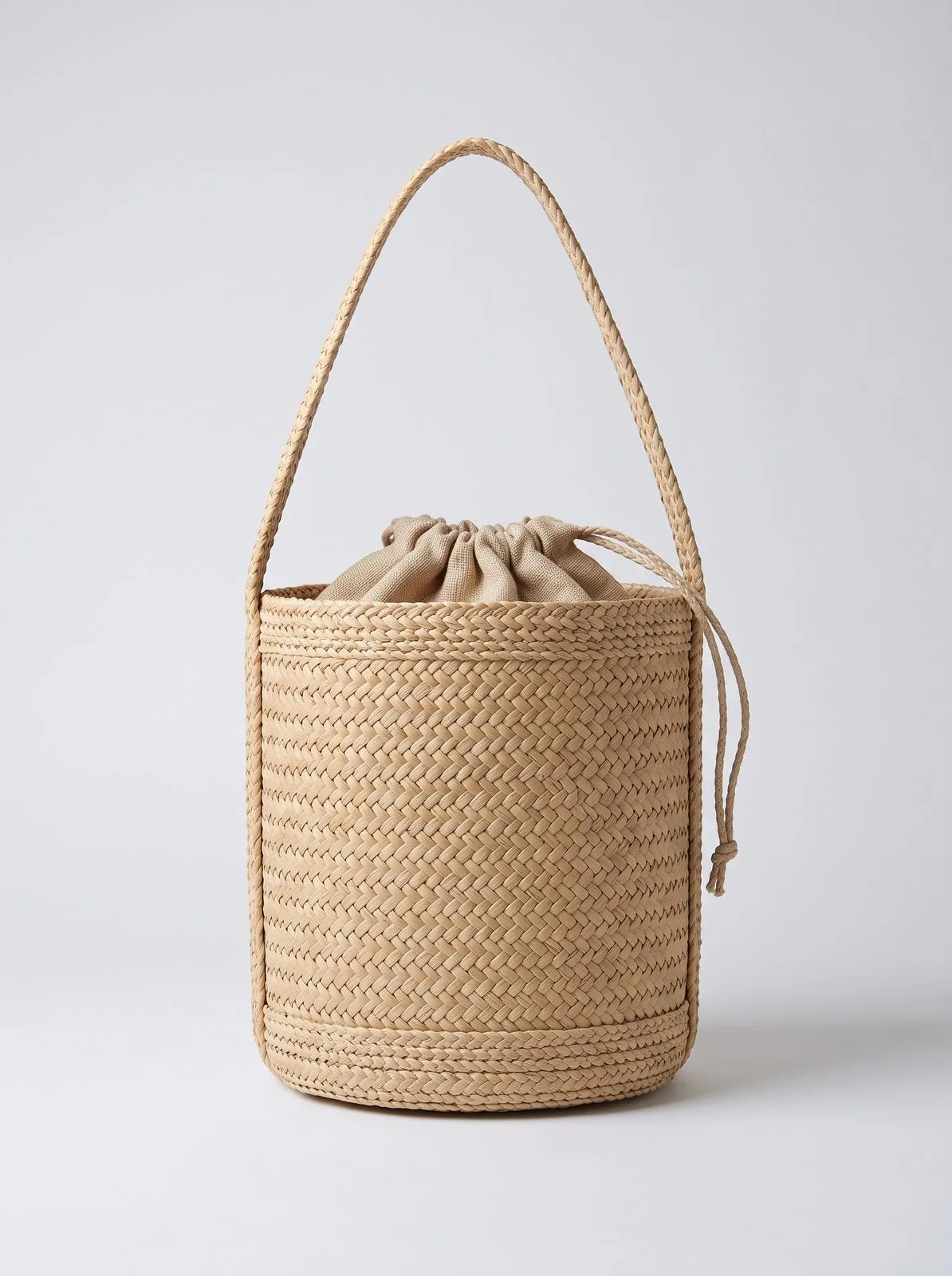
Cylindrical body, drawstring or tie closure. The bucket is the most forgiving shape to make and the least forgiving to design, because a cylinder has nowhere to hide. Every course runs the full circumference, and one uneven row is visible across a room.
The bucket is also where weave density becomes measurable. Our standard: gaps up to about 1mm at the mouth are acceptable; any gap over 2mm on the body is a reject. On a bucket that line matters more, because the body is the whole design.
The drawstring concentrates stress at the eyelets. If the fibre is brittle when dry, that is where it fails first.
Where it stops: a tall bucket in a heavy fibre reads sturdy; the same fibre in a short bucket reads dense. A soft bucket needs a different fibre, not a different height.
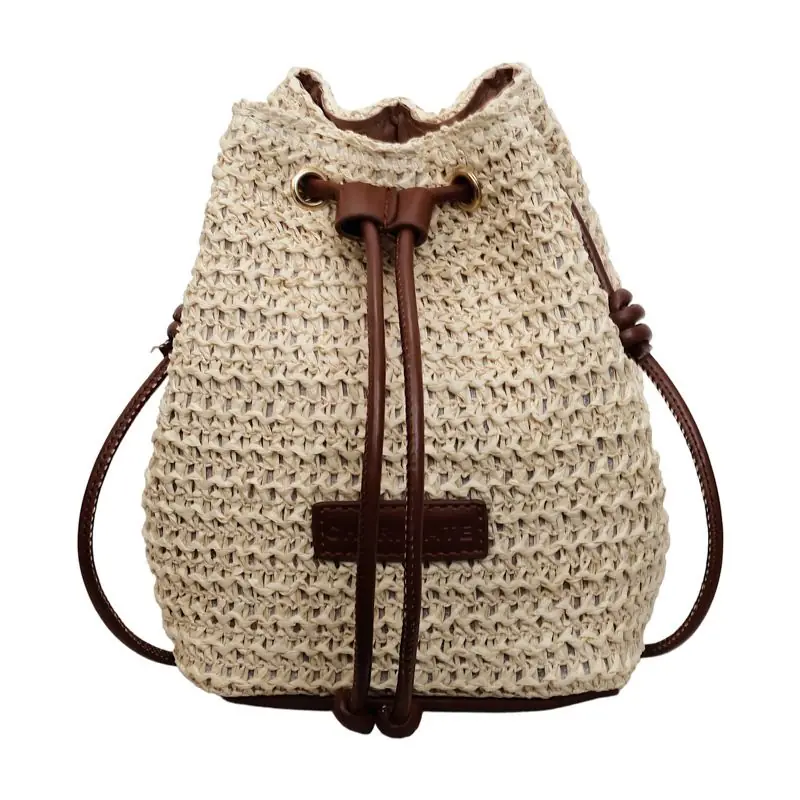 The bucket: every row crosses the full circumference, so an uneven course has nowhere to hide.
Basket — rigid by construction, not by material
Rigid base, open weave, structured walls. The basket is the one shape that stands unaided because the construction does the work, not the fibre. It is usually the first style a new market orders: it photographs well, survives transit, and reads as handmade at a glance.
The base is where baskets fail. Set the bag on a flat counter and press one top corner; if it rocks, the floor is off, and a wobbling basket reads as inexpensive whatever the label says.
Where it stops: the open weave lets small items through. A lining is possible and changes the bag completely — decide which bag you are selling before the sample.
Crossbody — small, and judged at arm's length
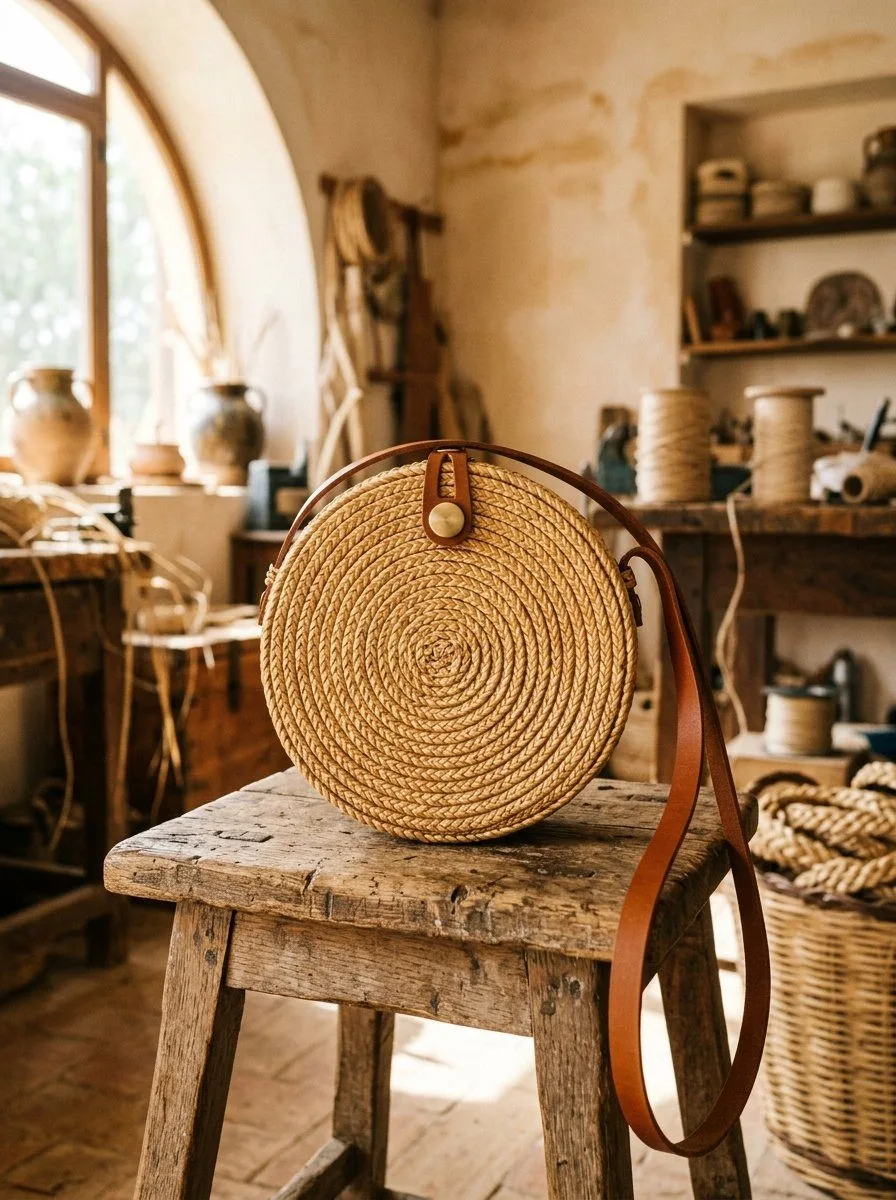
Long strap, compact body, flap or zip. Small bags expose sloppiness because there is less surface to distract the eye. A crossbody is judged at arm's length, not across a shop floor.
The strap is the design. Width, attachment and the point where it meets the body decide whether the bag hangs flat or swings. A narrow strap cuts into the shoulder; an over-wide one looks like a belt.
Where it stops: proportions do not forgive. A body 2cm too deep looks wrong in a way that is hard to name and impossible to forget. If you are working from a competitor sample, measure it before you brief us.
Clutch — a flat panel, and a colour test
Flat profile, hand-held, minimal hardware. A clutch is a surface, and the surface is the design. That makes it the shape where colour shows most: a large flat panel has no folds to break up an uneven dye lot. Our standard is blunt: if two adjacent bags differ by more than about 10% against the colour card, the lot is rejected.
Raffia takes dye more evenly than the other plant fibres we use, so most clutch work is raffia. It is also the piece buyers photograph most, which makes the raffia collection a hard test of colour accuracy.
Where it stops: a flat body has no structure of its own. Weave density and finish hold the line, not the shape. An open-weave clutch softens into a pouch within a season.
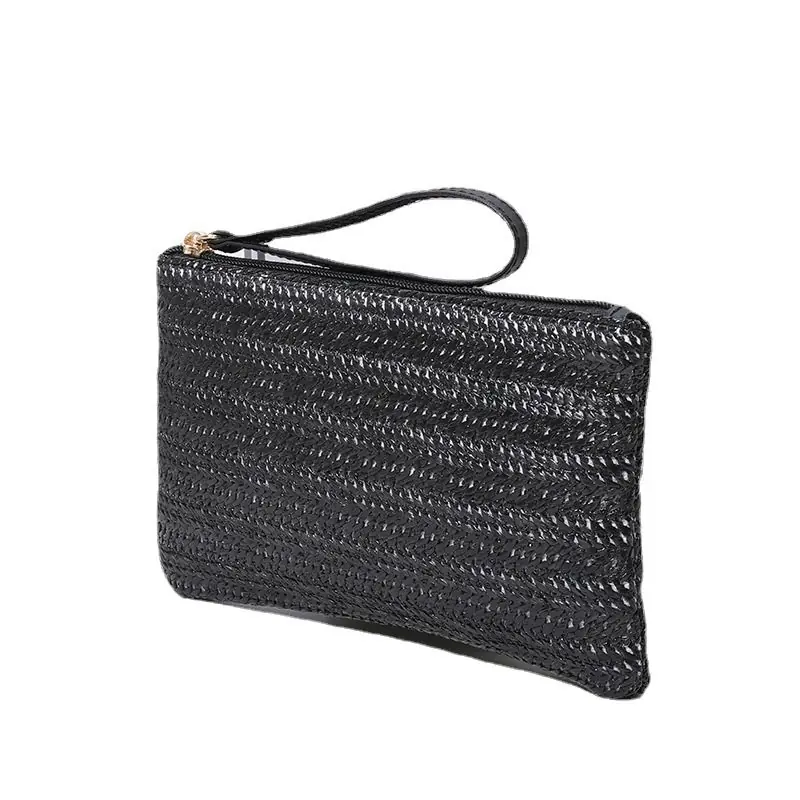 The clutch is a flat panel, so an uneven dye lot has nowhere to disappear.
Beach — oversized, and honest about it
Oversized, open weave, soft structure. The beach bag is the one shape where a loose construction is the point rather than a compromise.
It also takes the most abuse, so the handle join matters more here than anywhere else: a beach bag gets loaded past its design weight weekly, and a decorative handle will not survive that.
Size carries a cost line buyers forget. Carriers charge on volumetric weight, and a lightly stuffed oversized bag is the worst case. Moving from roughly 45cm to 55cm can add 20–30% to landed freight per unit though the bag weighs almost nothing — which eats most of the margin the size increase was meant to create.
Where it stops: open weave and heavy contents do not coexist for long. A beach bag carrying a laptop will fail at the handles.
The decision matrix
What separates the shapes is not which one is trending, but whether it must stand and what goes inside it.
| Shape | Built for | Stands when set down | Construction demand | Fibre that suits it | Most common failure |
|---|---|---|---|---|---|
| Tote | Daily carry, retail volume | With a defined base or lining | Medium to high | Any; raffia and paper straw most often | Handle anchors |
| Bucket | Structured casual, display piece | Yes, with a reinforced base | Medium | Medium-weight straw, firm raffia | Uneven rows, eyelet stress |
| Basket | Markets, gifting, first orders | Yes, by construction | Medium | Straw, braided grass | Base wobble |
| Crossbody | Evening, travel | No | High | Fine raffia, cotton-blend cord | Strap attachment |
| Clutch | Evening, surface-led | No | High finishing | Raffia, flat paper straw | Dye evenness |
| Beach | Resort, poolside, volume | No | Low to medium | Open-weave straw, paper straw | Handle load |
| Crossbody and clutch fail at finishing rather than weaving, which is why workshops take them on last. Beach is the only shape where a lower construction standard is correct — the open weave is the product. |
How we would build a first range
Most first orders we see put 200 pieces behind one shape — a large bet on a single photograph, and the bet that produces dead stock six months later.
A steadier structure is four styles × MOQ × two price bands. At 100 pieces a style that is 400 pieces, spread across enough shapes to learn something.
| Style | Role in the range | Band | MOQ |
|---|---|---|---|
| Soft tote | Volume, opening price | Entry | 100 pcs |
| Open basket | Gifting and market | Entry | 100 pcs |
| Bucket | The concept piece | Upper | 100 pcs |
| Clutch | Press and evening | Upper | 100 pcs |
| Timing belongs in the same decision: production peaks from March to July and buyers order in January and February, so a range finalised in April is already late. |
When this does not apply. A resort ordering one shape for one property should take depth over breadth: one silhouette, two colours, budget spent on the sample. If the brand rests on a single hero shape, protect it. If the order is gifting with a fixed unit budget, packaging is the real decision.
Common questions
- What are the main raffia bag styles?
- Tote, bucket, basket, crossbody, clutch and beach. Each answers a different carrying job, and the shape decides the weave density and handle.
- Which raffia bag shape sells best?
- The tote is the workhorse and the safest first style; the bucket is the most photographed. Clutch and basket are narrower bets.
- Which shape suits a first range?
- Build around one tote and one smaller shape, then add a third only if the first two sell. Four styles at MOQ is a cash decision, not a design one.
If you are choosing between two structures, send both sketches and we will sample them in the fibre you have in mind; seeing them side by side settles in a minute what a catalogue cannot. Custom development covers what changes when neither shape is right.
See the raffia bags we currently produce in this range.