We are a workshop, not a forecaster. What follows is our own reading of the raffia category for 2026: the size and pace of the market as we plan against it, and the direction of the briefs that actually reached our bench this season.
Treat the first as a planning number and the second as an observation. Neither is a prediction, and neither should replace your own sell-through data.
The size of the category, and what it does not tell you
The raffia products category — bags, hats and home — is worth roughly $0.37 billion in 2025. We plan against a figure of about $0.48 billion by 2032, which is growth of around 3.8% a year.
Steady, not explosive. Three things follow from that.
First, this is not a category where being early wins. It is a category where being consistent wins, because the same buyers return each season and they remember which supplier delivered what.
Second, a category growth rate says nothing about your price band. The top of the market and the entry price point do not share buyers, do not share retail doors, and do not move at the same speed.
Third, slow growth makes over-ordering the main financial risk, not under-ordering. A range that sells through at full price beats a range that sells 70% and discounts the rest.
Where the number does not apply: if you sell into resorts or hotels, your order cycle follows refurbishment schedules rather than consumer demand. We quote those orders against a delivery date, not against a forecast.
What we are seeing in inquiries
Since January we have tracked the direction of every raffia brief that reached the workshop. The shares below are a share of our own inquiries. They are not a market statistic, and a workshop sees a particular slice of the market.
| Direction | Share of inquiries | What buyers are asking for |
|---|---|---|
| Coastal grandmother | 32% | Natural field, soft body, leather-trimmed handle |
| Quiet luxury | 26% | Undyed or black, tight weave, minimal hardware |
| Coquette | 18% | Small bag, ribbon or bow detail, pale pink or cream |
| Boho / festival | 12% | Slouchy, fringing, mixed fibre |
| Literal resort / nautical | 8% | Navy trim, rope handle, wide open top |
| Two readings from that table. |
Quiet luxury is the second-largest share in our sample, and it is the most demanding on weave density and finishing. There is no pattern or colour to hide behind; the surface is the product.
Coquette is a smaller share, but it lands on much smaller bags. More units per kilo, more handling per unit, and a construction that needs a lining or a frame to hold a shape at that size.
Colour: natural is the base, not the whole range
Undyed raffia is still the most common single choice in the briefs we quote. What changed is that buyers no longer specify an all-natural range.
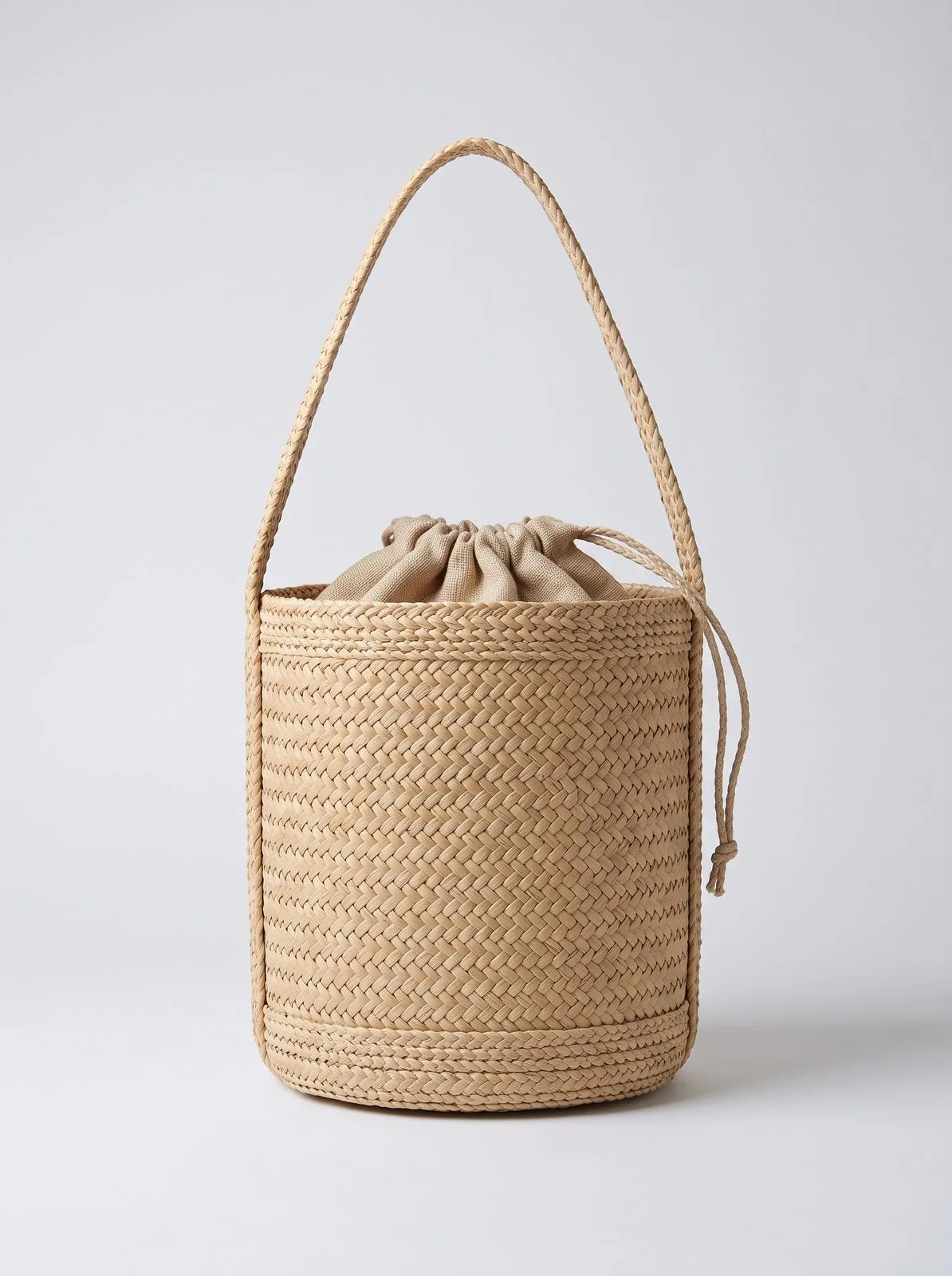
The common shape of a 2026 range is a natural field with one saturated colour sitting on it. Three versions come up more than any others: a black raffia bag with natural handles, a tan woven bag with a darker trim, and a terracotta body left entirely plain.
The reason is practical. A single strong colour reads at distance on a shelf and in a photograph, while the undyed fibre keeps the bag from looking manufactured. It is also the cheapest differentiation available, because it changes a dye lot rather than a construction.
Boundary: dye shifts between lots. If you cannot accept a visible batch difference, do not place the dyed piece directly beside a repeat of itself on the shelf. Put the natural pieces between them, or split the dyed colour across different styles.
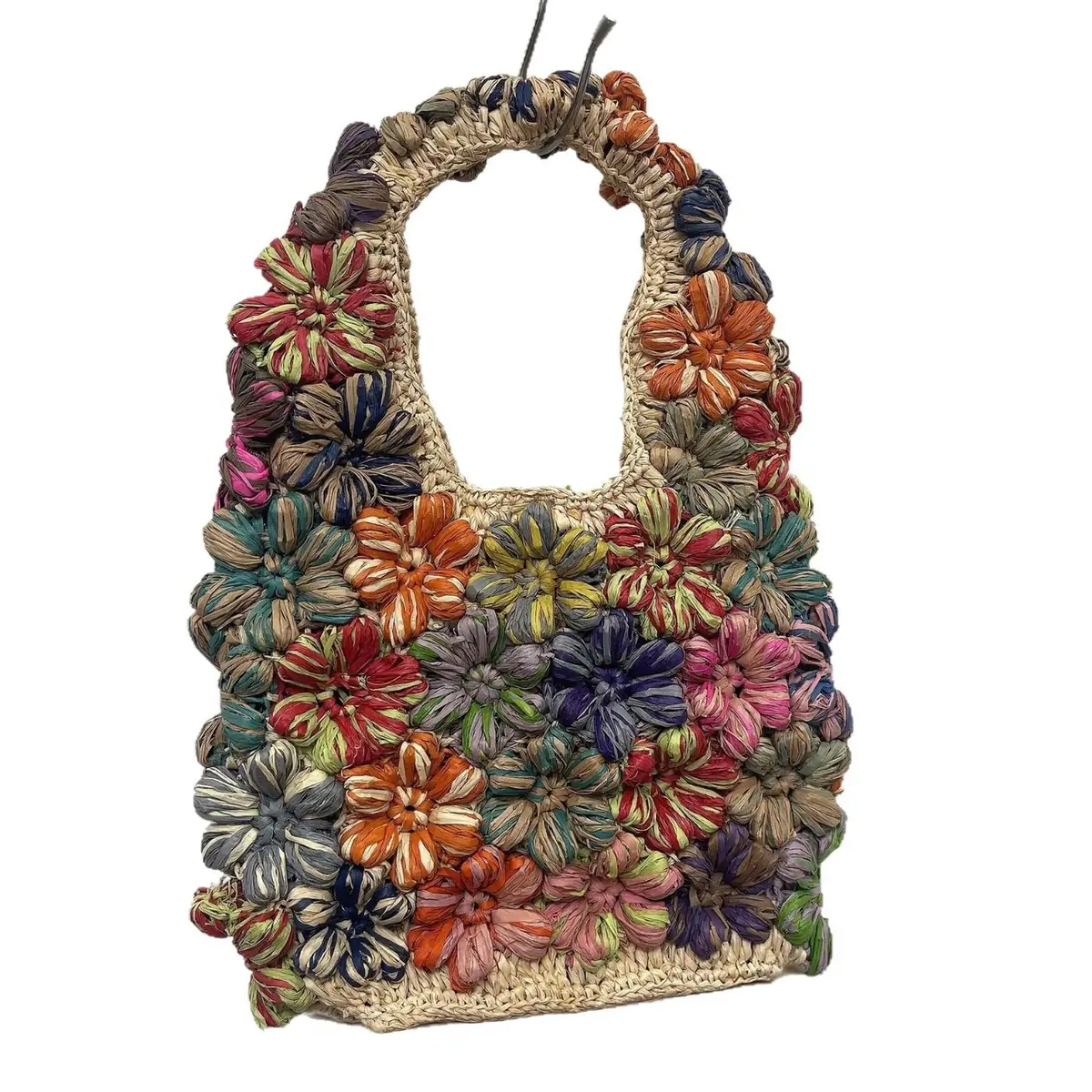
Colour at the other end of the scale: each flower is a separate colour decision. Most briefs this season move the other way, toward a natural field and one accent.
Shape: a defined opening on a soft body
Raffia drapes. Much of what was built two seasons ago followed that property into slouchy, unstructured shapes.
The current brief is softer in the body and harder at the mouth: a rolled or bound rim, a base that sits flat, and a body that collapses when set down but holds a clear line at the top. It reads as considered rather than shapeless, and it is more forgiving in transit than a frame.
Specify the mouth, not just the silhouette. A 35 cm body carries ±2 cm of legitimate tolerance. A rim that sags more than that is not tolerance; it is construction. Ask how the rim is built — a double row of tight weave, a bound tape edge, or a wire core. Each costs differently and behaves differently after a season of use.
Handles are the decision that shows
Almost every brief now names the handle as a decision rather than accepting whatever the sample came with. Four answers dominate:
- Rolled raffia, matching the body. Quiet, traditional, and the cheapest way to keep the bag coherent.
- Flat woven, slightly heavier. Reads more structural and holds its line better in a photograph.
- Leather or faux leather, in a contrasting tone. The strongest change in character, and the largest change in cost.
- Cotton cord, knotted. The most casual, and the one that ages fastest.
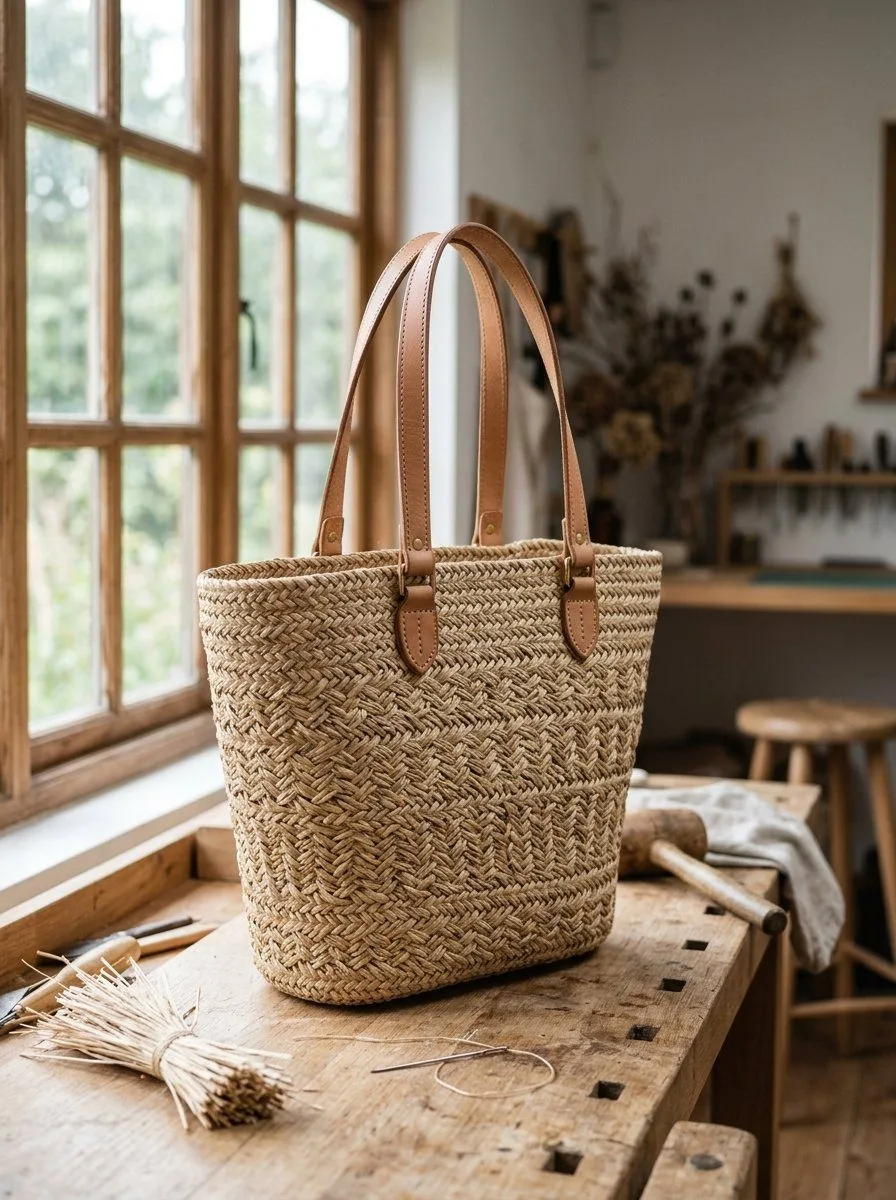
Leather handles on raffia are the most requested upgrade in our inquiries this season. They are also where the price moves most. If your margin is tight, hold the line on the handle rather than on the weave: a simpler handle on a good body looks intentional, and a cheap handle on a good body looks like a mistake.
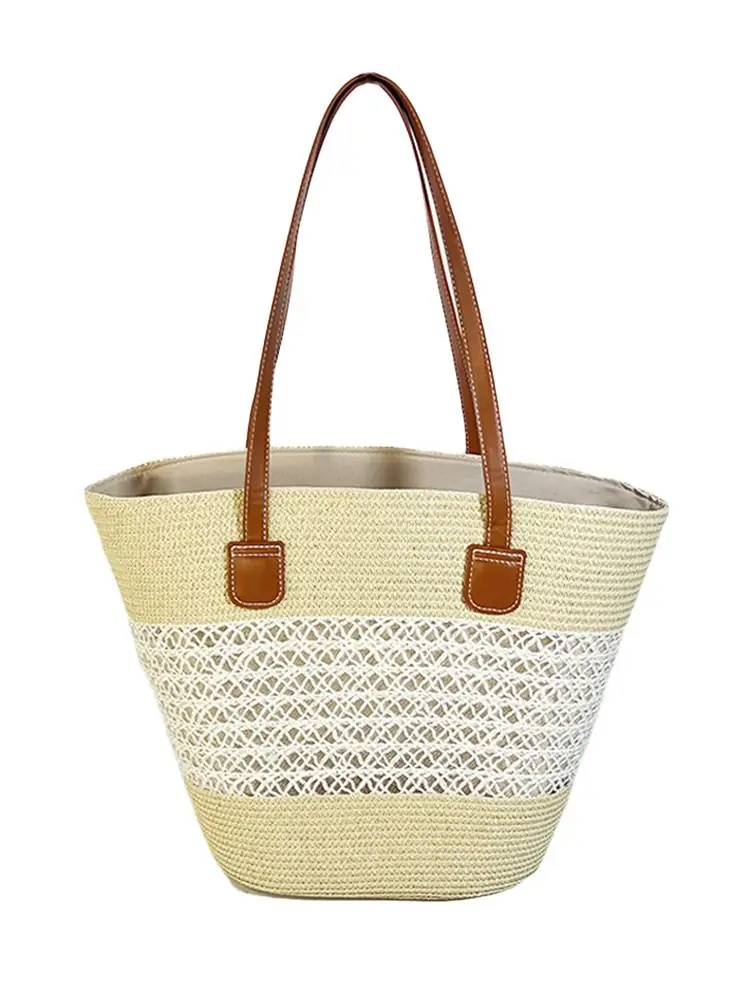
A natural body with tan leather handles and an openwork band. The handle is the upgrade most buyers ask for; the openwork is where the weave changes density.
Building a first range around this
Four styles at MOQ, across two price bands, beats one style at 200 pieces. At 100 pcs/style, four styles is 400 pieces and it tests four briefs instead of one.
| When | What | Why |
|---|---|---|
| Aug–Sep | Brief, fibre selection, handle decision | Dye lots and sample slots fill first |
| Oct–Nov | Sampling, 10–15 days plus 1–2 revision rounds of 5–7 days | Leaves room for a pre-production sample |
| Dec | Pre-production sample from bulk material, 7–10 days | Last point to change without cost |
| Jan–Feb | Bulk order | Production 30–45 days, 45–60 with custom dye |
| Mar–Jul | Selling season | Restock decisions by April |
| Freight belongs in the range decision, not after it. Raffia bags are bulky relative to weight, so volumetric weight can add 20–30% to landed cost. A 55 cm beach bag that ships open costs more than its invoice price suggests, which is why one oversized piece as the anchor works better than a range of oversized pieces. |
What we would not build a range on
Some directions are cooling, and we say so when a brief lands on them:
- Micro bags under 18 cm, in raffia especially. The weave does not scale down well and the work per unit stays high.
- Strong colour blocking across a whole collection. One accent is a range. Five accents is a discount rack.
- Heavy visible logos on woven surfaces. The weave distorts the mark, and the mark dates the bag.
- Stiff, structured raffia buckets. Raffia does not hold an architectural shape without a frame, and the frame removes the reason to use raffia at all.
- Polyester-mixed straw sold as natural. It may pass a photograph. It will not pass a customer.
None of these is forbidden. They are simply harder to sell at full price and harder to repeat next season.
If you are building a raffia range this season
Four things to settle before a sample is made: the direction and its share of the range, the colour structure (natural field plus accent), the handle, and the number of styles at MOQ. Get those four onto one page and the brief is answerable.
Common questions
- What raffia bag trends are you seeing in 2026?
- Natural and undyed bases with one colour accent, defined openings on soft bodies, and handles that carry the design. Buyers are avoiding all-over novelty.
- What colours are buyers ordering?
- Natural, sand, espresso and black remain the base; one seasonal accent is common. Bright all-over colour is a smaller share.
- What should a first raffia range include?
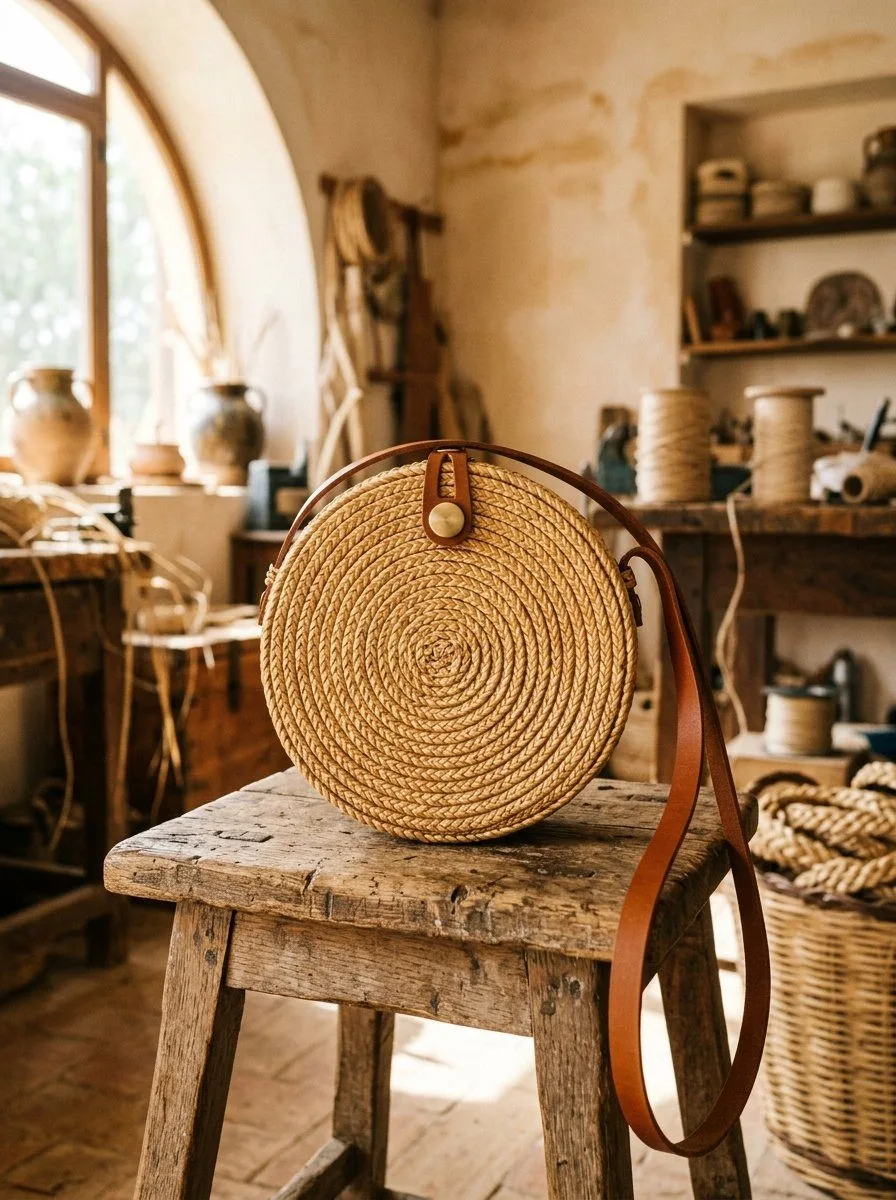
- One tote, one smaller shoulder or crossbody shape, and one colour accent. That covers most retail floors without spreading the buy.
How raffia behaves against the other fibres is set out in the material guide. If the direction is already decided, custom development covers building a bag to your own specification, and wholesale explains how a bulk order runs from brief to shipment. Current raffia styles are listed under wholesale raffia bags.
See the raffia bags we currently produce in this range.