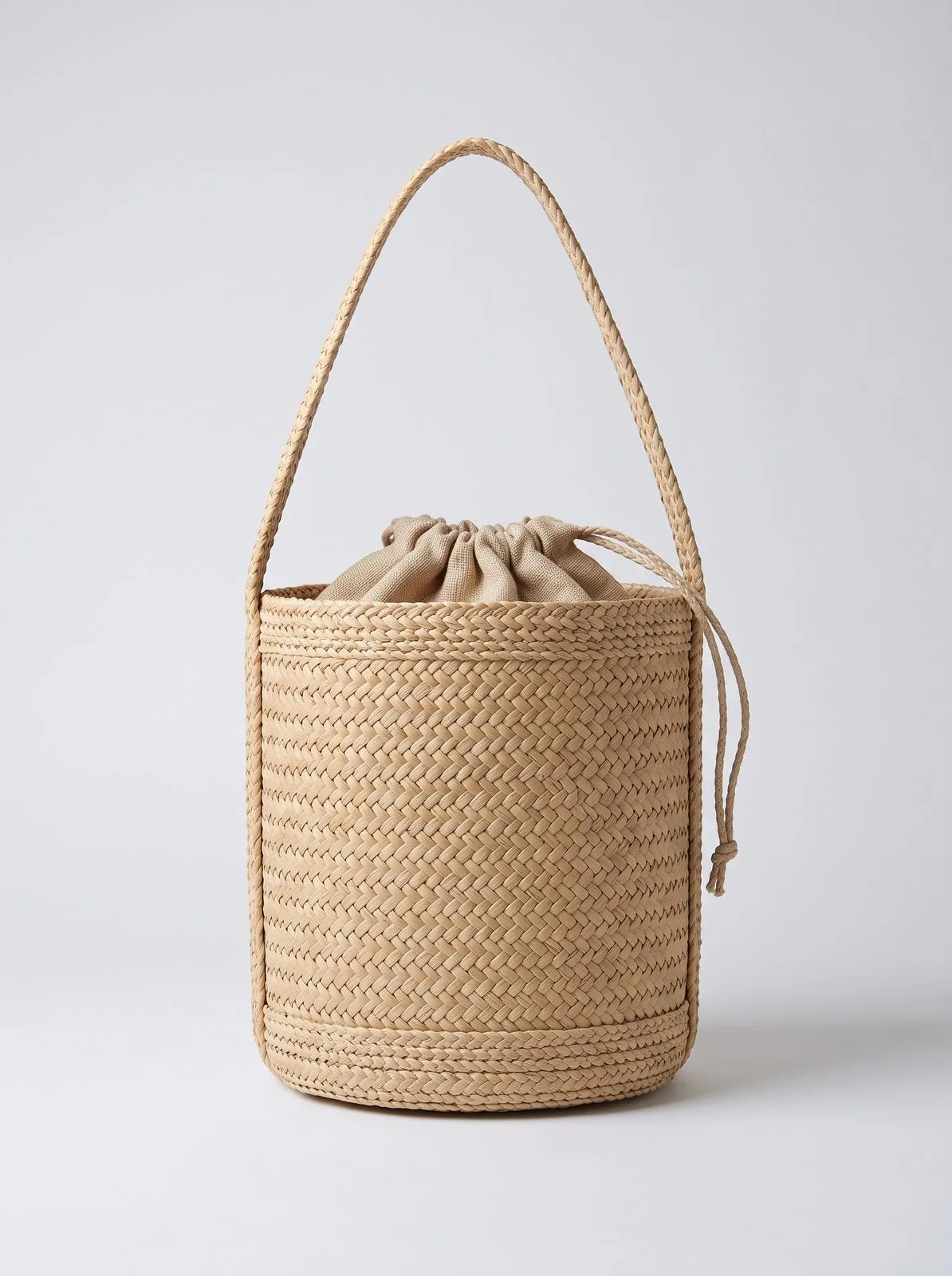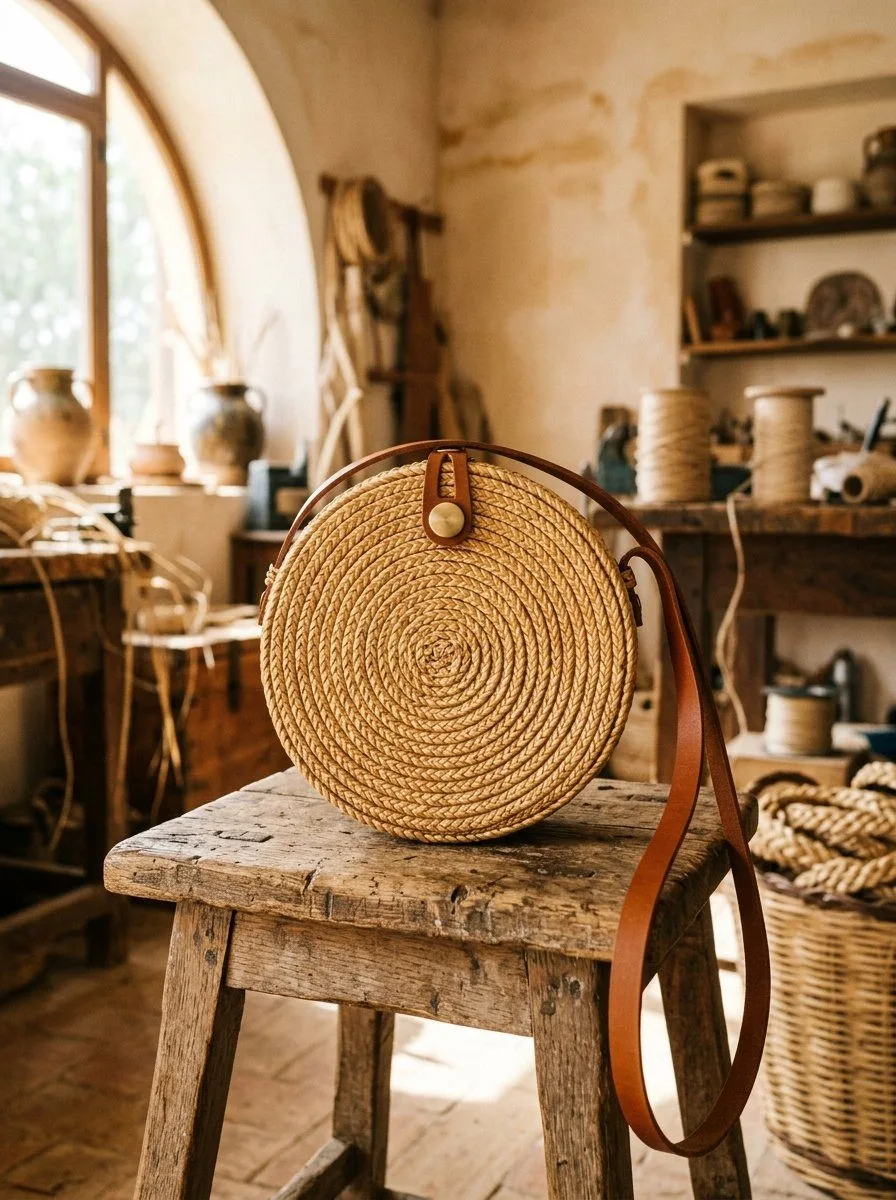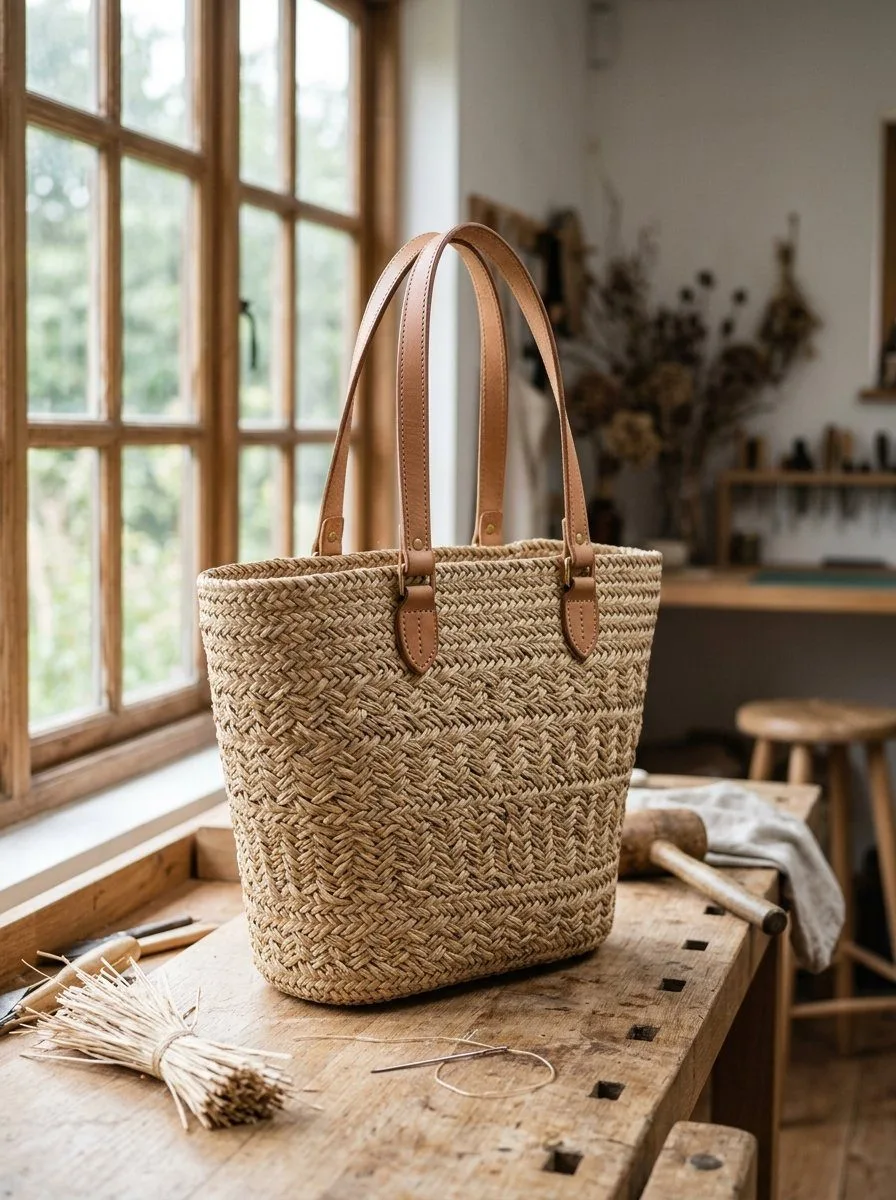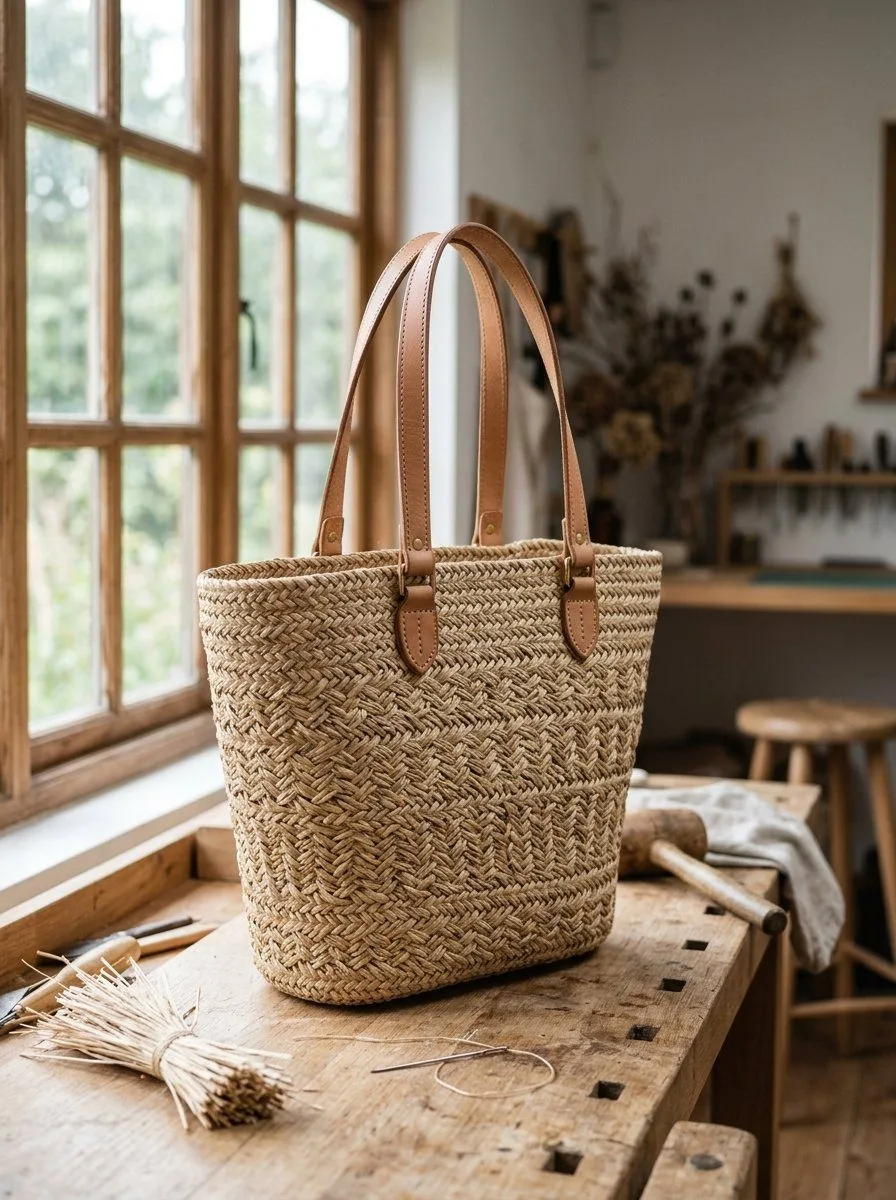
A tote is the most ordered bag we make and the one most likely to disappoint. Not because it was badly made — because the buyer and the workshop were picturing different bags. Both had two handles and an open top. One stood on a table. The other folded into a suitcase.
We see a version of this in most weeks' inquiries: a photograph, a target price and the word "tote". That is a starting point, not a specification.
Tote is a family, not a shape
The word describes an opening, a base and two handles. Everything else is a decision. Change the base and you change whether the bag stands. Change the weave and you change how it drapes. Change the handle join and you change how much it carries before something gives.
In our sample room, the pair that starts this conversation is usually two natural straw totes, both undyed, both around 35cm wide. One has a flat unstiffened base and a loose weave; it folds and slouches. The other has a gusseted base, a tight weave and a lined body; it stands empty. Same fibre, same colour, roughly the same size. Different products.
That is why a photograph is a weak brief. It shows the outside of one of them.
The four decisions that define a tote
| Decision | What it changes | What to write on the spec sheet |
|---|---|---|
| Base | Whether the bag stands, folds flat, or sags under load | "Stands when empty" or "packs flat"; gusset depth |
| Handle join | How much weight the bag takes before the join moves | Woven-through, stitched, riveted or reinforced; seam allowance |
| Weave and drape | How firm the surface feels and how the body behaves when set down | Tight, medium or open; firm or soft hand |
| Lining | Interior structure, weight, and whether the inside is finished | Lined or unlined; lining fibre and colour; pocket layout |
| The handle join is where a cheap tote fails first. It takes more load than any other point, and it is easy to make look right in a photo and weak in the hand. We reject any handle with movement at the fixing, loose thread, or stitching that has not passed through the woven layer. A handle height difference over 2cm between the two sides is also a reject. These are not cosmetic preferences; they are the load path. |
Lining is the decision buyers skip and then notice. An unlined bag shows the back of the weave and lets small objects find the gaps. A lined bag holds its shape, hides the construction and adds a component that has to be checked: no raw edges, no colour mismatch, no corner pulling away. If the styling depends on the bag looking crisp, the lining is doing half the work.
Size is a capacity decision
Totes are sold by look and bought by capacity. The two are not the same. A wide bag with a shallow base holds less than it appears to, and a photograph makes every bag look deeper than it is.
| Format | What it is for | What it has to hold | Decision that makes or breaks it |
|---|---|---|---|
| Flat packable | Travel, errands, a second bag | Phone, wallet, bottle, folded jacket | Base and handle fold without cracking |
| Gusseted day tote | Work, market, everyday | 13-inch laptop or tablet, notebook, pouch | Gusset depth and a base that does not sag |
| Structured 35cm tote | Resort shop, retail, gifting | Towel, paperback, sunscreen, sunglasses | Tight weave, stiffened base, lined body |
| Oversized beach tote | Pool and beach | Two towels, a change of clothes, a bottle | Handle join and base reinforcement |
| Shoulder or crossbody hybrid | City, travel | Phone, passport, cards, small camera | Handle drop and a closure |
| Width and depth on our 35cm reference size carry a ±2cm tolerance. That is a production tolerance, not a promise about volume. Check the opening: the mouth is what decides whether the towel goes in easily, regardless of body width. Handle drop is confirmed per style, because "shoulder bag" means different things to a 160cm and a 180cm wearer. |
Fibre and weave follow the job
Raffia is soft, drapes and takes colour evenly; it makes the softer end of a tote range. Natural straw is crisp and holds a line, so it makes the bag that stands on its own. Paper straw is smooth and uniform, which suits a style that has to repeat exactly across a range.
Weave does the rest. A tight weave gives a firm surface and a cleaner edge; an open weave gives movement, light and a softer body. At the same 35cm silhouette, the two behave nothing alike.
The time follows the structure rather than the size. A simple small bag can be about 2 hours of handwork. A structured handbag is closer to 20 hours. Fine crochet can pass 100 hours. That is why "the same tote in a cheaper weave" is not a small change; it is a different construction and a different cost base.
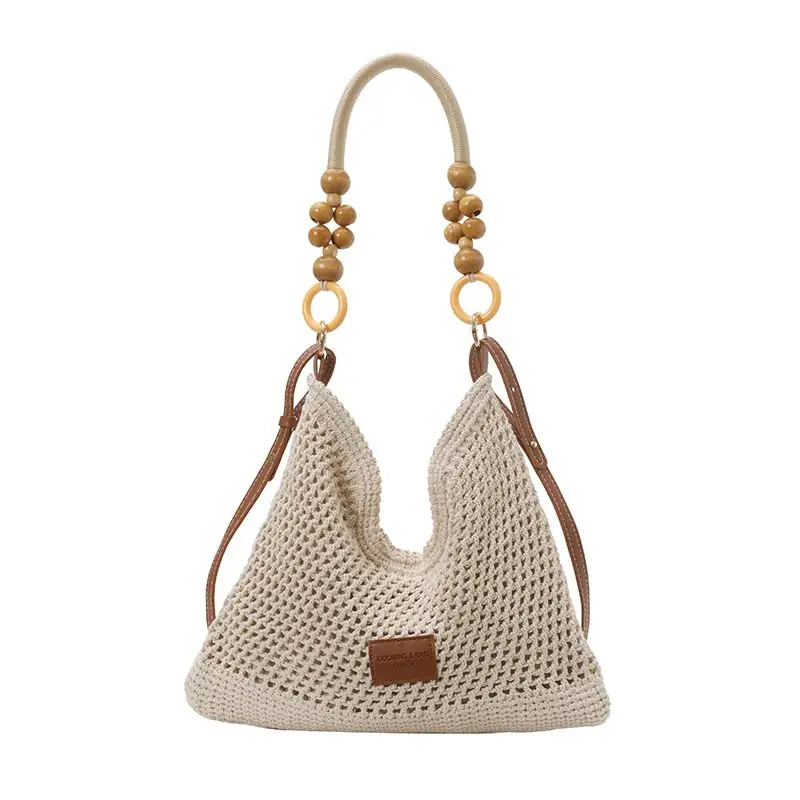 Drape is a construction decision. This crochet body is made to collapse; a tight flat weave at the same size would stand.
What to specify, in order
Send the answers as sentences, not adjectives. "Soft" means something different to a designer and a sample maker.
- What goes in it. Name three objects, not a category.
- Must it stand when empty? Yes or no; this decides the base.
- How is it carried? Hand, shoulder or crossbody; confirm the drop.
- Firm or soft surface? Tight, medium or open weave.
- Lined or unlined? And what the lining must do.
- Fibre. This follows from the five answers above, not the other way round.
- Quantity and repeat. One style or a range, and whether a second lot has to match.
The ten-minute fill test
When the sample arrives, do not judge it on a table. Fill it with the three objects from your brief, pick it up by one handle, then both, and set it down. Look at the base.
Almost every tote problem appears in that sequence: a base that sags, a join that creeps, a body that folds inward and closes the opening. An empty bag hides all three.
Our incoming check is equally short: handle height within ±1cm, no more than 2cm difference between the two handles, no movement at the fixing, and no visible gap over 2mm in the body. A 1mm gap at the mouth is acceptable; a 2mm gap in the body is not. Then empty it and look inside. A lining that has pulled away at a corner will not improve with use.
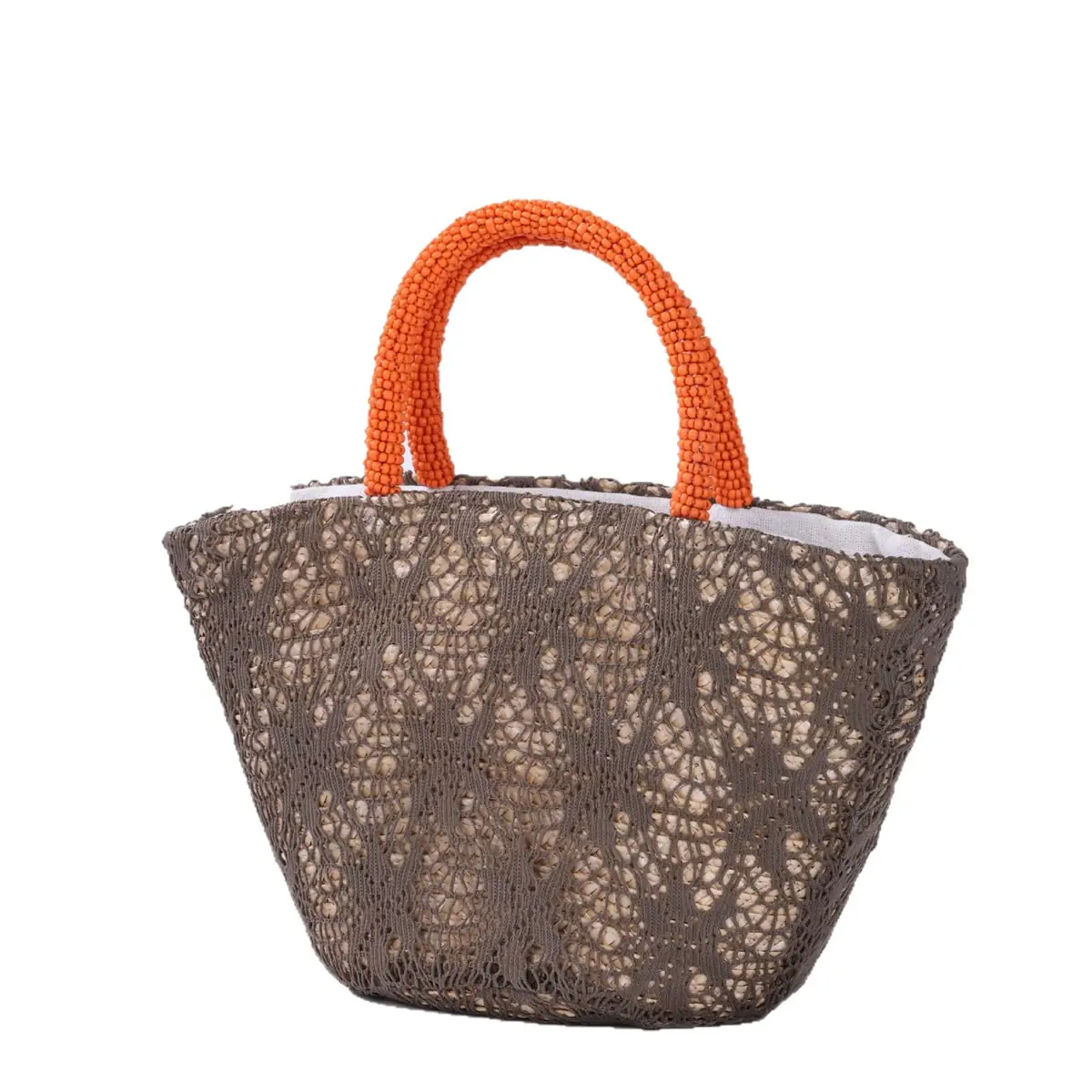 An open weave and a contrast handle are the two things a photo shows. Neither tells you whether the base holds under load.
When a tote is the wrong shape
Totes are poor at three jobs: security, heavy daily loads and evening. An open top is wrong for a commuter carrying a laptop through a city, and adding a zip and a padded sleeve turns the bag into something else. If the brief needs a secure, compact bag, start from a zip-top or flap construction rather than shrinking a tote.
The soft, packable souvenir is the other mismatch. A structured 35cm tote is the wrong answer for a bag that has to fold into a suitcase; a flat base and a loose weave are the right one.
None of this makes the tote a bad structure. It makes it a specific one.
The first order
We would rather see four styles at MOQ 100 than 200 pieces of one shape. Two of the four in a lower price band and two higher give you a read on the market before the season commits you.
Sampling runs 10–15 days. Bulk runs 30–45 days after approval, and 45–60 if you add custom dyeing or a new mould. Orders placed in January and February land for the March–July peak. Freight belongs in the landed cost: a filled tote does not pack as tightly as a flat one, and volumetric weight can add 20–30%.
Where to go next
Common questions
- What size should a handwoven tote be?
- Size follows the job: a market tote needs capacity, a commuter tote needs a defined base and a closure. State the dimensions, and the fill test will confirm them.
- What is the difference between a tote and a shopper?
- In practice, little. A shopper usually has a wider opening and a shorter handle drop; a tote can be open or closed and may have a structured base.
- How do I choose a tote for my range?
- Decide capacity, base structure, handle drop, closure and fibre, in that order. Each decision narrows the pattern and the cost.
Fibre-by-fibre specifications are in wholesale tote bags; the wider comparison is in the woven bag material guide. Wholesale covers how an order runs, and if the tote has to be your own structure rather than an adaptation, that is custom development.
Start with the three objects you named in the brief. They settle more format questions than any reference image.
See the straw totes we currently produce in this range.