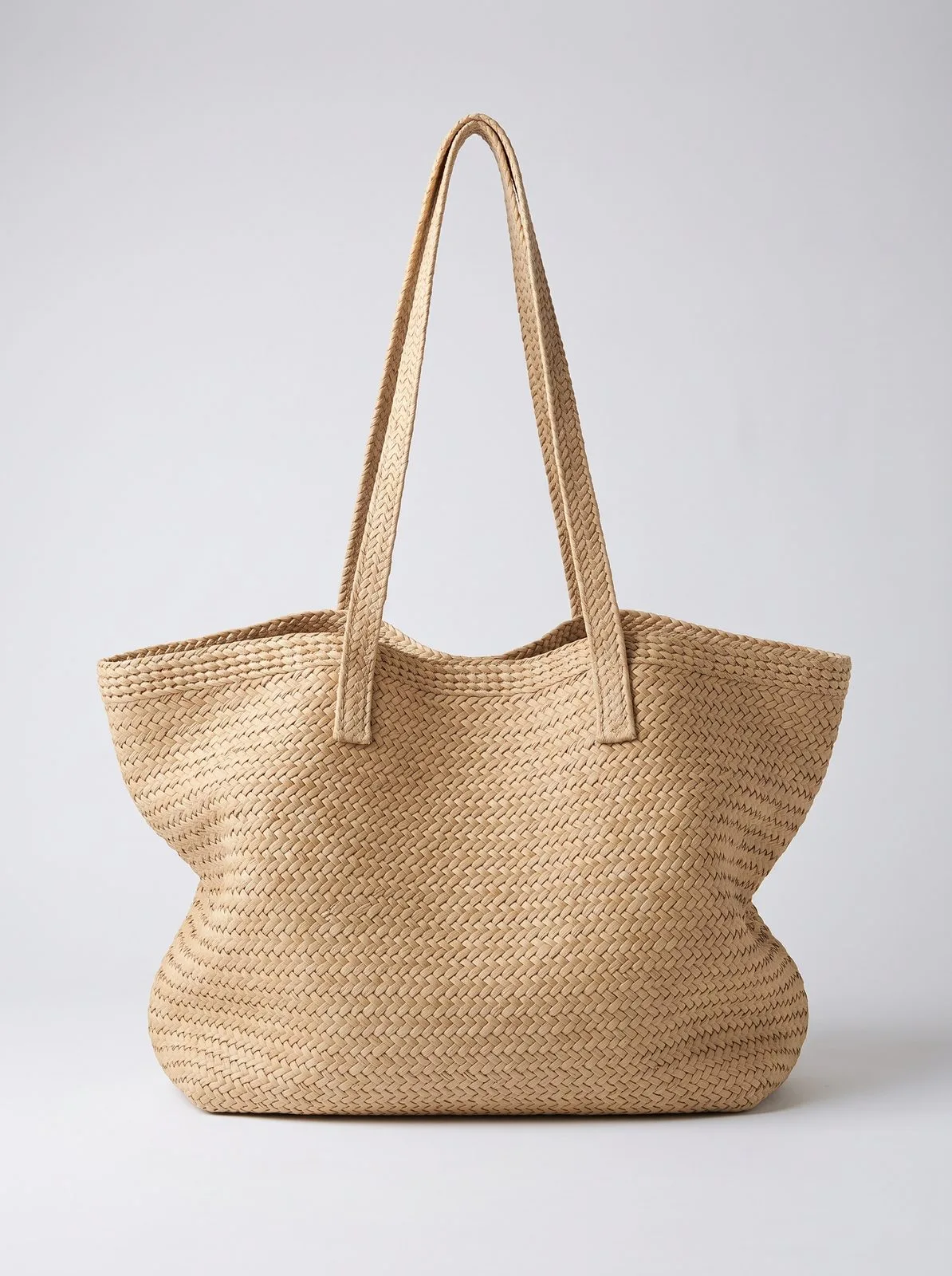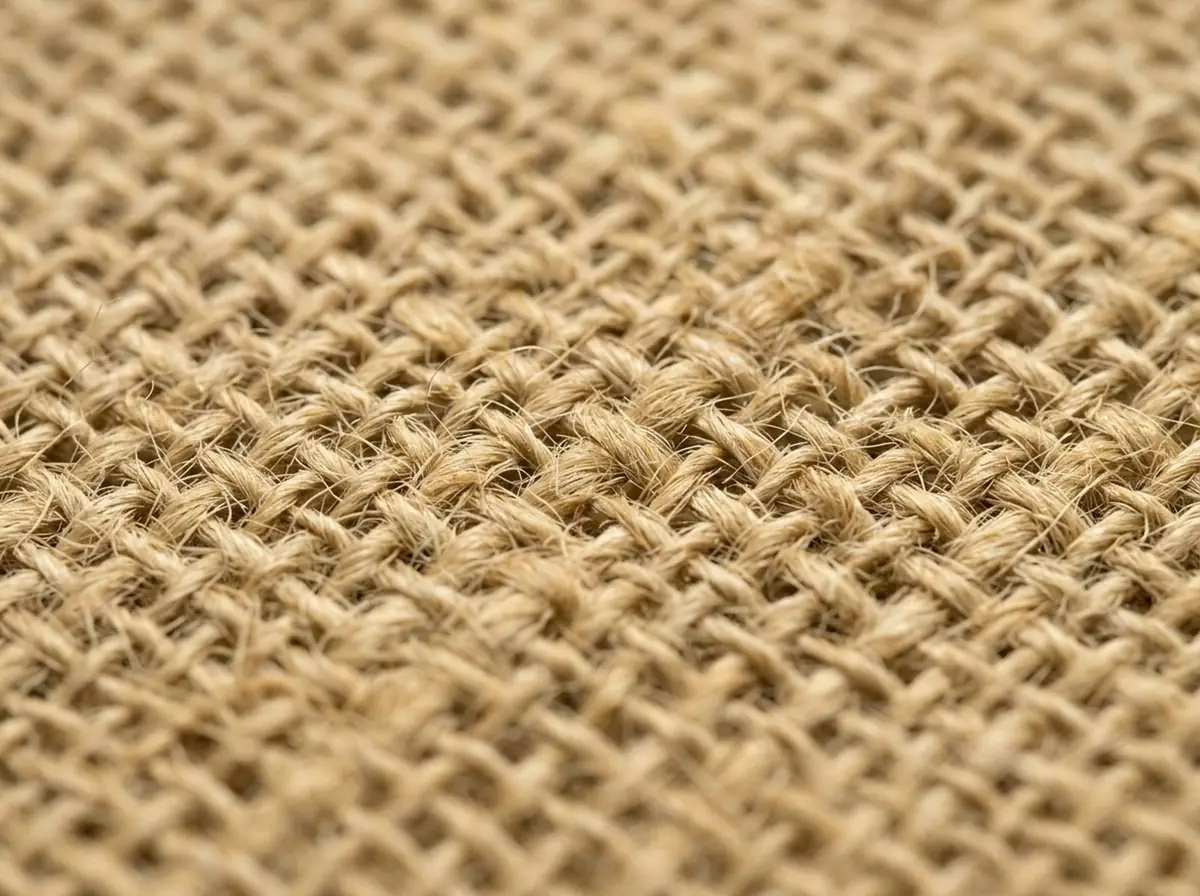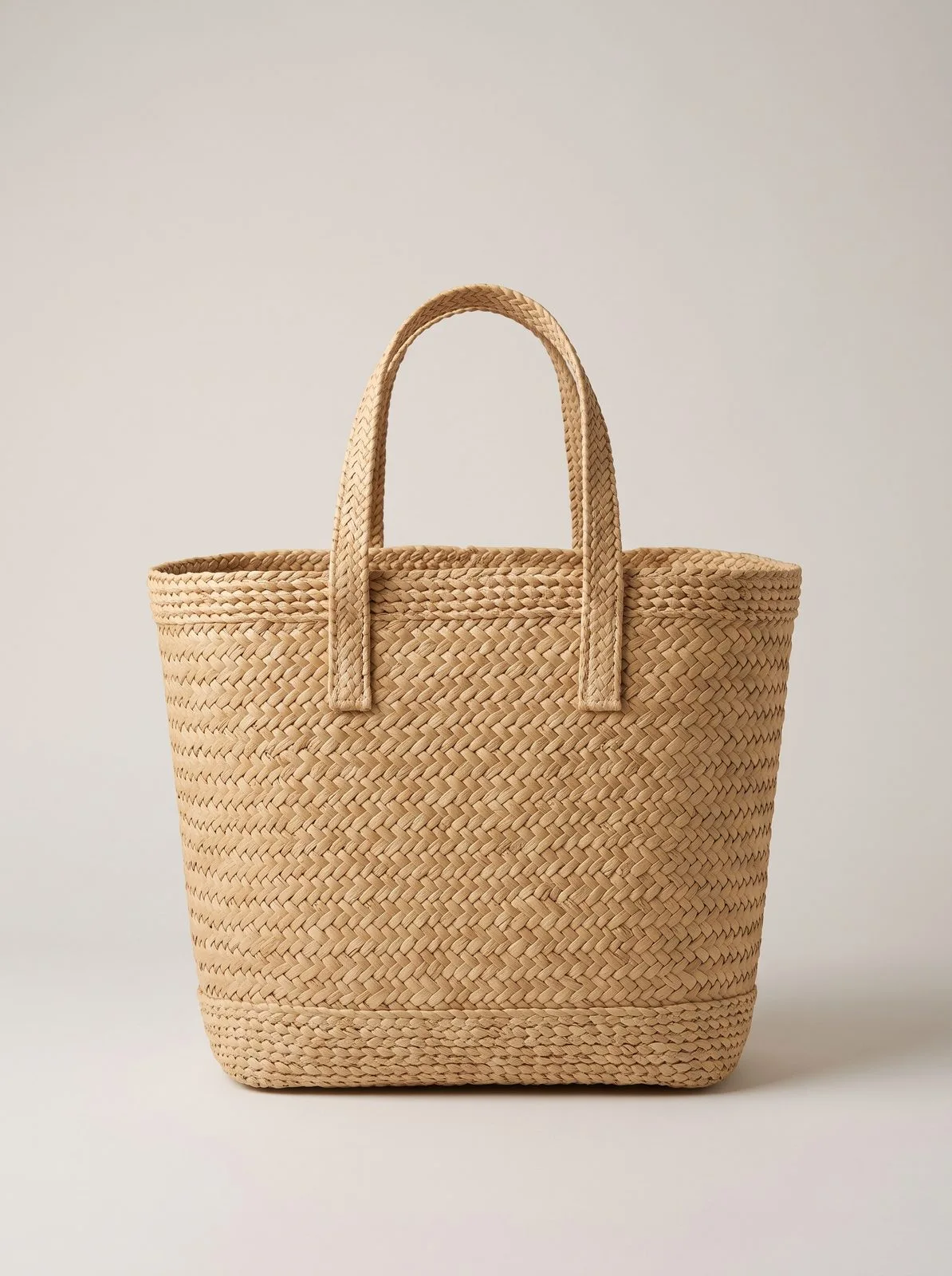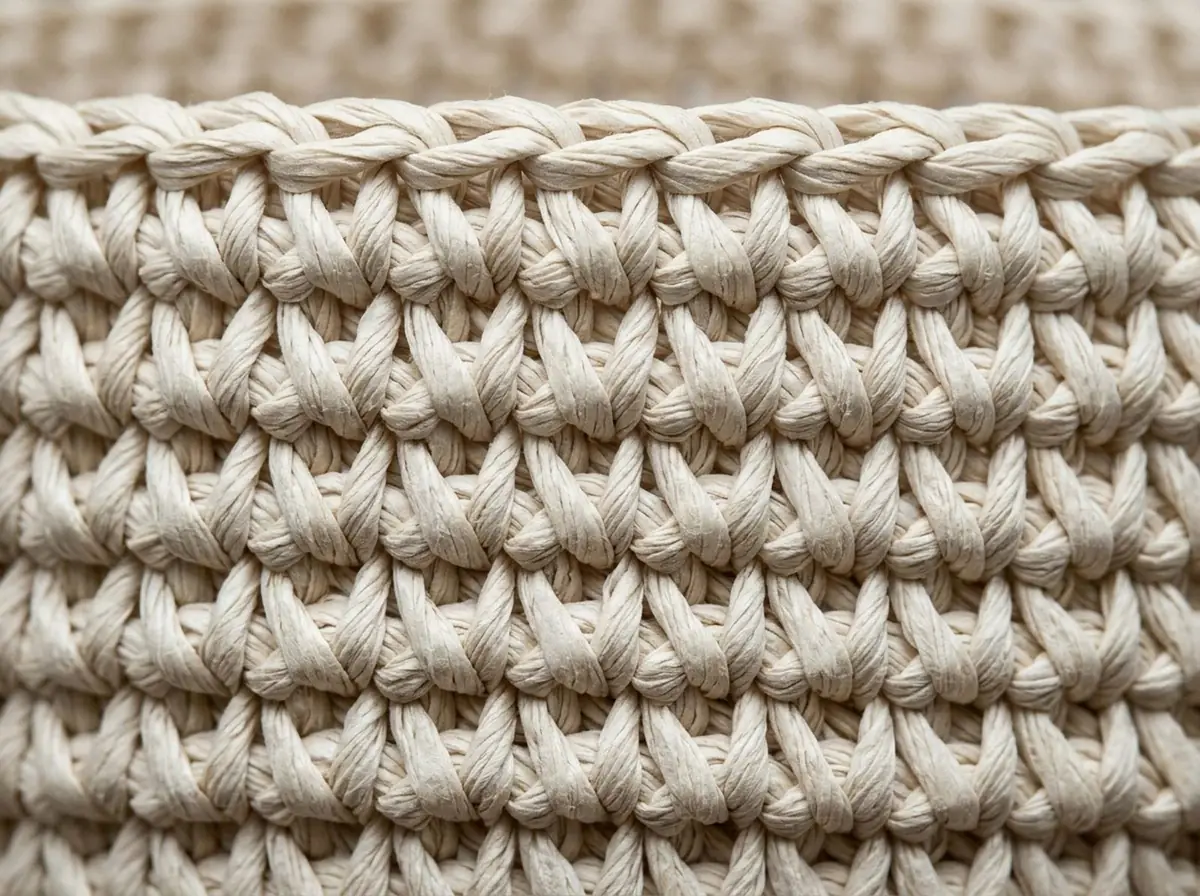
Paper straw is the fourth fibre in most handwoven ranges and the one that causes the most confusion in a first meeting. Buyers often assume it is a grade of natural straw, or a bleached raffia. It is neither. It is paper, made to a sheet, slit into narrow strips and twisted into cord, then woven the way a plant fibre is woven.
That difference sounds small on a spec sheet. It changes how the bag behaves, how the colour repeats, and what you can honestly say about it.
What paper straw actually is
Paper straw begins as paper made to a controlled thickness, then slit into strips of a set width. The strips are twisted into cord, or left flat and woven as a tape, and the cord is what goes on the frame.
The words overlap, which is where the confusion starts. "Straw" on a product page can mean the plant — wheat or rice stems, braided grass, seagrass. "Paper straw" also names the drinking straw in every café. Neither is what is in the bag. The quickest test is the strand itself: a natural strand tapers and thickens along its length and carries the marks of the plant, while a paper strip holds one width from end to end.
At arm's length the two read alike. At 30cm, in a tight weave, they do not.
The other lookalike is synthetic ribbon, usually polypropylene. It is brighter, it springs back when folded, and it does not crease the way paper does. On a hanger the difference is obvious; on a website it is not, which is why a sample matters more than a photograph for this fibre.
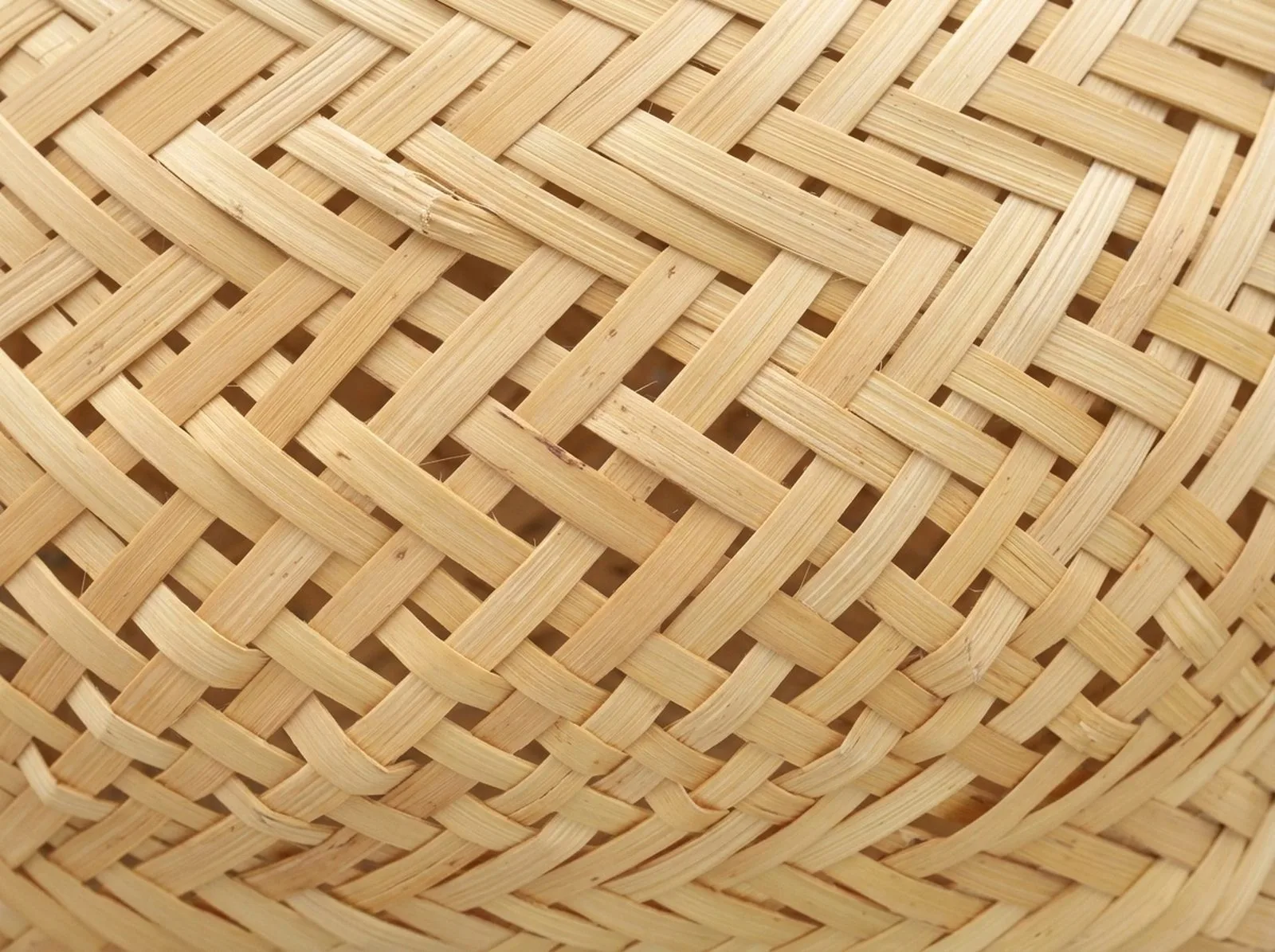 Braided natural straw for comparison: the strand varies along its length, and the plait records that variation.
Why it behaves more predictably
Three properties follow from how the material is made.
Consistent width. A paper strip is cut to a width and stays at it. In a tight weave that reads as an even surface, without the small thick-thin rhythm natural fibre has.
Consistent supply. Natural fibre is graded after harvest. We lose 25–30% of raffia in sorting and drying, and fresh raffia arrives at around 40% moisture, yielding 200–600g of usable dry fibre per kilo. Paper arrives dry, at a known width and weight. There is less to discover on the day.
Repeatable colour. Paper takes dye cleanly and repeats closely. On a seven-colour range across three seasons, the paper straw pieces are the ones that come back matching the card; the raffia pieces are the ones that need a conversation.
That predictability has a cost that is not financial. Paper has less give. It creases at a sharp fold and does not recover the way a plant strand does, so corners need a radius and the pattern has to be drafted for it.
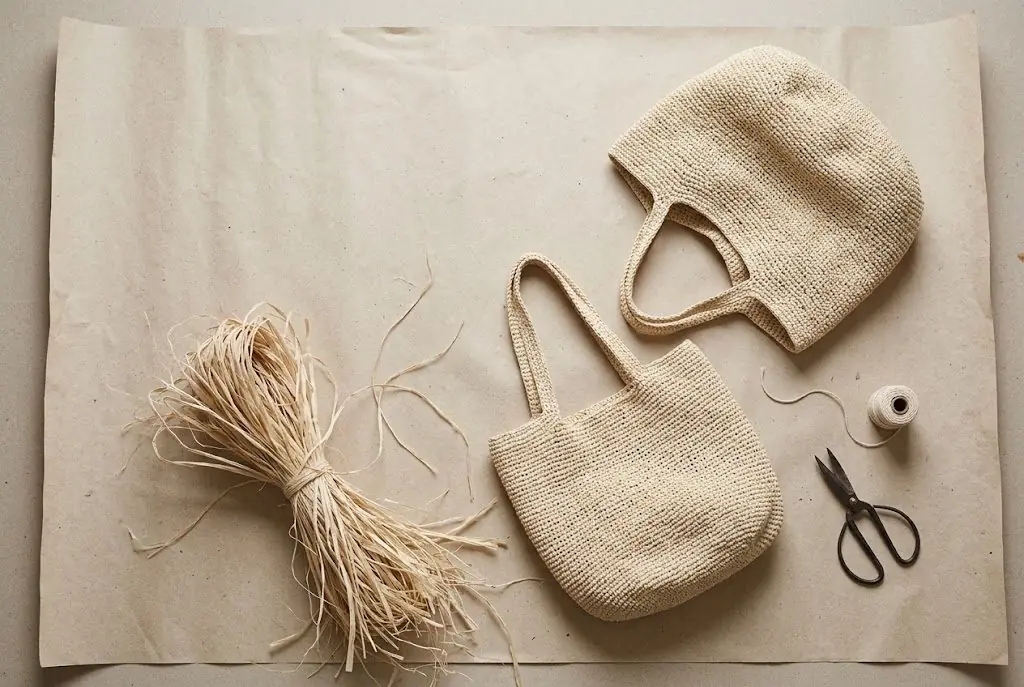 Raffia strands beside finished work: the variability is in the fibre before it is ever woven.
Four fibres, side by side
| Paper straw | Raffia | Straw / braided grass | Jute | |
|---|---|---|---|---|
| Consistency between batches | High | Moderate | Low to moderate | Moderate |
| Strand width | Uniform | Tapers | Varies by plait | Fairly uniform, hairy |
| Dye take-up | Clean, repeats closely | Even for a plant fibre, drifts between lots | Uneven, often best left natural | Earthy, hard to shift |
| Behaviour when wet | Softens, must dry flat | Tolerates damp, can spot | Can spot and stiffen | Swells, smells if stored damp |
| Structure | Firm, creases at sharp folds | Springy | Stiff, holds shape | Soft, heavy |
| Best for | Tight, precise, repeat ranges | Premium surfaces, colour | Structure, open weaves | Rustic bodies, handles, trim |
| The comparison is honest in both directions. Paper straw wins on repeatability and loses on character. Raffia wins on character and loses on repeatability. A range that needs both usually carries both. |
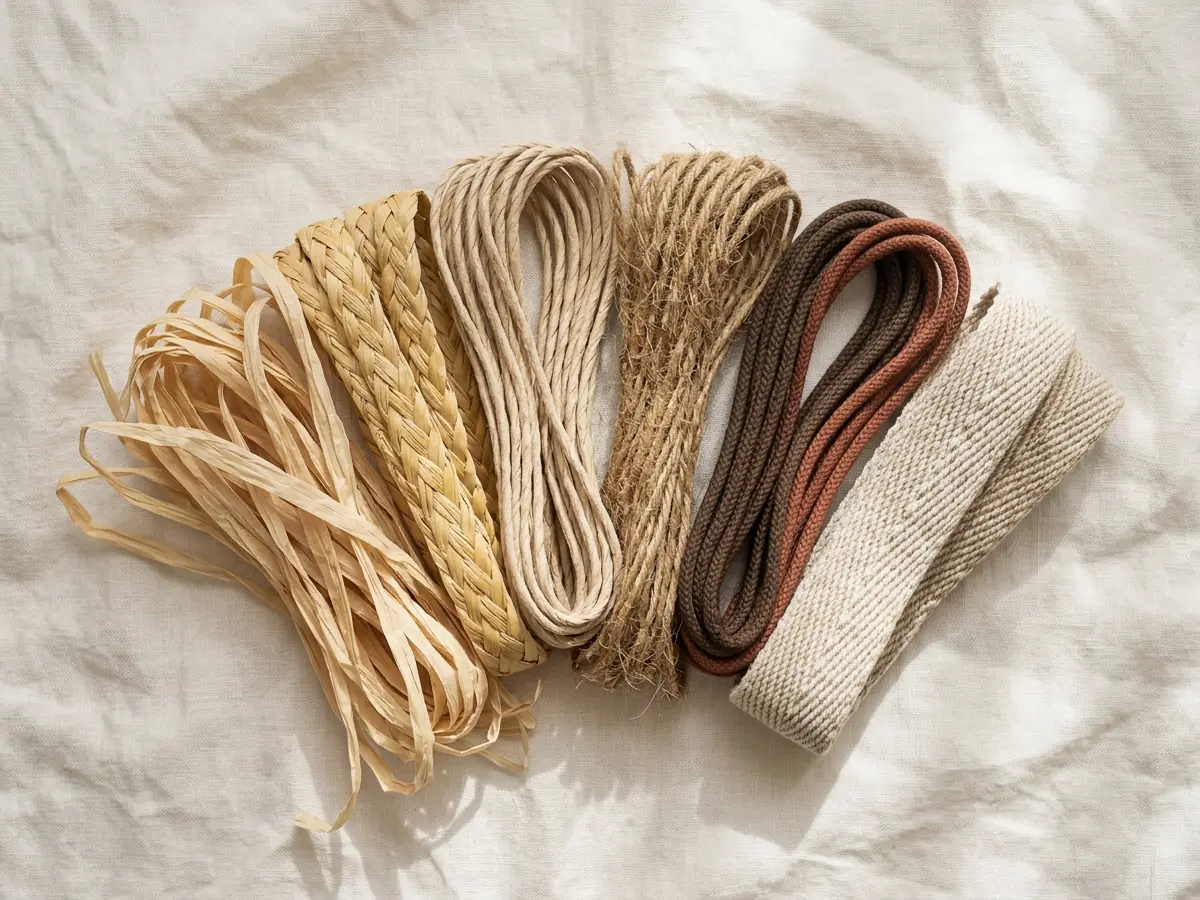 Paper straw, raffia, braid and engineered cord side by side: the difference is in the strand.
What paper straw does not do
It does not read as wild. Paper straw looks precise. If the brand's promise is "pulled from a field", the bag will contradict the copy, and no amount of styling will fix that.
It does not like water. Paper-based cord softens when soaked and takes time to dry flat. A resort bag in paper straw is fine for towels and sunscreen. It is not fine for a wet swimsuit left inside overnight, and the care card should say so.
It is not a natural-fibre claim. It is plant-derived and heavily processed. Describing it as the same material as raffia is misleading, and in some markets the word "paper" now signals single-use, which is the opposite of what a bag at this level is selling.
It does not hide a repair. A splice in paper cord is neat but visible close up. If the design has a large unbroken front panel, plan the weave so the splice lands on a seam.
Where it earns its place
In most ranges we see, paper straw is not a substitute for natural fibre; it is used beside it. The precise pieces go to paper, the irregular pieces go to raffia or braid. The range ends up with a consistent core and something with a grain.
It is also the fibre that makes a large colour range practical. Eight colours in raffia means eight dye lots to reconcile across a season. Eight in paper straw is a schedule, not a negotiation.
The material guide sets the fibres side by side in more detail, and the straw bag range shows how the two are mixed in production.
How to specify it
Paper straw is easy to specify badly, because the name covers twisted and flat, several widths and several paper weights. A brief that names only the fibre leaves the rest to the workshop.
Fibre: paper straw cord, twisted, 3mm nominal
Colour: 2 colours, matched to physical card
Weave: medium, gaps ≤1mm at mouth
Splices: not on front panel
Lining: cotton twill
Handles: same cord, double, anchored through weave
Finish: no visible glue at edge
MOQ is 100 pieces per style. Engineered cords are quoted from 100–300 depending on the cord, so confirm the band before you cost the range. Sampling runs 10–15 days, and one revision round usually follows at 5–7 days.
How to check a paper straw sample
Five checks, in this order.
- Strand width. Measure several strands at different points on the panel. A paper cord should hold its width; if it varies visibly, the slitting was inconsistent.
- Splices. Turn the bag inside out. Every splice should sit on a seam or under a handle, not on the front panel.
- Creases. Fold a corner the way the finished bag folds, press for ten seconds, release. Paper that holds the crease will hold it on the shelf too.
- Colour against the card. Check in daylight and under shop light. Paper repeats closely, but it still needs a physical card, not a JPEG.
- Handle anchor. Pull each handle firmly. Any give at the anchor is a reject, the same as on any other fibre.
If a supplier cannot tell you the cord width and the splice policy, the sample is not ready to approve.
When paper straw is the wrong choice
Choose it when you need a consistent surface, a wide colour range, a geometric shape, or repeat orders that must match. Choose something else when the surface itself is the product — an irregular, slightly unruly weave that photographs as texture. A luxury bag whose value rests on the look of a hand-pulled fibre should not be made in paper straw, even though it can be.
The line is not about quality. Paper straw is not a cheap substitute in the way buyers sometimes assume; it is a different material with different behaviour.
Buyers who understand the difference tend to use it deliberately, and their ranges are better for it. Name it accurately on the product page, too: "paper straw" is concrete and defensible, while "natural straw" is not, and the buyer who discovers the difference after delivery will not read the rest of your copy.
Common questions
- What is paper straw?
- Twisted paper cord used as a weaving fibre. It is more uniform than natural straw and takes dye evenly, which makes it predictable in bulk.
- Is paper straw durable?
- It is strong in dry use but weakens faster than raffia or straw when it stays damp. It suits lined bags and dry climates better than wet ones.
- Paper straw vs raffia — which should I choose?
- Paper straw for consistency and colour control; raffia for texture, fold and a natural premium. The shape and the price band decide.
If you are unsure which side of the line a design falls on, send the sketch and the colour direction to our team. We will tell you what the fibre will do before anyone spends a sample on it.
See the straw bags we currently produce in this range.