A handwoven bag is not made in a single act. It is made in six, and the order does not change: fibre is graded, prepared, woven, assembled, inspected, packed. What changes between one order and the next is how long each stage takes, and which of them is likely to go wrong for the bag you have specified.
That is the useful part for a buyer. When a shipment arrives and something is off, the sequence tells you where to look, and whether the fault was set in the fibre, in the dye bath, at the bench or in the carton. A colour fault and a handle fault are not the same kind of problem. One can be corrected with a new lot and a new approval. The other is corrected by rework, if it can be corrected at all.
Each stage below gets four questions: what happens, how long it takes in the measure that actually matters, what goes wrong, and what you can see from the outside. The fourth question is the reason to read the rest.
| Stage | What it produces | Time, as it actually works | The failure that starts here |
|---|---|---|---|
| 01 Fibre intake | graded, dried, traceable lots | no fixed clock; moisture decides (fresh raffia ~40%) | mould, inconsistent hand |
| 02 Preparation | strip, coil, colour-sorted material | folded into per-piece hours; 200–600 g usable per kg fresh | joins, width drift |
| 03 Weaving | the body | ~2 h pouch · ~20 h structured bag · 100 h+ fine crochet, per piece | gaps, tension, soft base |
| 04 Assembly | handles, base, lining, trim | per piece; the handle anchor is the load-bearing joint | handle failure, collapsed base |
| 05 Inspection | a pass or fail per piece, plus a batch record | every piece, plus 5% of cartons (minimum 10) | defects that reach the carton |
| 06 Packing | a shippable order | inside the 30–45 day bulk window; 45–60 with custom dye | damp, mislabels, crushed goods |
| Not every stage has a clock in the usual sense. Saying so is more honest than inventing one. |
01 · Fibre intake and grading
Fibre arrives in bales or sacks and is inspected before anything is cut. The checks are physical: moisture, strip thickness, how much of the delivery is short or uneven, and whether the colour is even enough to use on a face panel. Fresh raffia can arrive at around 40% moisture. At that level it cannot be cut cleanly. The strips tear along the grain, and a torn strip becomes a join later.
Two numbers govern the stage. Drying brings the fibre down to a working moisture, and the yield from that drying is wide: 200 to 600 grams of usable material from a kilo of fresh fibre. Grading and preparation lose 25–30% of the raw weight — short fibres, uneven strips, joins that cannot sit on a visible panel. The practical result is that the same finished bag can require two to three times as much raw fibre from one delivery as from another. A quote built on finished weight alone is missing that.
What goes wrong here: fibre from two deliveries mixed without a lot record; material packed damp, which surfaces as mould weeks later inside a sealed carton; and a batch that feels fine in the hand but is too short-fibred to weave at the density the sample used.
Typical time is set by moisture, not by a schedule. The stage ends when the fibre is dry enough and the lot has been graded, and in a wet week that is simply longer. No production manager can compress it without paying later.
What you can see at this stage is almost nothing, which is the point. Ask for the lot reference and the yield figure. If your second order feels different in the hand, the difference usually began here rather than at the loom.
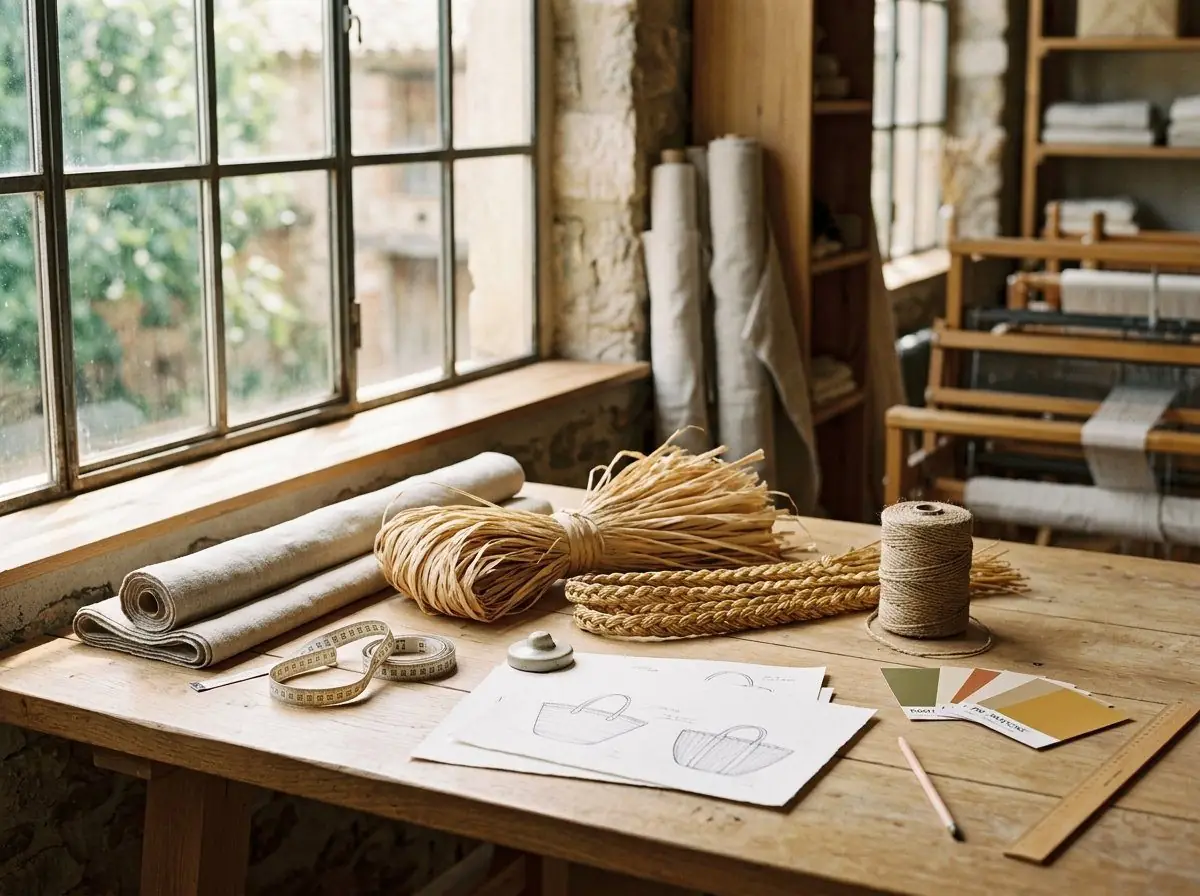
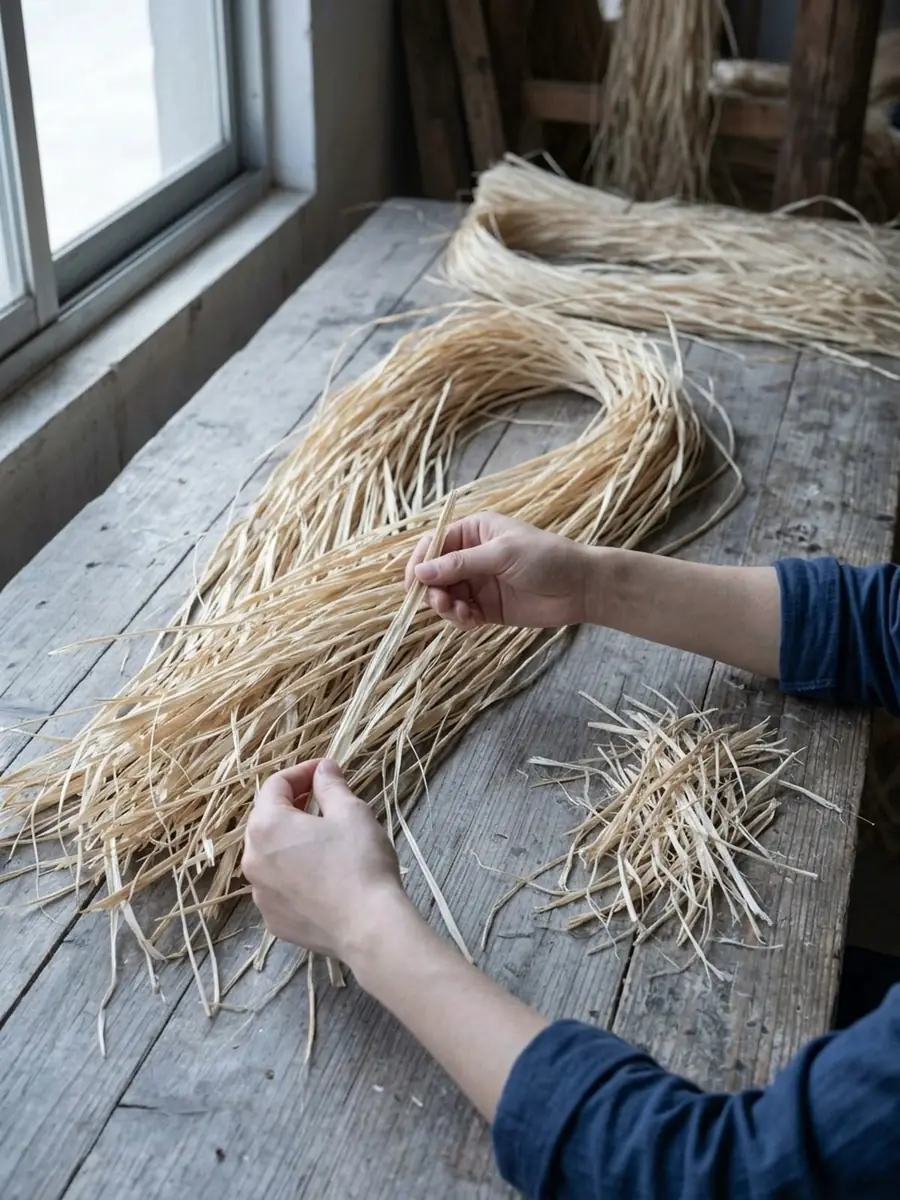 Stage one: fibre is graded and dried before a single strip is cut. A batch that fails here never reaches the bench.
02 · Preparation: cutting, sorting, colour
Preparation turns fibre into something that can be woven. Strips are cut to a working width, weak sections are removed, joins are made where they will not sit on a face panel, and colour is sorted so that one panel is not half a shade off the next. For crochet and coiled work, the strip is also wound or plied.
This stage does not appear as its own line in a quote. It sits inside the per-piece hours, and it is one of the reasons two bags of similar size can carry very different hours. A bag with long straight runs and one colour prepares quickly. A bag that needs an even tone across a large face, or a strip width held to a tight tolerance, takes far longer before the first row is woven.
Strip width is the quiet failure. A strip slightly narrower than the sample breaks under tension. One slightly wider buckles at the turn. Either produces a surface that no amount of skill at the loom can correct afterwards. Colour sorting is the second: in a natural fibre, one off-tone strip in a pale panel reads as a stain, even though nothing has stained it. Join placement is the third. A splice in the middle of a face panel is not a fault in the material, but it is a fault in the bag.
What you can see: run a thumb across the face. It should feel even in width, not ridged. Turn the bag over. Most joins belong on the back or the base, so if you can find several on the front, ask why. On a sample, look at the base corners. The turns are where strip width shows itself.
03 · Weaving
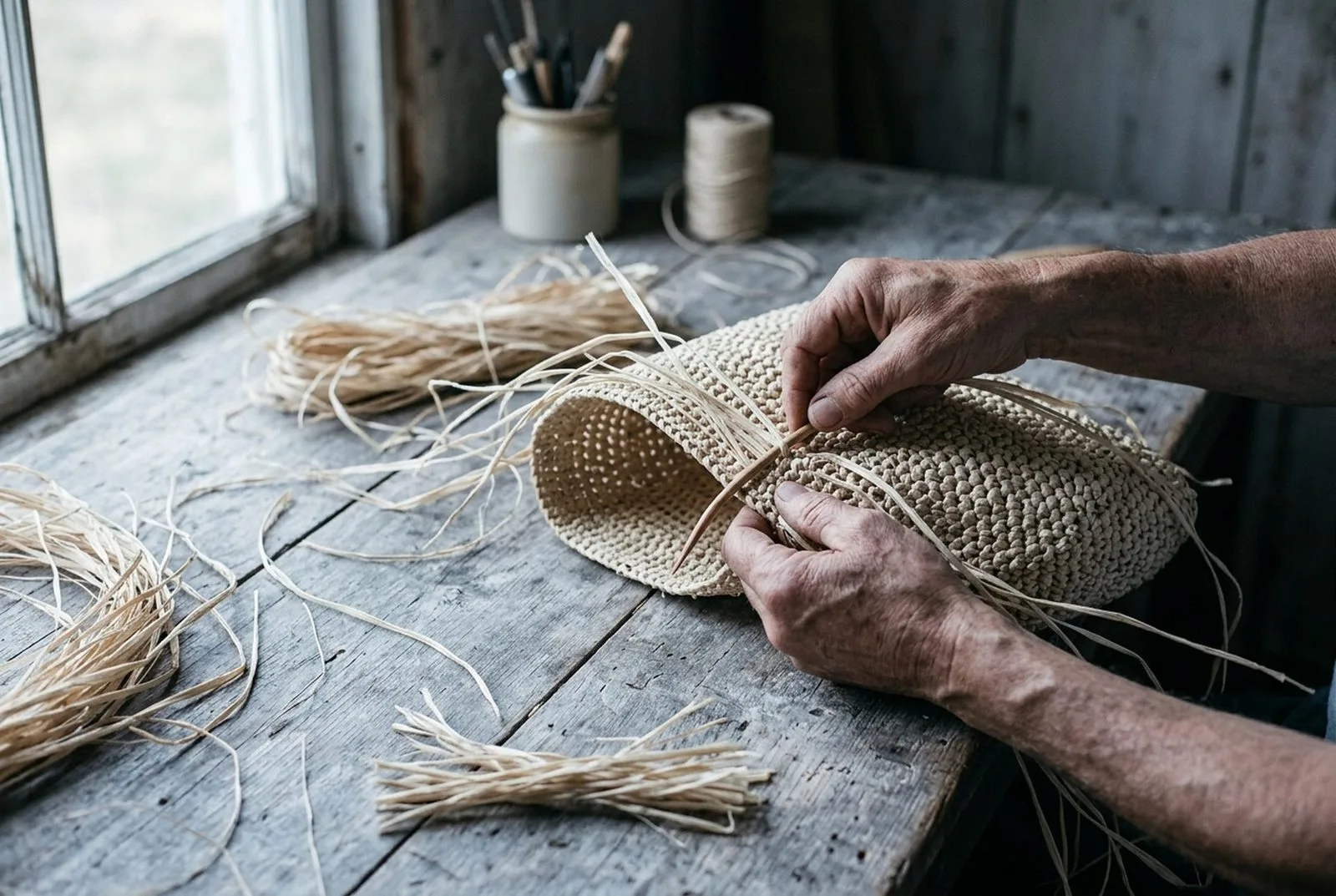
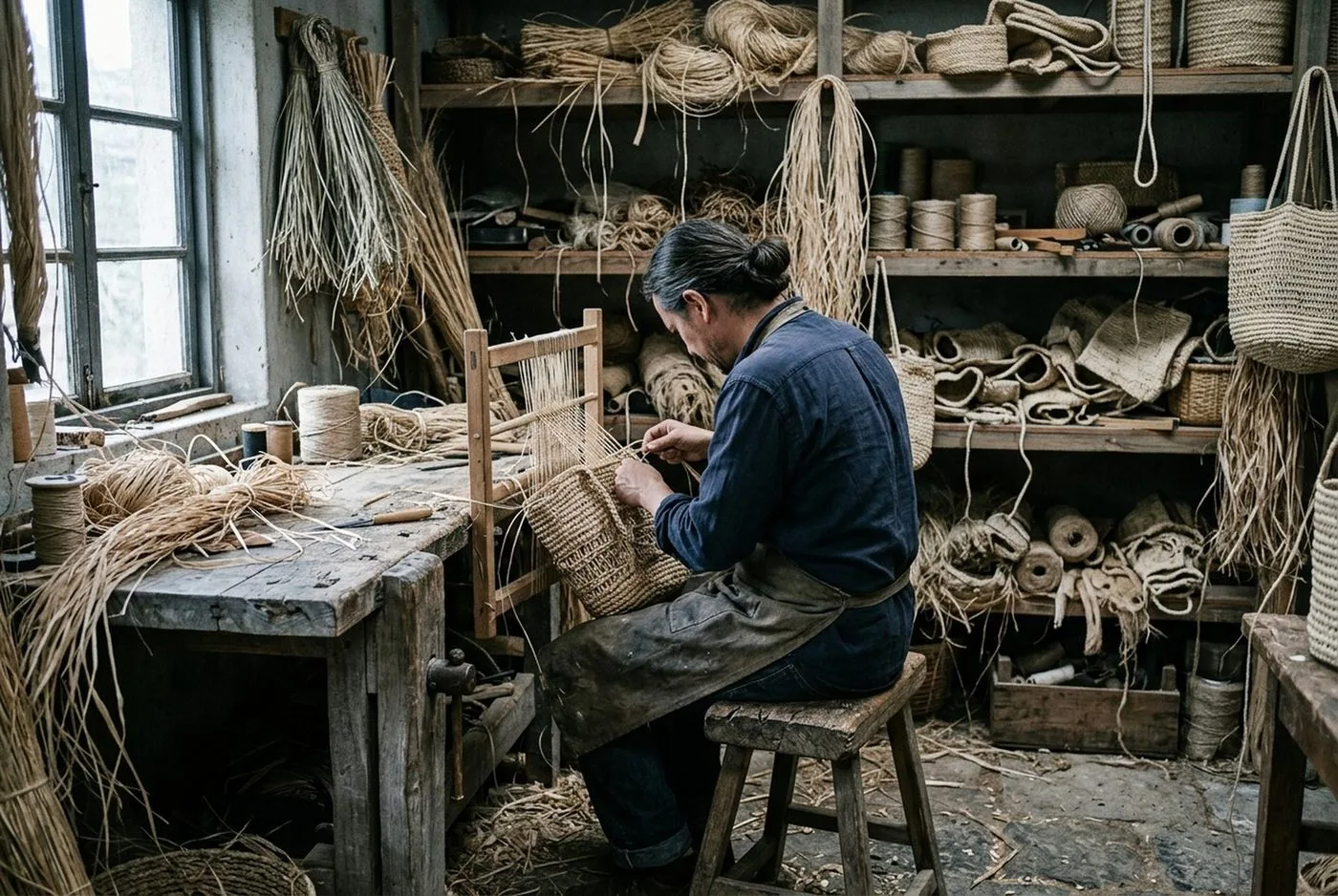
The body is built row by row. Crochet builds from a loop, plain weave crosses warp and weft, coiling wraps a core. The method decides how the bag holds its shape, and the tension is set by hand, hour after hour.
This is where the order-of-magnitude differences live, and they have little to do with size. A simple small pouch can be around two hours of hand time. A structured handbag is typically around twenty hours. Fine crochet work can run past a hundred hours for a single piece. A buyer comparing two bags of similar dimensions may be comparing two hours with twenty, and the price gap is not a negotiating tactic.
Tension drift is the common fault across a long panel. The first rows and the last rows are made by the same hands, but not in the same mood; a hot afternoon and a stiff batch both change the pull. A weaver compensating for stiff fibre by working looser produces a body that is sound but softer than the approved sample. Gaps are the visible version of the same problem. At the mouth, a hairline gap of 1 mm or less is normal in handwork and we accept it. On the body, a gap over 2 mm is a reject, because it opens with use.
Base shape is set here too. A bag that stands on the bench can still collapse when loaded, if the base rows were not built with weight in mind. That failure is invisible in a photograph and barely visible in an empty sample. Put something in it.
The argument in our workshop is rarely about whether a bag looks handwoven. It is about which gaps are allowed at the mouth and which are not allowed on the body. New buyers often ask for zero gaps. Zero gaps is machine work.
What you can see: the hand of the panel under your palm, firm with a little give, not stiff as board and not slack. Sight down the side seam; it should be straight. Load the bag and watch the corners.
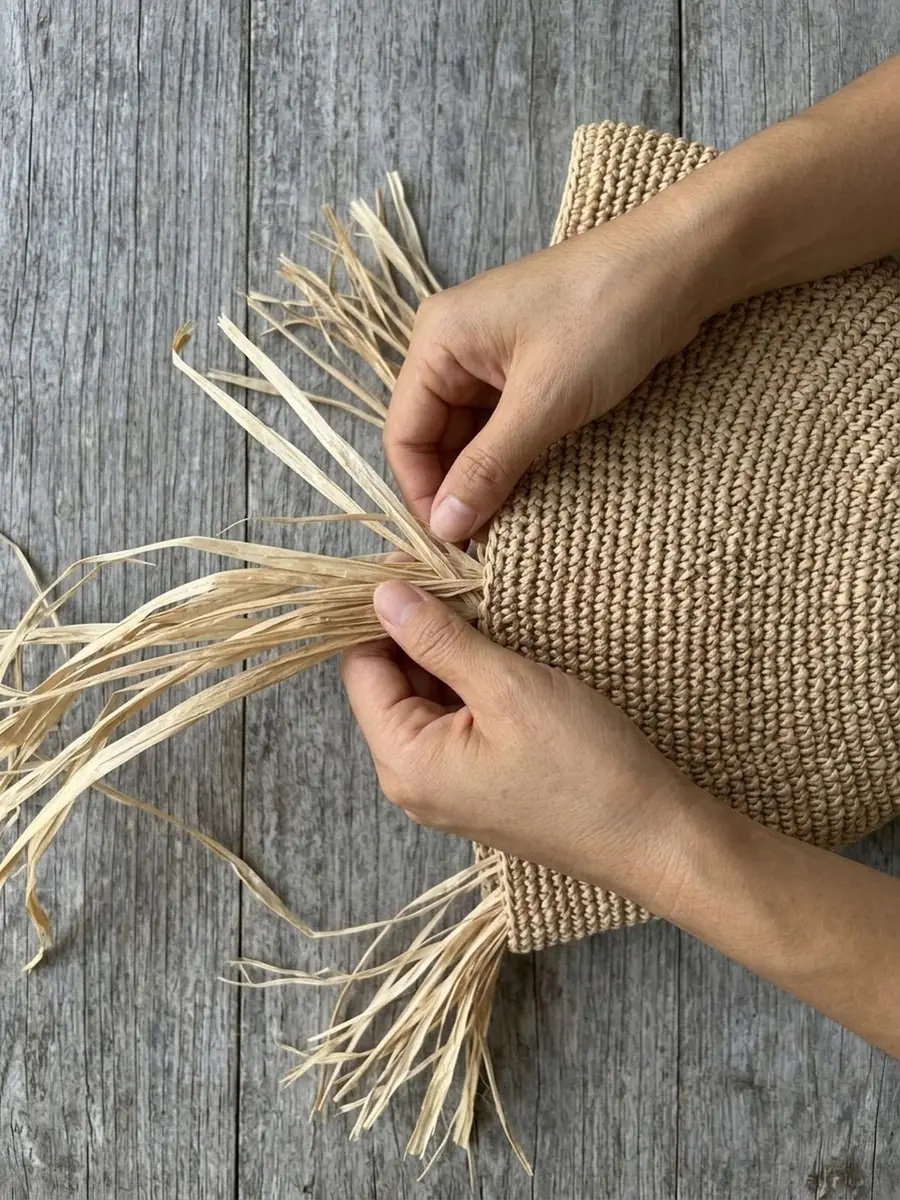 Stage three: rows are added by hand, and the tension is set by the weaver rather than by a machine.
04 · Assembly: base, handles, lining, trim
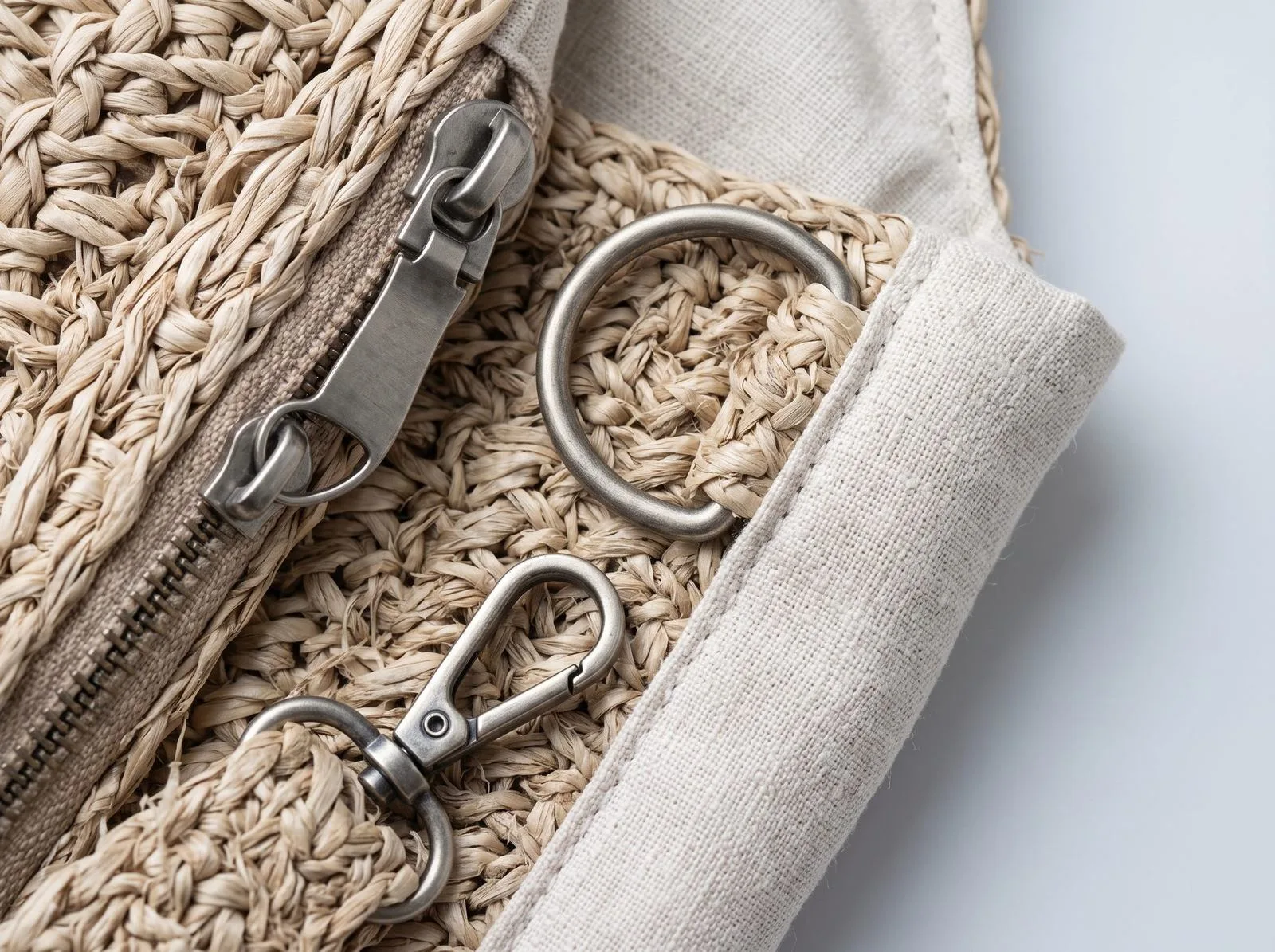
Assembly is where a woven body becomes a bag. The base is reinforced and blocked, handles are anchored, the lining is set, closures and hardware go on, and the edges are bound or rolled. Some of this is sewing. Some of it is judgement about how much a bag is going to carry.
The handle anchor is the point that takes the most load of anywhere on the bag, and it is made by hand on every piece. On a structured bag, the base and lining take longer than they look. On a soft tote, the trim is the slow part, because a rolled edge hides nothing at either end.
Three failures matter. First, an anchor stitch that passes through the surface weave but not through the layer beneath. It looks identical to a correct anchor, survives a sample review, and fails under load once the bag is in use. Second, base reinforcement built to stand but not to carry. Third, a lining set against the inside of the weave rather than into a seam; it looks right until the bag is turned out.
Our rule at this bench: any movement at the handle root, any loose thread, or any stitch that does not pass through the woven layer is a reject. Not a repair. A repair at that joint is visible, and the joint has already lost its strength.
What you can see: load one handle and lift. The bag should not tilt or crease at the root. Turn the lining out and check that it is sewn to a seam, not tacked to the inside of the weave. Run a finger along the edge binding; it should be continuous, with no cut row showing underneath.
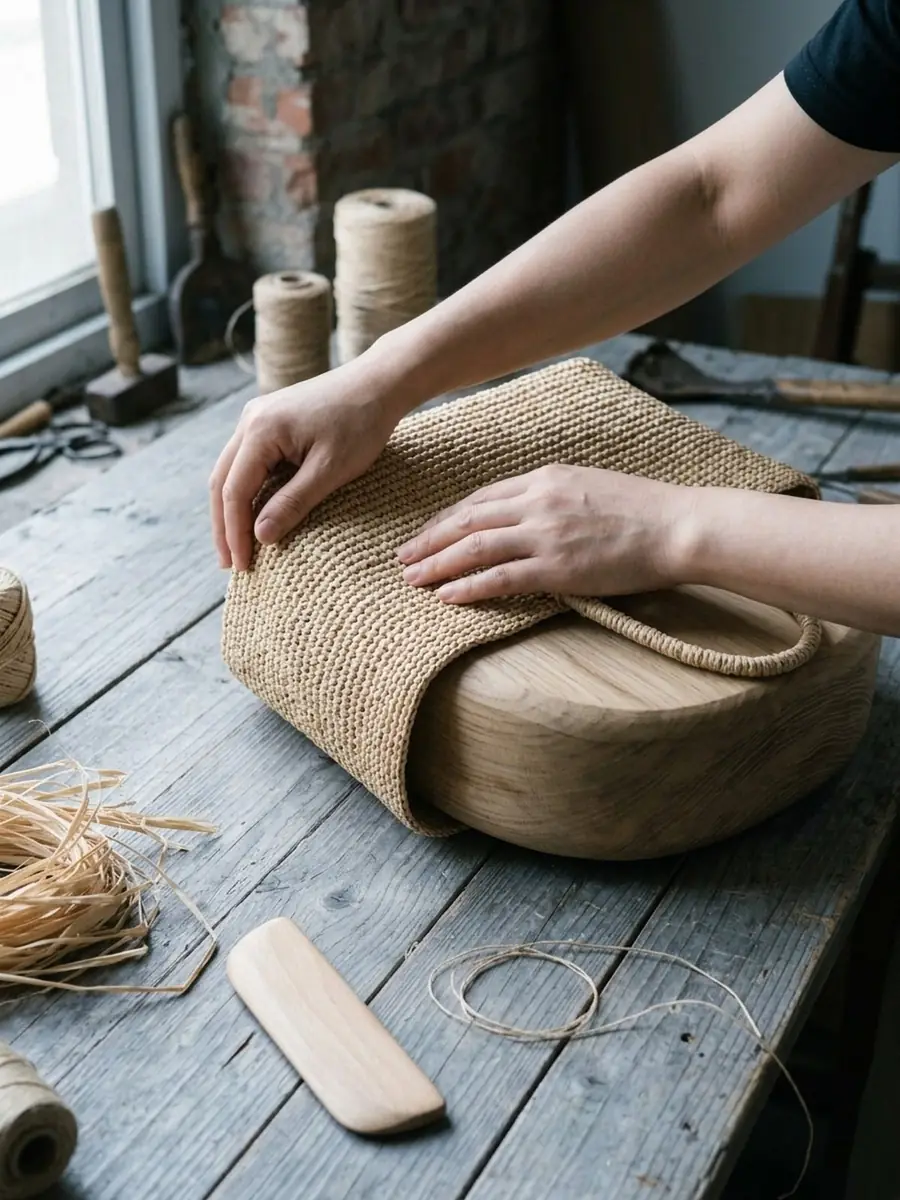 Stage four: the silhouette is trimmed and aligned by hand. The edge is where a cut row would show.
05 · Inspection: six checkpoints
Inspection is not one event at the end. We run six checkpoints, and each one exists because a defect that passes it becomes more expensive at the next.
| # | Checkpoint | What it catches | If it fails |
|---|---|---|---|
| 1 | Incoming fibre | moisture, short fibre, off-tone lots | lot rejected or re-graded before cutting |
| 2 | Dye lot against the card | batch-to-batch colour drift | re-dye, or reassign to a darker colourway |
| 3 | First-off piece | pattern errors, wrong strip width, wrong hardware | setup corrected before the run |
| 4 | In-line bench check | tension drift, gaps, row count | stop and re-set, not patch at the end |
| 5 | Final piece-by-piece | handles, lining, dimensions, closures | rework or reject per piece |
| 6 | Carton audit | pack, labels, moisture protection | repack before dispatch |
| Every piece is checked at the bench. The batch audit then pulls 5% of cartons, minimum 10 pieces, so the record reflects the run rather than the best bin. A defect rate under 5% is normal for handwork. Between 5% and 10% needs an explanation and a cause, not just a credit. Over 10% we rework or reject the lot, and the cause is almost always upstream at stage 1, 2 or 3 rather than at the bench where it was found. |
Dimensions belong here because they are measurable. At 35 cm bag width and depth, the tolerance is ±2 cm. Handle height is ±1 cm. A difference of more than 2 cm between the two handles is a reject, because the bag hangs crooked and the customer feels it before they see it.
What you can see: the inspection record, the measured dimensions against the spec, and the defect rate with its cause. Whether the record exists matters more than the rate itself. A maker who checks at each gate can tell you where a problem started. A maker who only inspects at the end can tell you there is a problem, but not why, and the next order will repeat it.
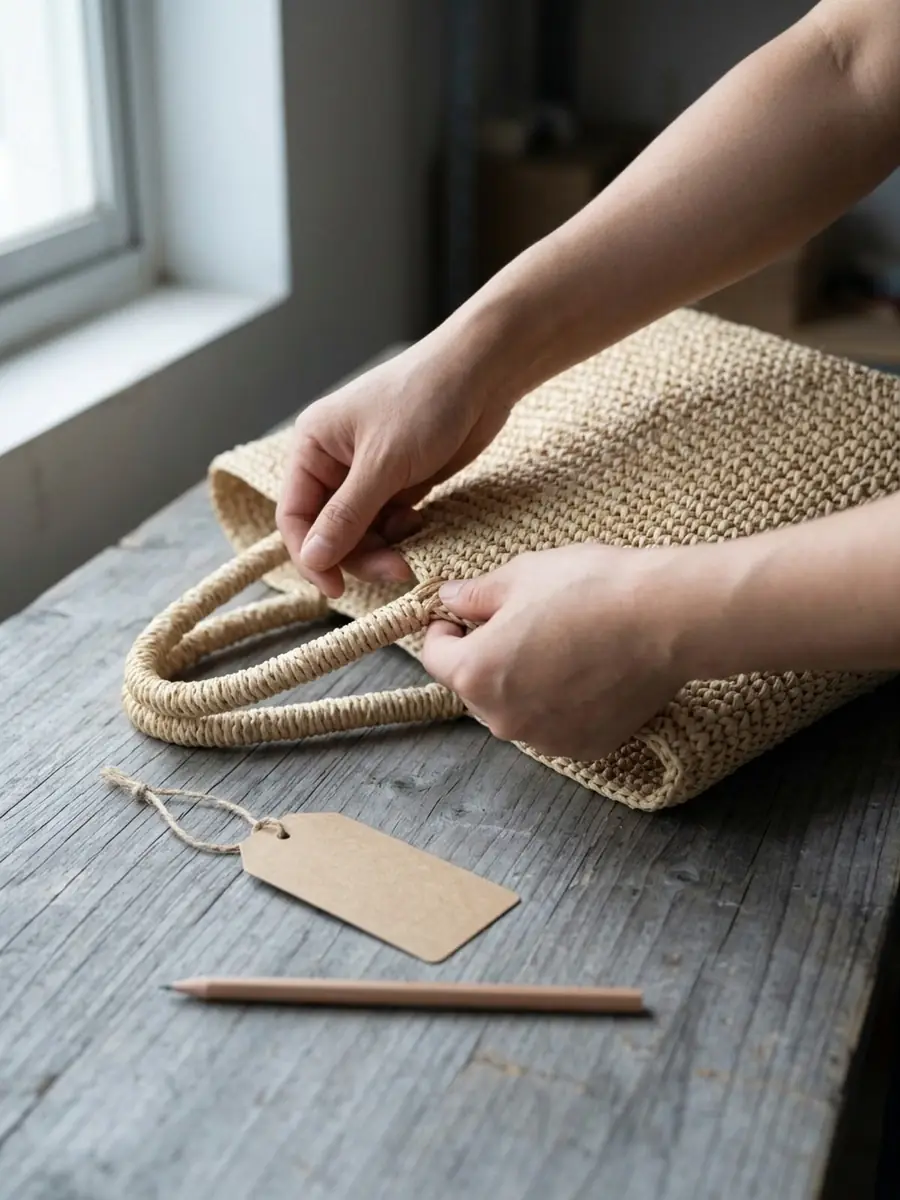 Stage five: every piece is checked by hand, with the handle anchor and lining as the two points that decide whether it passes.
06 · Packing and dispatch
Packing is the stage buyers leave until last and the one most expensive to change late, because it is where printing and cartons get committed. Individual polybag, a moisture barrier, a dust bag and hangtag where specified, then a double-wall export carton with the marks agreed in advance.
What goes wrong: a carton specification changed after printing; single-wall cartons sent into a humid container; no moisture barrier, which appears as a smell at the receiving dock and as mould a week later. Any mould is a reject, whoever caused it. Labels applied by hand at the last minute put the wrong barcode on the wrong carton, and that mistake is discovered by your warehouse, not by ours.
Packing runs inside the 30–45 day bulk window. Custom dyeing or a new mould pushes the whole run to 45–60 days, and packing does not compress to absorb the difference. If the calendar is tight, that is the line to move, not the inspection.
What you can see: a packing list and photographs of the sealed cartons with labels, sent before dispatch. Not because you doubt the workshop, but because a mislabelled carton found at the warehouse costs more to fix than one confirmed here.
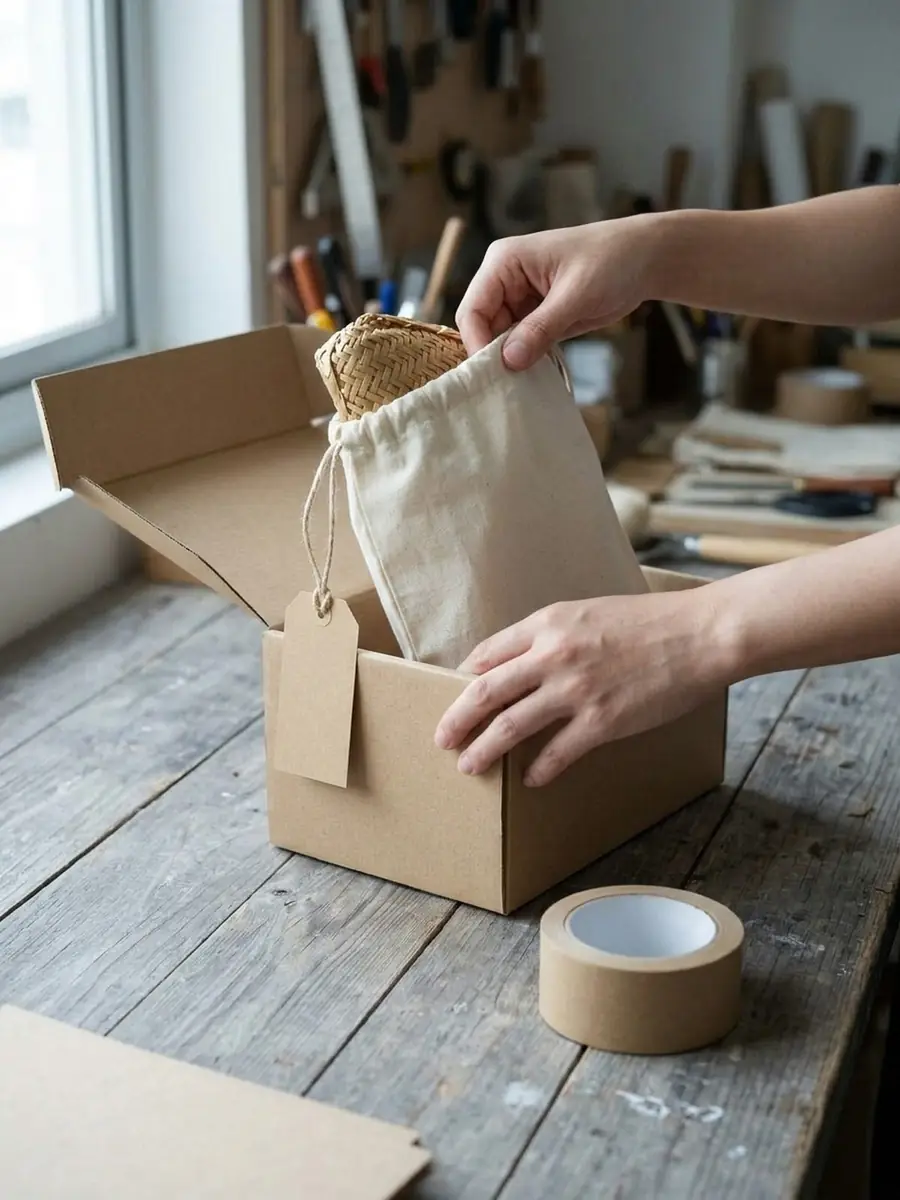 Stage six: moisture protection and carton marks are settled before the container is loaded, not after.
Where a fault starts, and where it can still be caught
Most disputes are not about whether something is wrong. They are about when it went wrong and who should pay for it. This is the table we use in that conversation.
| What you see at the dock | Stage where it started | Cheapest place to catch it | Can it be fixed now? |
|---|---|---|---|
| Colour off the approved card | 02, with the lot set at 01 | dye lot approval, before weaving | Only if the fibre is not yet woven |
| Gaps in the body | 03 weaving | in-line check, checkpoint 4 | No; reject or rework |
| Handle root loose | 04 assembly | first-off and final piece check | Yes, by re-anchoring; strength is reduced |
| Base collapses under load | 03 or 04 | loaded sample review | No; it is structural |
| Musty smell or mould | 06 packing, or 01 drying | moisture check at intake; barrier at packing | No; reject |
| Bag measures 3 cm over spec | 03 or 04 | tape measure on the first-off | Sometimes, depending on the structure |
| The pattern in that table is consistent: the later a fault is discovered, the less of it can be saved. Colour is the one exception that buyers usually get backwards. It feels like a finishing problem, but it is decided before weaving starts. |
When the six-stage model does not apply
This sequence is right for a handwoven bag made to your specification. It is not universal.
If you buy a stock or white-label bag that already exists, you are buying stages 01 to 04 as someone else's decisions. Your leverage is at 05 and 06, inspection and packing, and the process is not open to you. That is a legitimate way to buy. It is not the same as process control.
If the bag is mixed-material, a woven panel on a sewn body or a woven bag with a leather base, the sequence reorders. Cutting and sewing come first, and the weave becomes a component rather than the start. The failure points move with it, mostly to the joins between materials.
If the order is a repeat, stages 01 and 02 collapse into a comparison against the card and the last lot. A workshop that kept the lot reference can do that in a way you can audit. One that did not is starting again from a photograph.
If you are sampling, you only see stages 01 to 04 at sample scale. A sample fee is quoted per style and credited against the bulk invoice once the order reaches MOQ. Ask what the sample is actually made from at that point, because it is the thing the bulk will copy.
What to ask for, one line per stage
Lot reference and yield (01). Strip width and join policy (02). Hand hours per piece (03). Handle anchor construction (04). Inspection record and defect rate (05). Packing specification and a photograph of a sealed carton (06).
None of these are trade secrets. They are the ordinary record of a workshop that knows what it is doing, and a workshop that cannot produce them is telling you something too.
Common questions
- How long does it take to make a handwoven bag?
- Bench time ranges from about two hours for a simple small bag to twenty hours for a structured one, and over a hundred for fine crochet. Bulk lead time is 30–45 days after sample approval.
- What are the six stages?
- Fibre intake and grading, preparation, weaving, assembly, inspection and packing. Each stage has its own check, and a fault caught earlier is cheaper to fix.
- Where do defects usually start?
- Most start in preparation — uneven strips or a skipped colour sort — and only surface after weaving. That is why grading is treated as a separate stage.
If you are specifying an order, wholesale sets out how the process runs from brief to shipment. If the bag does not exist yet, custom development is the route, and the material guide answers the fibre question that comes before all six stages.
See the straw bucket bags we currently produce in this range.